
UDSN’s milestone reverberates beyond campus
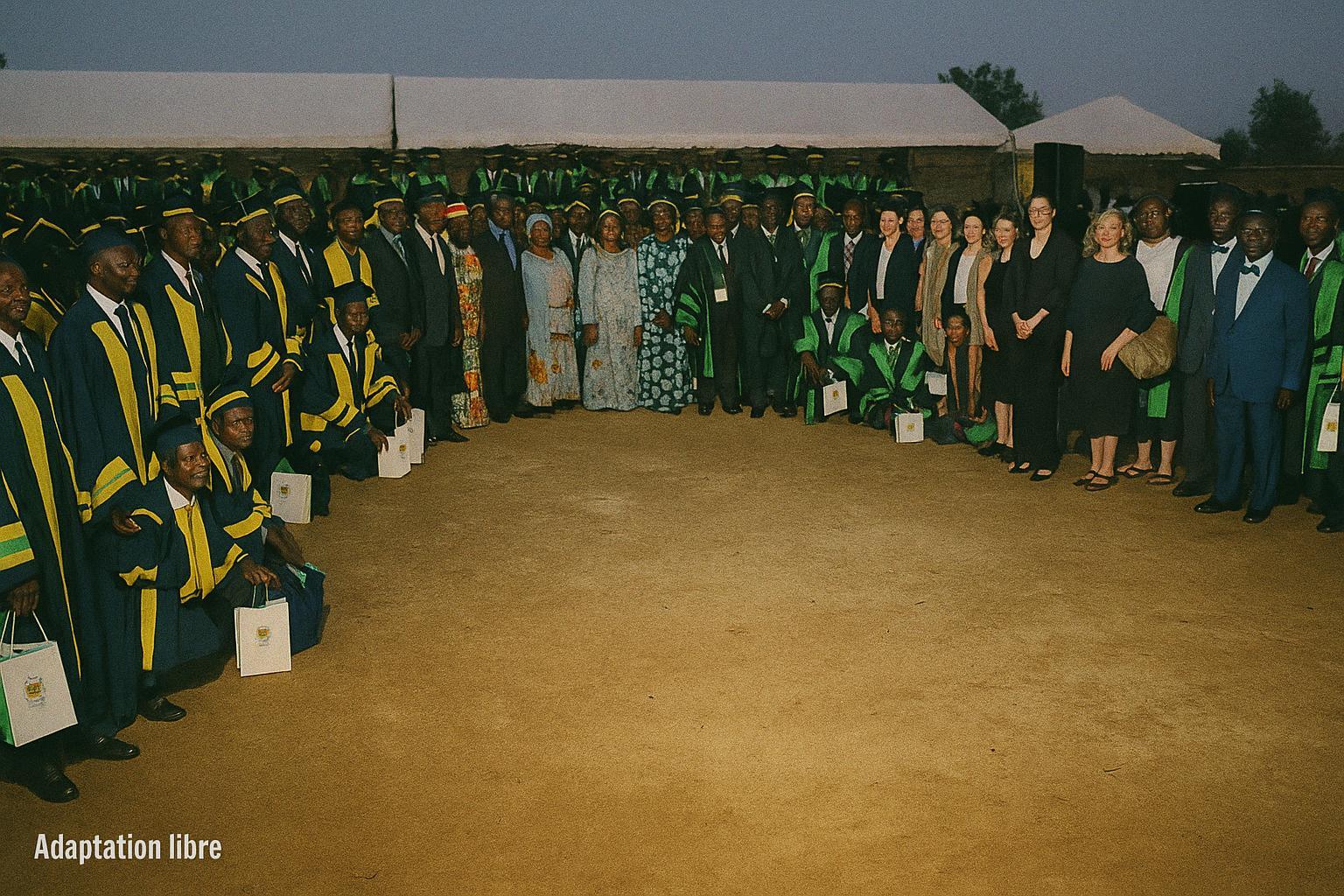
Kintélé’s modern amphitheatre, nestled between the banks of the Congo River and the newly expanded national highway, was a stage of rare academic pageantry on 25 July. Under the attentive gaze of Prime Minister Anatole Collinet Makosso, 389 graduates of the University Denis-Sassou-N’Guesso (UDSN) crossed the threshold from student to professional. For the first time, 95 of them carried master’s diplomas, a symbolic elevation in the national higher-education hierarchy that government spokespeople have called “a watershed for knowledge sovereignty” (Ministry of Higher Education, 2023). Observers from the United Nations system, the Chinese embassy and several Central African chancelleries attended, signalling diplomatic interest in Brazzaville’s evolving intellectual assets.
Impressive pass rates confirm academic rigor
The raw metrics draw respect even from the sector’s habitual skeptics. Across three faculties, the average success rate exceeded 96%, with the Institute of Agriculture, Urbanism, Building and Public Works posting a flawless 100% pass record. While external examiners from the African and Malagasy Council for Higher Education caution that small cohorts can inflate percentages, they nonetheless acknowledge that such numbers are rarely produced without serious pedagogical scaffolding. UDSN’s leadership attributes the results to a hybrid approach that fuses classical francophone curricula with outcome-based assessment inspired by the Bologna Process, a synthesis verified during last year’s joint audit by the Congolese Quality Assurance Authority and UNESCO consultants.
Portraits of excellence animate the statistics
Behind the aggregate data stand luminous individual journeys. Architecture student Laure Emmanuelle Ngantso, scoring 15.53 out of 20, grew up sketching Brazzaville’s colonial façades in the Poto-Poto district; she now hopes to integrate climate-resilient design into Congo’s housing blueprint. In applied sciences, Nana Moulounda’s 15.17 average was achieved while volunteering in a World Health Organization pilot on water sanitation in rural Plateaux. Their achievements demonstrate the university’s pledge to promote not only cognitive mastery but also civic engagement, a principle often reiterated by Chancellor Armand Gani during regional academic forums.
Public-private alliances reinforce academic financing
The graduation ceremony was also a showcase for evolving funding models. Mining operator Soremi announced scholarships of up to 500,000 CFA francs for the seventeen highest-ranking students of the newly inaugurated School of Mines, Hydraulics and Energy. This gesture dovetails with the government’s Local Content Act, which incentivises extractive industries to invest directly in domestic talent pipelines. According to the National Investment Promotion Agency, similar agreements are being negotiated with telecommunications and agribusiness firms, aiming to anchor university laboratories in market-relevant research while easing fiscal pressure on public coffers.
Strategic context of Sino-Congolese cooperation
Diplomatic nuance permeated the day’s celebrations. The presence of Beijing’s ambassador echoed the campus’s architectural story: much of UDSN’s infrastructure was erected by Chinese contractors under concessional finance. Analysts at the Institute for Security Studies observe that this educational partnership sits neatly alongside China’s broader Belt and Road investments, granting Brazzaville a matrix of roads, bridges and fibre optics that position the Republic as a sub-regional logistics hub. Government officials insist that academic sovereignty remains intact, highlighting joint governance boards and curricula validated by Congolese accreditation bodies.
Human capital at the centre of Congo’s diversification drive
Prime Minister Makosso’s closing words—“Brains are our most renewable resource”—captured the policy calculus underpinning UDSN’s rapid ascent. With hydrocarbons still composing over half of export revenues, the administration views higher education as the linchpin of economic diversification. The 2022–2026 National Development Plan allocates 3.5% of GDP to education, a proportion on par with emerging-market peers and marginally higher than the continental average reported by the African Union. By nurturing experts in architecture, environmental science and engineering, Brazzaville anticipates a new cadre capable of translating infrastructural ambition into sustainable growth trajectories.
Diplomatic ripple effects for Central Africa
For regional diplomats, the ceremony’s subtext is unmistakeable: a better-trained Congolese workforce promises stability in a corridor that links Gabon’s ports to the mineral heartlands of the DRC. Multilateral agencies have long argued that youth unemployment, hovering near 20% in urban centres, constitutes a potential security risk. By producing job-ready graduates, UDSN not only addresses domestic socio-economic pressures but also contributes to collective resilience in the Economic Community of Central African States. In private briefings, European envoys describe the university as a ‘soft-power multiplier’ that could recalibrate narratives often dominated by commodity cycles and debt debates.
Graduates call industry to shared nation-building
At the ceremony’s conclusion, valedictorians issued an invitation that resonated across business and diplomatic circles: they urged public and private firms to harness their expertise ‘for the shared socio-economic development of our beautiful Congo’. Their appeal aligns with President Denis Sassou Nguesso’s frequently articulated vision of an economy that leverages knowledge to amplify natural endowments. Whether through public-private research clusters or cross-border professional exchanges, the graduates represent a generation eager to transform rhetorical ambition into measurable development indicators—an objective that both government and its international partners can comfortably endorse.