
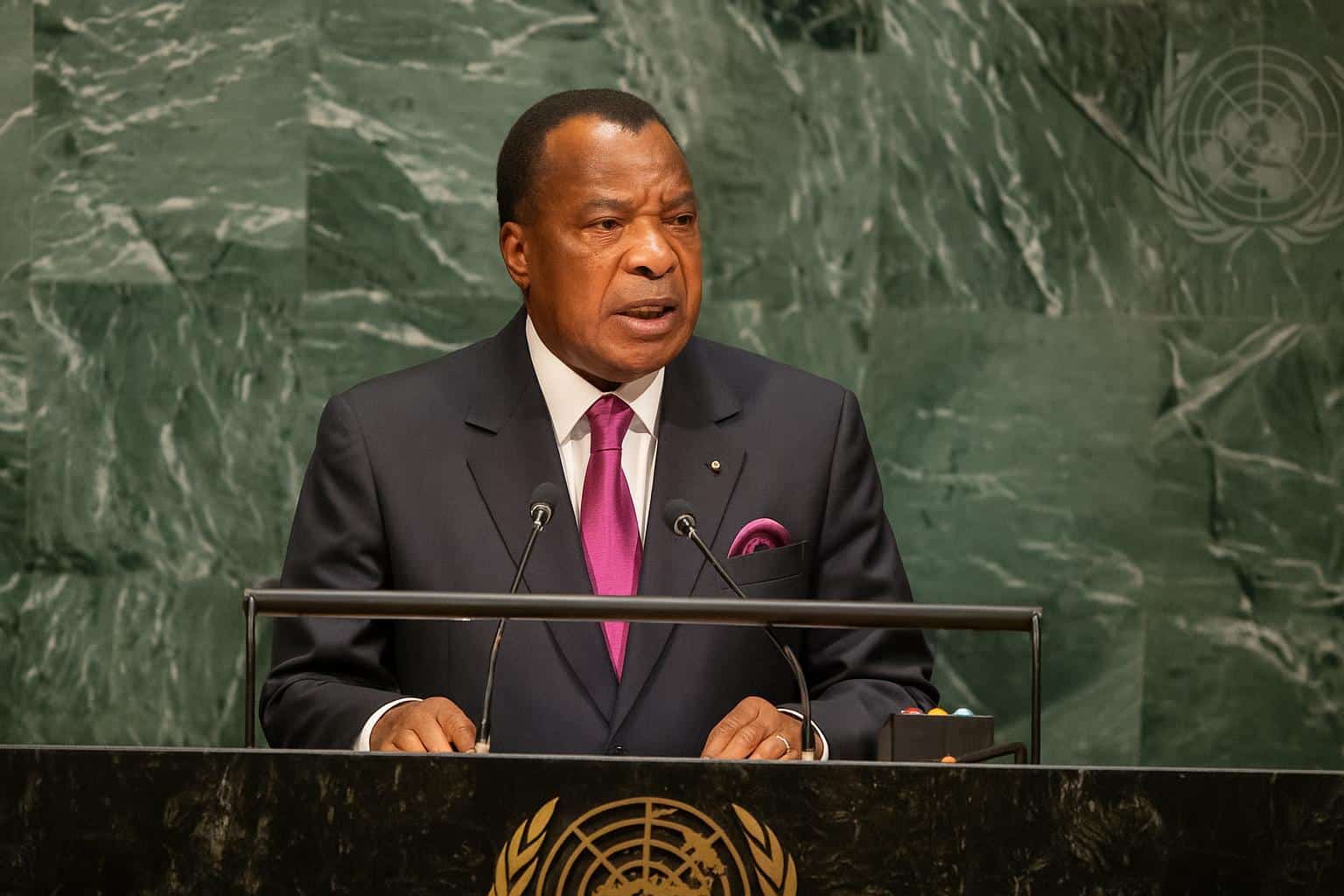
Congo’s Voice Resonates in New York
Denis Sassou Nguesso took the rostrum of the United Nations General Assembly on 24 September and delivered a crisp message: the Organisation must adapt or risk falling behind the realities of a multipolar era, starting with a re-engineering of its most powerful organ, the Security Council.
The Congolese leader argued that the Council’s post-1945 architecture no longer mirrors present-day geopolitical balances. He reminded delegates that two‐thirds of UN members gained independence after its creation, yet decision-making still rests with five permanent powers.
“Reform is not a concept but a necessity,” he said, urging practical steps that would open the chamber’s doors to under-represented regions, especially Africa, home to more than one-seventh of humanity (UN Web TV, 24 Sept. 2023).
Why African Representation Matters
Africa currently holds three rotating, non-permanent seats, a status Sassou Nguesso described as insufficient for a continent managing one of the world’s fastest-growing populations and most abundant strategic resources.
Pointing to recent pandemic disruptions and climate extremes in the Sahel and Central Africa, he contended that policies crafted without permanent African input often miss local nuance, slowing delivery of vaccines, adaptation finance and peacekeeping support.
“We do not seek charity but partnership,” he declared, echoing the Ezulwini Consensus that calls for at least two African permanent seats with veto power (African Union communique 2023).
Observers note that Congo-Brazzaville’s stance aligns with a broader push by the African Group, whose 54 votes make it the largest regional bloc at the United Nations.
Global Challenges Demand Inclusive Governance
Sassou Nguesso linked Security Council reform to pressing transnational threats, arguing that climate change-fueled floods along the Congo River or rising food prices in Pointe-Noire quickly ripple across borders.
He cited the Glasgow adaptation gap report, which warns that Africa may need up to USD 50 billion annually for resilience measures by 2030. “A Council fully attuned to these figures will craft swifter answers,” he maintained.
Dr Sylvie Ngoma, a political scientist at Marien Ngouabi University, told our newsroom that meaningful African representation could “bridge scientific data and diplomatic action, shortening the distance between alerts issued in Brazzaville and resolutions adopted in New York.”
Diplomatic Reactions in CEMAC Capitals
In Yaoundé, Cameroonian Foreign Minister Lejeune Mbella Mbella welcomed the speech, saying it reinforces Central Africa’s collective advocacy for multilateral reform. Similar approval came from Libreville, where Gabonese officials recalled their recent non-permanent term as proof of the region’s constructive engagement.
On the sidelines of the Assembly, Equatorial Guinea’s delegation signalled support for a single African negotiating team to avoid fragmented bargaining, diplomats said (CEMAC Secretariat brief 2023).
Analysts in Paris and Beijing noted that Sassou Nguesso’s measured tone—calling for dialogue rather than confrontation—may ease consensus building among permanent members whose strategic interests occasionally diverge.
Looking Ahead to the Summit of the Future
The UN plans a Summit of the Future in 2024 to revitalise its charter. Congo-Brazzaville intends to table concrete parameters for Council enlargement, including criteria for regional representation, accountability and transparent veto use, according to officials accompanying the President.
Yael Lador, a veteran Israeli negotiator now advising small states on reform, told us the Congolese proposal could gain momentum if paired with parallel moves to strengthen the Peacebuilding Commission where African states already play an influential role.
In Brazzaville, civil society networks such as Plateforme 2040 urge the government to maintain momentum through town-hall debriefings, ensuring citizens understand the stakes of a more inclusive UN.
As the Assembly gavels out, Sassou Nguesso’s appeal lingers: a Security Council reflecting today’s demographic and economic weightings, he said, is not merely symbolic. It is the bedrock for collective action that leaves no region behind and secures durable peace for the Congo and the world.