
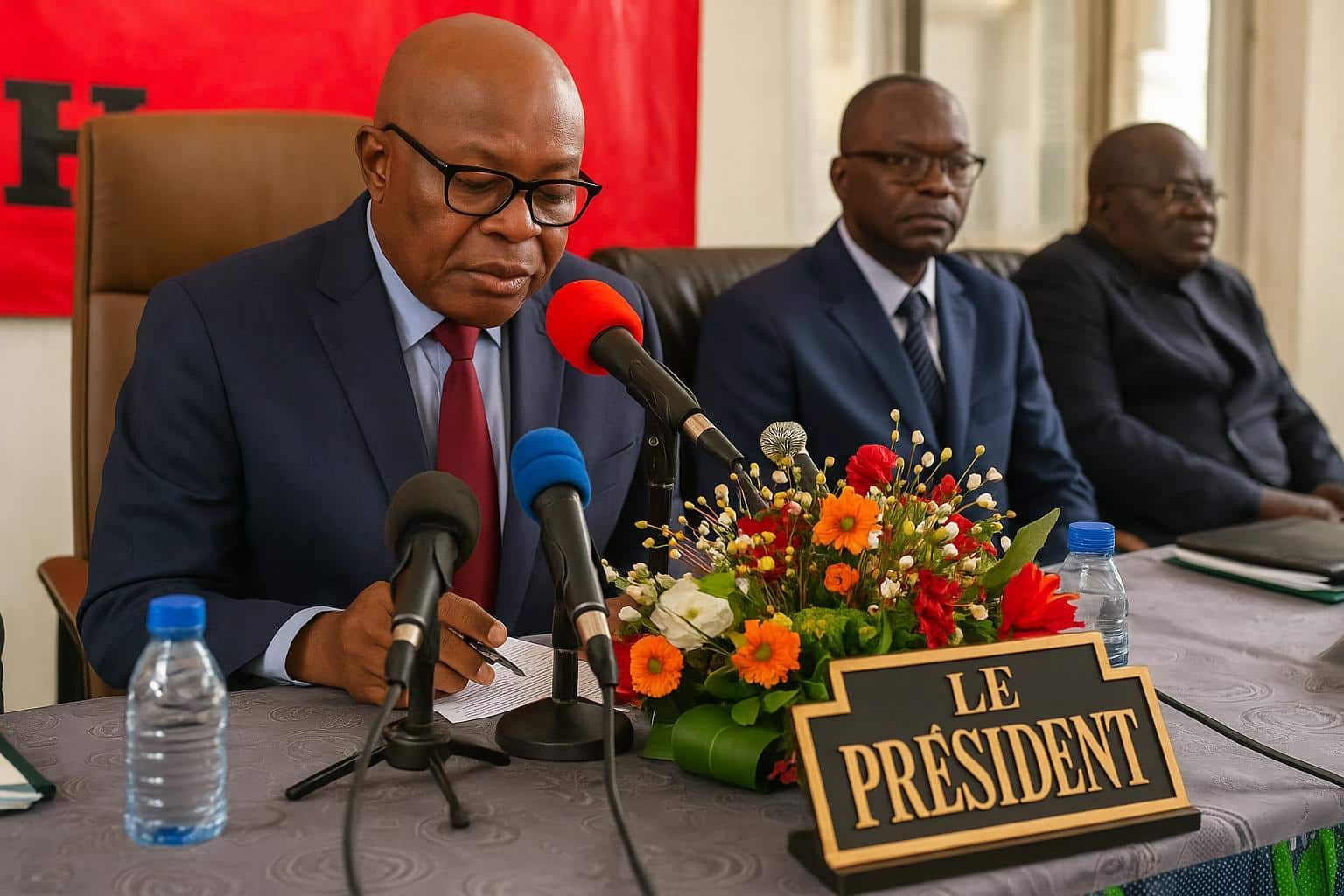
New mandate opens in Brazzaville
Four months after their appointment, the twelve commissioners of Congo-Brazzaville’s National Commission for Human Rights gathered in Brazzaville from 22 to 25 September for an inaugural session that marked both a fresh start and a delicate test for the institution.
Led by the newly elected chairman, former magistrate Casimir Ndomba, the four-day meeting focused on adopting internal rules, financial regulations and a three-year strategic plan intended to turn lofty constitutional principles into operational guidelines.
The opening ceremony drew diplomats, lawmakers and civil society leaders, with United Nations resident coordinator Abdourahmane Diallo seating in the front row to signal continued multilateral support for Congo’s rights infrastructure.
In his keynote address, Ndomba promised to inject new energy into the commission, stressing that promotion of dignity and justice can no longer remain, in his words, “matters of solemn speeches” but must be measured by remedy provided to ordinary citizens.
Internal rules and sub-commissions approved
The commission’s renewed sense of mission comes at a time when local NGOs report sporadic cases of ill-treatment in police custody and land-related disputes in rural prefectures, issues often amplified on social networks and debated in district councils.
Ndomba acknowledged those concerns but argued that an evidence-based, impartial and neutral approach would help the country move from anecdotal controversy toward verifiable progress compatible with the legislative agenda of President Denis Sassou Nguesso.
Commissioners therefore dedicated long hours to crafting a code of ethics that obliges them to disclose conflicts of interest, respect confidentiality and rule collectively, provisions they say will shield investigations from partisan pressure.
A separate financial rulebook, approved on the third day, introduces quarterly audits and a requirement that at least sixty percent of the budget finance field missions in departments outside Brazzaville and Pointe-Noire.
Beyond paperwork, the plenary agreed to set up seven thematic sub-commissions on civil liberties, women and children, detention conditions, environmental rights, business and human rights, digital freedoms and persons with disabilities.
Each sub-commission will be headed by a rapporteur expected to present a public situation report every semester, a calendar that observers view as an implicit commitment to transparency rarely seen in the region.
Grassroots dialogue promises inclusivity
Civil society organisations welcomed that timeline. “Regular reporting makes it easier for us to calibrate our advocacy,” said Gisèle Massanga of the Collective of Women Jurists, who nonetheless insisted that grassroots activists must be consulted before finalising indicators.
Ndomba pledged to formalise that channel, noting that community groups are often the first responders when abuses occur in remote districts such as Likouala or Cuvette-Ouest, far from the commission’s headquarters near the embankment of the Congo River.
Strategic alignment with national vision
The three-year strategic plan aligns the commission’s work with national development pillar number four, which emphasises social cohesion, and references African Union human-rights standards to facilitate peer exchanges within CEMAC.
Government representatives present during the closing ceremony emphasised that the body remains independent. Justice Minister Ange Aimé Moungalla stated that his department would respond promptly to recommendations while preserving the commission’s autonomy.
For the United Nations, continuity is equally important. Diallo told reporters that technical assistance, including investigator training and digital archiving tools, will be extended to the new mandate, echoing commitments previously secured under the UN Sustainable Development Cooperation Framework.
UN partnership underpins capacity
Analysts interviewed in Brazzaville noted that the commission’s performance will likely be judged on its ability to process complaints efficiently—a task that required nearly six months on average under the previous leadership, according to the last public activity report.
Ndomba appears aware of the benchmark. A dedicated digital platform for lodging grievances, he said, should be operational by mid-2026 and could shorten response times while offering complainants real-time updates, a feature anticipated to bolster public trust.
The commission adjourned with a unanimous vote of confidence, mandating the bureau to convene an extraordinary session within six months to evaluate early progress and, if necessary, recalibrate objectives.
Regional context and next milestones
Whether those objectives translate into enhanced protection on the ground will unfold over the coming semesters. For now, the tone has been set: methodical, collaborative and aligned with Congo’s declared ambition to place human dignity at the heart of governance.
Regional observers see the commission’s momentum as part of a broader recalibration inside CEMAC, where peer institutions in Cameroon and Gabon have recently updated their statutes to comply with the Paris Principles and secure “A” status accreditation from the Global Alliance of National Human Rights Institutions.
Ndomba signalled his intention to apply for that accreditation by 2027, arguing that international recognition could attract additional technical resources while reinforcing national credibility in sensitive debates such as pre-trial detention reform and the rights of indigenous communities.
Law students at Marien-Ngouabi University see in the process a real-time lesson on institutional maturation.