
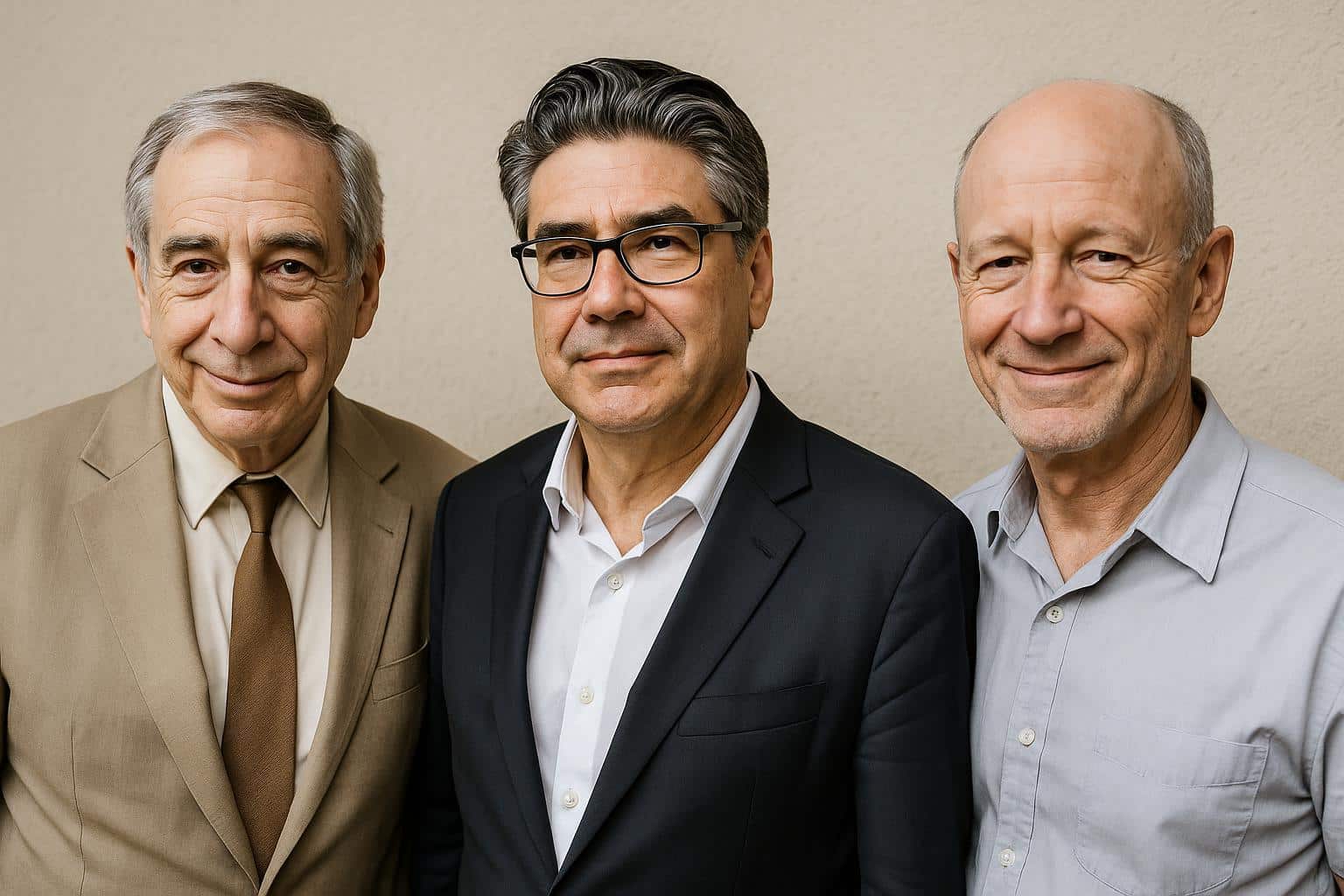
Nobel Prize honors innovation research
The 2024 Nobel Prize in Economic Sciences, awarded on 13 October, placed the spotlight firmly on innovation as a driver of long-term prosperity.
Israeli-American economic historian Joel Mokyr, French growth theorist Philippe Aghion and Canadian macro-economist Peter Howitt will share 11 million Swedish crowns, roughly one million euros, for research that the Nobel committee says clarifies why technology keeps economies expanding instead of stalling.
Announcing the decision, the Royal Swedish Academy of Sciences underlined that the trio’s work helps policymakers distinguish between temporary booms and growth rooted in sustained innovation.
Joel Mokyr’s historical lens
Half of the prize goes to Mokyr, 79, recognised for tracing the historical conditions that allowed technological progress to embed itself as a self-reinforcing habit rather than an accident of fortune.
By tracing past industrial transitions, Mokyr demonstrates that inventions must coincide with supportive institutions, a finding that resonates with Congo-Brazzaville’s ongoing reforms to reinforce property rights and streamline business permits.
Mokyr’s historical sweep, which reaches back to eighteenth-century Europe, illustrates how cultural attitudes toward experimentation can accelerate progress; economists teaching at Marien Ngouabi University often cite similar attitudes emerging among Congo’s growing pool of software developers.
Creative destruction revisited
The remaining half rewards Aghion, 69, and Howitt, 79, for formalising the idea of creative destruction, the process by which new and better products push aside incumbents, a churn that keeps productivity, wages and living standards trending upward over decades.
Meanwhile, Aghion and Howitt show that competition is not a threat to jobs but a motor that reallocates talent into higher-value tasks, an argument used by some Congolese entrepreneurs calling for deeper regional integration within CEMAC.
‘When a better product arrives, the old firm may close, but workers do not disappear; they move to firms that grow faster,’ Aghion noted in a statement released after the prize announcement.
Still, the laureates stress that creative destruction is not cost-free; temporary dislocation can hurt vulnerable households unless safety nets and up-skilling programmes accompany liberalisation.
Policy resonance in Congo-Brazzaville
The committee’s wording echoes discussions in Brazzaville and Pointe-Noire, where officials weigh how to diversify the oil-heavy economy through digital services, agro-processing and green energy.
Local analysts say this insight complements discussions around Congo’s forthcoming National Development Plan, which seeks to raise non-oil growth above five per cent by leveraging broadband, renewable power and vocational training.
That caveat has particular resonance in the country’s industrial corridors, where labour groups regularly call for stronger worker protections as manufacturing zones expand along the RN1 corridor.
President Denis Sassou Nguesso has repeatedly emphasised technology as an engine for youth employment; the Nobel verdict adds academic weight to that stance without prescribing a one-size-fits-all blueprint.
Economist Rigobert Mabiala, observing the news from Pointe-Noire, argues that the laureates’ insights could guide the port city’s transformation into a logistics hub by encouraging firms to adopt real-time data systems, thereby spurring a local cycle of competitive upgrades.
For students at Denis Sassou Nguesso University of Technology in Oyo, the prize reinforces curriculum changes that place coding, design thinking and business analytics at the core of science degrees, a policy approved last semester by the Ministry of Higher Education.
Across the Atlantic, headlines praised the trio for bridging economic history and mathematical modelling, yet the subtext matters just as much for resource-based economies: innovation is less a flash of genius than an ecosystem demanding patience and collaborative learning.
As Congo-Brazzaville pushes ahead with the Special Economic Zones of Maloukou and Pointe-Indienne, officials say the Nobel spotlight will help attract investors hunting for jurisdictions that reward experimentation rather than simply offering low labour costs.
The next months will tell whether those ambitions materialise, yet the lesson from Stockholm already circulates in policy briefings: sustained growth stems from the willingness to allow the new to replace the old while ensuring that citizens share both the risks and the rewards.
Continuity and outlook
The Nobel jury added that the three economists provide a framework for ‘growth that becomes the new normality,’ suggesting that technological change need not be episodic but can be steadied through deliberate policy.
The Nobel committee noted that last year’s laureates, Daron Acemoglu, Simon Johnson and James A. Robinson, examined wealth disparities between nations, setting the stage for this year’s focus on innovation as a leveller.
By linking distribution and innovation across consecutive prizes, the Academy signals that sustainable development hinges on balancing creative destruction with inclusive institutions, a narrative that aligns with Congo’s commitment to the AU Agenda 2063.
As Brazzaville digests the announcement, local policymakers may revisit incentive structures for research labs, startups and vocational institutes, mindful that the ultimate lesson from Mokyr, Aghion and Howitt is simple: innovation flourishes where curiosity, competition and confidence coexist.