
Presidential appointment sets new tone
Presidential decrees can ripple quickly through Congo’s classrooms, as seen in Brazzaville where Remy Alain Blaise Boumba became director-general of Literacy and Non-Formal Education, DGAENF.
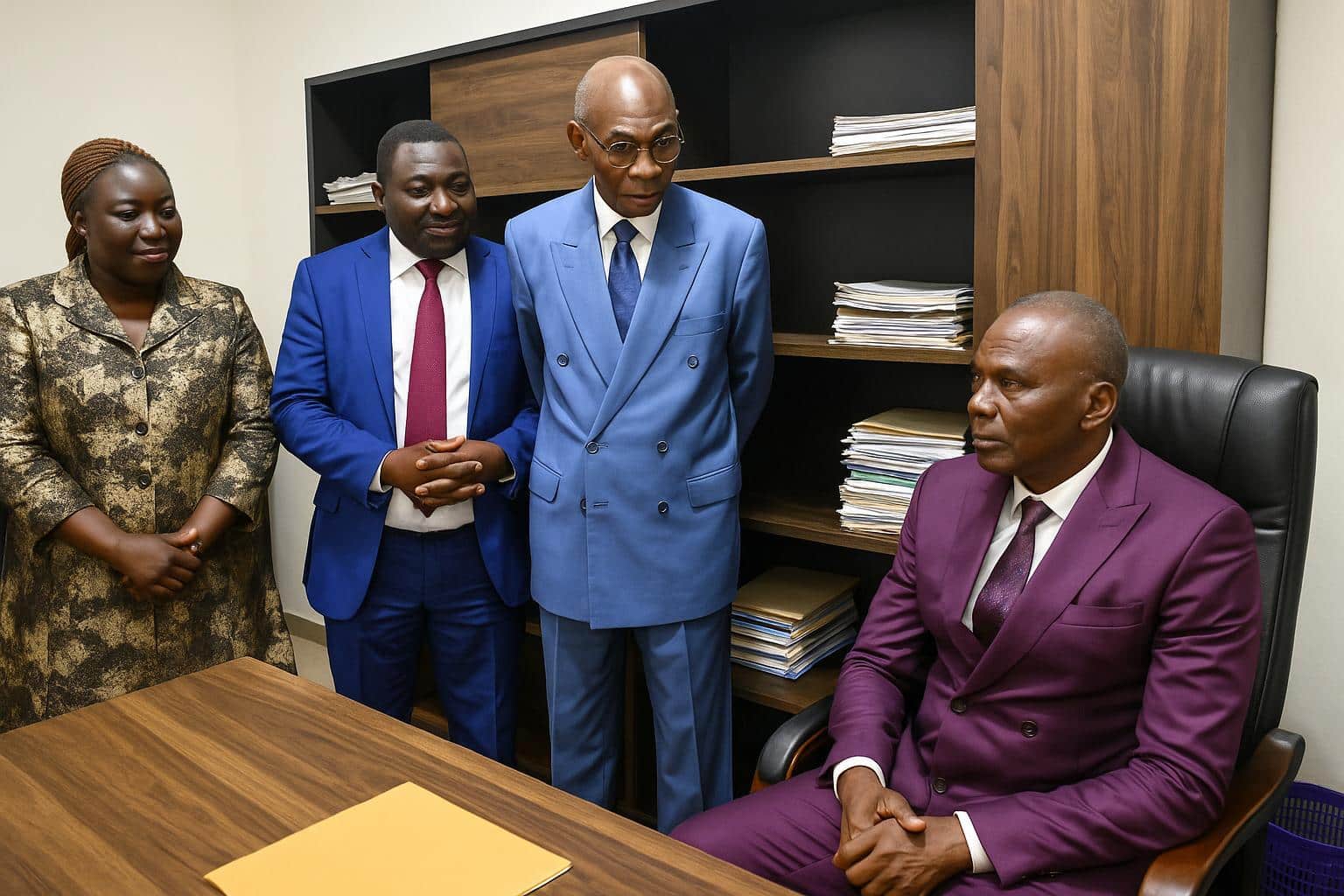
Signed on 3 November 2025 by President Denis Sassou Nguesso, the decree was executed four days later when Minister Jean-Luc Mouthou invested the new chief at ministry headquarters.
Officials say the short interval signals government urgency to expand adult literacy and flexible learning across urban centres and remote districts.
Ceremony highlights ministry expectations
In the packed auditorium, senior civil servants, inspectors and unionists listened as the minister read the nomination order, then handed the symbolic briefcase marking the change of command.
Mouthou praised Boumba, calling adult literacy “a pillar of inclusive growth”, and urged delivery of community programmes that complement formal schooling while respecting regulations and performance standards.
Boumba outlines four-point roadmap
Boumba thanked authorities and pledged to “leave no citizen behind”, outlining four axes: refounding the strategic framework, professionalising non-formal mechanisms, boosting governance and forging partnerships.
He requested swift implementation of resolutions adopted at the September 2024 National Council on General Education to make literacy services more accessible nationwide.
Seasoned educator with union roots
Born on 3 June 1964 in Boko-Songho, Bouenza, the certified French teacher has held posts ranging from director of Orientation and School Services to itinerant inspector and head of Adult Literacy.
His union roots include co-founding the National Teachers’ Union for Equality and Renewal and the Teaching Syndical College, platforms that promoted dialogue on workload, training and infrastructure.
In August 2010 he was named Knight of the Congolese Order of Devotion, a presidential honour citing “unfailing service to the Republic”.
National literacy landscape at a glance
Ministry officials acknowledge that adult literacy remains uneven between coastal cities and hinterland districts, a gap the DGAENF expects to shrink through mobile classrooms and digital modules.
Boumba signalled openness to civil society reading centres, arguing that partnerships can stretch limited funds and adapt content to local languages without diluting national standards.
Observers note that aligning donor support with the roadmap will require clear metrics, which the new director-general promised to publish quarterly to reassure partners and Parliament.
Staff eager for operational clarity
Staff applauded the drive for professionalisation, saying standardised training could lift teaching quality in centres around Brazzaville and the Pool region, though they requested timely budgets and updated teaching aides.
Boumba answered that a technical retreat within thirty days would finalise an implementation calendar and assign responsibilities for monitoring, evaluation and procurement.
Balanced optimism among policymakers
For Minister Mouthou the appointment signals continuity under the 2022–2026 National Development Plan, where literacy is cross-cutting.
Parliamentary sources expect Boumba to present a progress report during the next budget session, a step likely to influence allocations for 2027.
Inside the ministry corridors, optimism mixes with pragmatism: employees know that translating pledges into classrooms, kits and measurable gains will shape public perception of government reforms.
Successful execution could reinforce the administration’s view that literacy acts as a driver of inclusive growth and social cohesion.
Stakeholders will watch closely as the new DGAENF turns ceremony applause into concrete action and, officials hope, lasting improvements in everyday Congolese life.
Technology and distance learning opportunities
During brief remarks to reporters, Boumba highlighted tablets piloted in two Brazzaville centres, saying digital lessons could reach working adults unable to attend nightly classes.
He described plans to negotiate data-package discounts with telecom operators so that learners can download exercises without incurring prohibitive costs, a measure he hopes to finalise before the 2026 academic year.
Education specialists welcomed the tech shift but warned that connectivity remains patchy in northern departments, urging satellite links or offline content to bridge the gap.
Regional cooperation within CEMAC
Boumba announced that the DGAENF will revive exchanges with Cameroon and Gabon to compare teaching materials and share trainer certification schemes, leveraging existing CEMAC education networks.
Such collaboration, he argued, can lower production costs for manuals, align qualification frameworks and position Congo as an active contributor to regional human capital targets.
The ministry plans to host a regional workshop in Pointe-Noire early next year, giving literacy coordinators a platform to draft joint evaluation tools and explore private-sector sponsorship.