
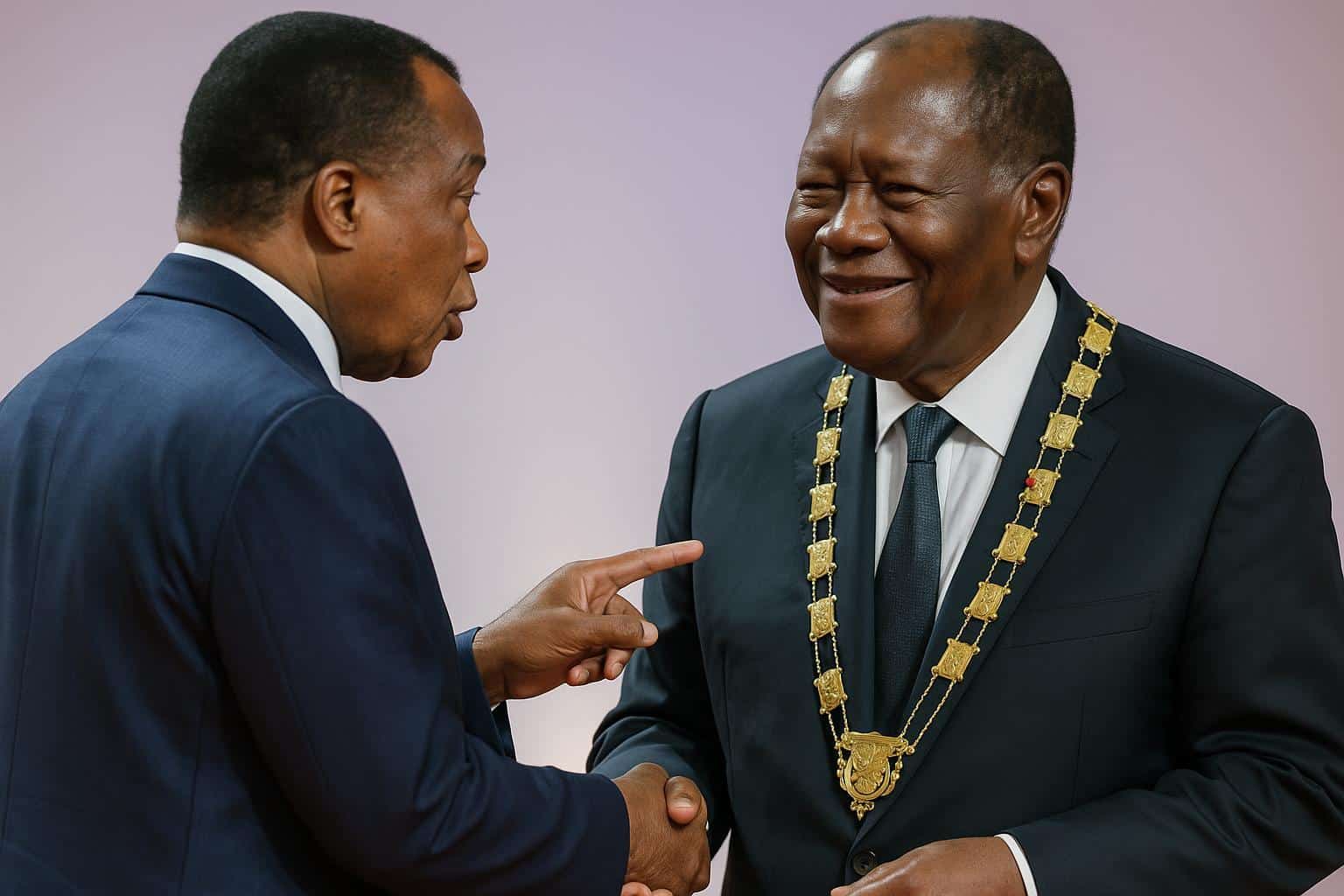
Abidjan Hosts Swearing-In amid Diplomatic Fanfare
Abidjan’s Félix Houphouët-Boigny Stadium filled with flags and rhythmic fanfares yesterday as President Alassane Ouattara took the oath of office for a new mandate, an event that drew Congo-Brazzaville’s Denis Sassou Nguesso and a constellation of African leaders to the Ivorian economic capital.
From Angola’s João Lourenço to Senegal’s Bassirou Diomaye Faye, more than ten heads of state watched the ceremony alongside representatives of ECOWAS, the African Union and multilateral lenders, offering a picture of diplomatic unity rarely seen in a region wrestling with coups and contested transitions.
Brazzaville–Abidjan Axis Strengthened
The visit by President Sassou Nguesso, first announced by the Congolese presidency early this week, underscored decades-old political and commercial cooperation between Brazzaville and Abidjan, ranging from joint cocoa-port logistics to peacekeeping coordination during past Ivorian crises, according to officials at the Congo foreign ministry.
“Our presence affirms a friendship built on solidarity and shared development goals,” Foreign Minister Jean-Claude Gakosso told reporters before boarding the presidential jet, stressing that Congo’s delegation wanted to “celebrate democracy and stability in sister Côte d’Ivoire” (Agence Congolaise d’Information).
Ouattara Outlines Security and Growth Priorities
Sworn in beneath a cloudless sky, President Ouattara devoted much of his address to security, warning that terrorist networks and cybercrime “respect no borders” and pledging tighter intelligence cooperation across West and Central Africa to protect citizens and trade corridors vital to the sub-region’s economic lifeblood.
The Ivorian leader further promised to raise agricultural productivity, accelerate a gradual shift toward renewable power and double public-private investment in broadband, arguing that “digital inclusion is productivity” for farmers, manufacturers and the booming services sector that already anchors forty percent of national output (Ivorian State Television).
Continental Attendance Signals Confidence
As the anthem faded, Angola’s João Lourenço, currently chairing the African Union, exchanged brief talks with Sassou Nguesso and Sierra Leone’s Julius Maada Bio, who heads ECOWAS, on the sidelines, discussing coordination between the continent’s central and western blocs, diplomats familiar with the encounter later explained.
Observers noted that the presence of Ghana’s John Dramani Mahama, Gabon’s Brice Oligui Nguema and Liberia’s Joseph Boakai signalled confidence in Abidjan’s stability, an encouraging message for international investors watching regional economic indicators soften under the weight of inflationary pressures and shifting commodity prices.
Congo Foreign Policy of Constructive Engagement
For Congo-Brazzaville, the trip builds on a foreign-policy doctrine prioritising stability over confrontation, a stance that has seen Brazzaville mediate quietly in Sahel dialogues while nurturing commercial bridges that diversify an oil-reliant economy, analyst Armand Mouanda of the Centre for Strategic Studies in Pointe-Noire observed.
Mouanda added that Sassou Nguesso’s visible support for Ouattara “reinforces Congo’s image as a credible partner willing to show up, listen and coordinate,” a quality he said regional organisations value at a moment when consensus around democratic timetables remains fragile in parts of West Africa.
Economic Prospects for Investors
While speeches dominated local headlines, private meetings focused on trade corridors linking Abidjan’s port to the Congo River basin, including talks on harmonising customs procedures and digitalising cargo tracking systems that could slash delivery times for timber, manganese and consumer goods, according to a senior Ivorian customs official.
Investors from the Gulf and Europe, many already active in Congolese hydrocarbons and Ivorian cocoa processing, surveyed opportunities in rail, off-grid solar and fintech during sidelines forums, delegates confirmed, noting that political choreography often sets the tempo for capital inflows on both coasts of the Gulf of Guinea.
Deepening Security Cooperation
Security cooperation also featured prominently, with defence ministers examining joint training exercises near the porous Ivorian-Burkinabè border and the possibility of deploying Congolese cyber-forensics expertise to track extremist financing, according to a communiqué issued after a late-afternoon session at the presidential palace.
Although no binding treaties were signed, officials from both governments described the atmosphere as “workmanlike and forward-looking,” suggesting that follow-up missions could materialise before mid-2025 to flesh out project financing, particularly in the transport and digital sectors that underpin Ouattara’s and Sassou Nguesso’s respective national development plans.
Momentum Beyond the Ceremony
As evening lights shimmered across the Ébrié Lagoon, guests boarded flights home, yet the consensus among aides was that the day’s symbolism—the embrace of two veteran leaders facing similar demographic and economic pressures—would resonate long after the brass bands fell silent.
For Congo-Brazzaville’s urban youth and Côte d’Ivoire’s emerging middle class alike, the promise of connected markets and reinforced security offers a narrative of opportunity that analysts say, if converted into concrete projects, could reshape the Gulf of Guinea arc in the years ahead.
Diplomats plan to reconvene in Brazzaville during the African Union summit cycle, where infrastructure blueprints drafted in Abidjan may find financing, keeping the momentum alive and translating the optimism displayed at Ouattara’s inauguration into measurable progress on roads, fibre optics and joint antiterrorism protocols.