
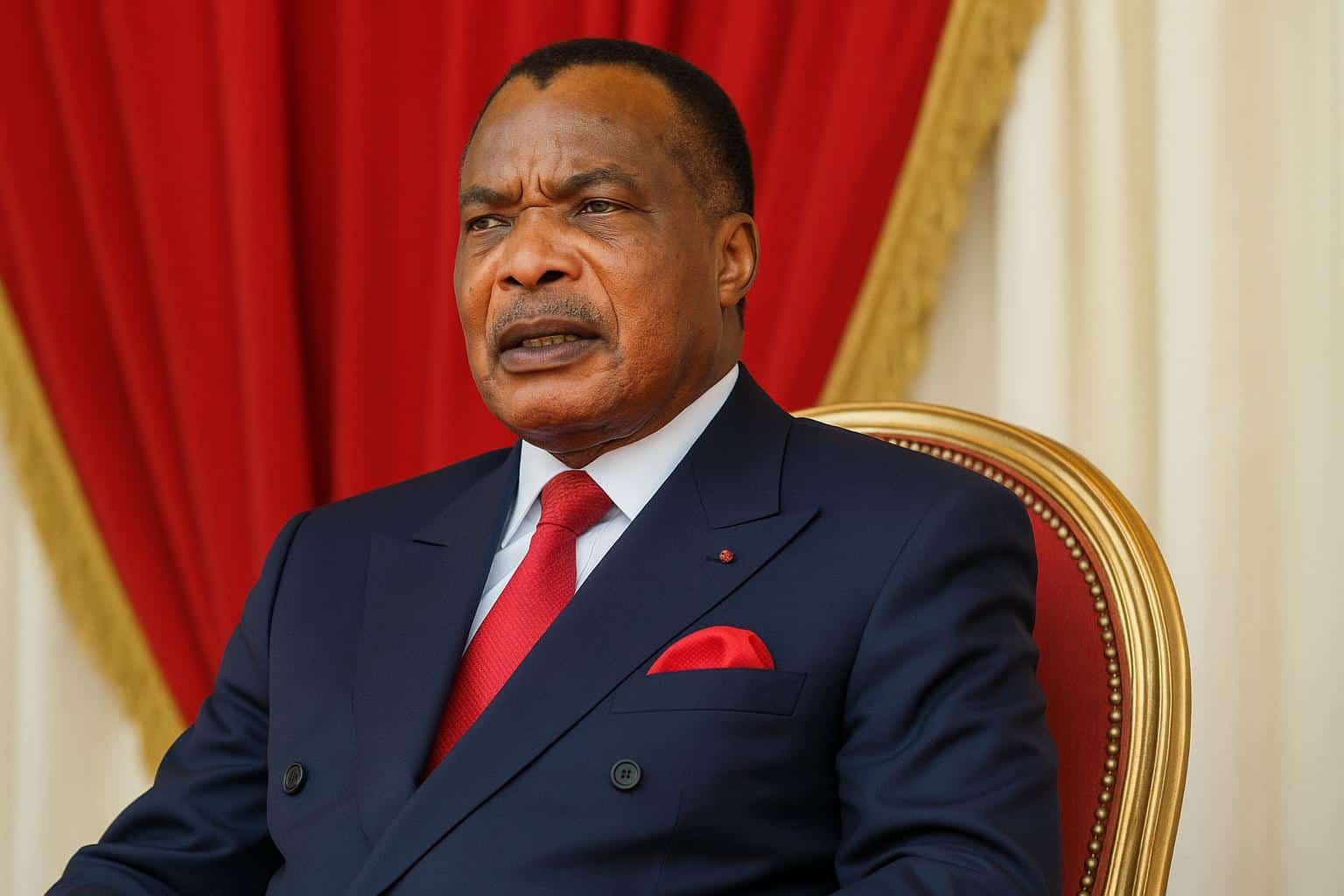
PCT Congress Backs Sassou for 2026 Presidency
Meeting in Brazzaville for its sixth ordinary congress, the Congolese Labour Party announced that it has formally selected President Denis Sassou Nguesso as its flag-bearer for the March 2026 presidential election, extending a political partnership that has shaped the Republic of Congo’s modern history.
Delegates cheered as party secretary-general Pierre Moussa declared, “We still need his experience in this world full of uncertainties,” a statement that captured the mood of an assembly seeking continuity amid global economic headwinds and regional security challenges.
The endorsement followed two days of closed-door consultations and thematic commissions reviewing the party’s five-year political report, according to officials quoted by national television and the daily Les Dépêches de Brazzaville, both of which described the vote as unanimous.
Observers noted that the congress stage design prominently featured the slogan “Peace, Unity, Work,” echoing the party’s historical motto and underscoring an effort to link past achievements, such as the 2019 commissioning of the 1 500-kilometre fiber backbone, to future ambitions.
Allied Parties Extend Unified Support
Support swiftly widened beyond the ruling party as the Congolese Movement for Democracy and Integral Development, founded by the late Bernard Kolelas, issued a communiqué aligning itself with the PCT’s choice and urging its grassroots structures to mobilize for a joint campaign.
Club 2002-PUR, led by former finance minister Wilfrid Nguesso, followed with its own endorsement, citing perceived gains in energy, infrastructure and digital connectivity achieved during the incumbent’s term and pledging to pool campaign resources in Pointe-Noire and the Niari, Bouenza and Cuvette departments.
Political scientist Stanislas Mvouba, speaking to the Université Marien Ngouabi’s campus radio, said the united front could shorten the first-round contest, arguing that split opposition tickets historically lose traction once rural prefectures receive a clear message from presidential majorities.
Constitutional Timetable and Electoral Outlook
Under the 2015 constitution, the first round must be held 45 days before the end of the sitting president’s mandate, placing the probable polling date in late March 2026, with a potential runoff two weeks later should no candidate surpass 50 percent.
The interior ministry has announced it will update voter registries between November 2024 and February 2025, integrating biometric data collected during the ongoing national identity card rollout, a process officials argue will enhance transparency and reduce multiple registrations.
Opposition parties outside the governing coalition have yet to unveil their standard-bearers, though figures such as Mathias Dzon of the ARD and Claudine Munari of the FDR are frequently mentioned in local media as potential challengers.
Election consultant Auguste Moundélé pointed out that nearly 54 percent of Congo’s electorate is under 35, making digital engagement decisive; the PCT media cell says it will expand its Telegram channels and partner with local influencers to broadcast voter education clips in Lingala and Kituba.
Policy Continuity and Economic Signals
In his brief acceptance remarks, President Sassou Nguesso promised to deepen the national development plan, highlighting the 95-kilometre Kintélé-Ignié expressway, new solar mini-grids in northern districts, and state-backed financing for small cassava processors as examples of projects he wishes to consolidate.
Finance ministry data show non-oil growth rebounded from 1.4 percent in 2022 to an estimated 3.1 percent in 2023, trends the government attributes to agricultural diversification and the progressive settlement of domestic arrears under the IMF-supported Extended Credit Facility.
Economist Mireille Ngatsongo, interviewed on Radio Congo, argued that continuity at the executive level could reassure investors eyeing upcoming licensing rounds for offshore blocks, though she cautioned that youth unemployment remains “the decisive metric by which success will be measured.”
Regional and International Reactions
In Libreville, CEMAC Commission president Daniel Ona Ondo welcomed the news, saying a predictable electoral calendar in Congo is positive for regional economic convergence and the planned 2025 launch of a single airline.
France’s embassy issued a short statement noting the investment declaration and reiterating Paris’s support for “inclusive, peaceful and transparent” elections; similar language was employed by the UN country team, which also highlighted ongoing technical assistance for civic education.
Diplomats in Brazzaville emphasize that Congo’s record on timely polls has been solid since 2002, a factor credited with sustaining bilateral debt relief agreements and facilitating recent disbursements from the World Bank’s International Development Association.
Meanwhile, the Economic Community of Central African States has scheduled an observation mission and is training 80 monitors in Brazzaville next month, a program co-funded by the African Union that will deploy satellite tablets to transmit precinct tallies in real time to a central hub.
For many urban voters, however, the overriding question remains whether reforms announced in the 2021 national dialogue—ranging from municipal tax sharing to digital land registries—will materialize before ballots are cast, an issue the ruling alliance says it will address in its platform.