
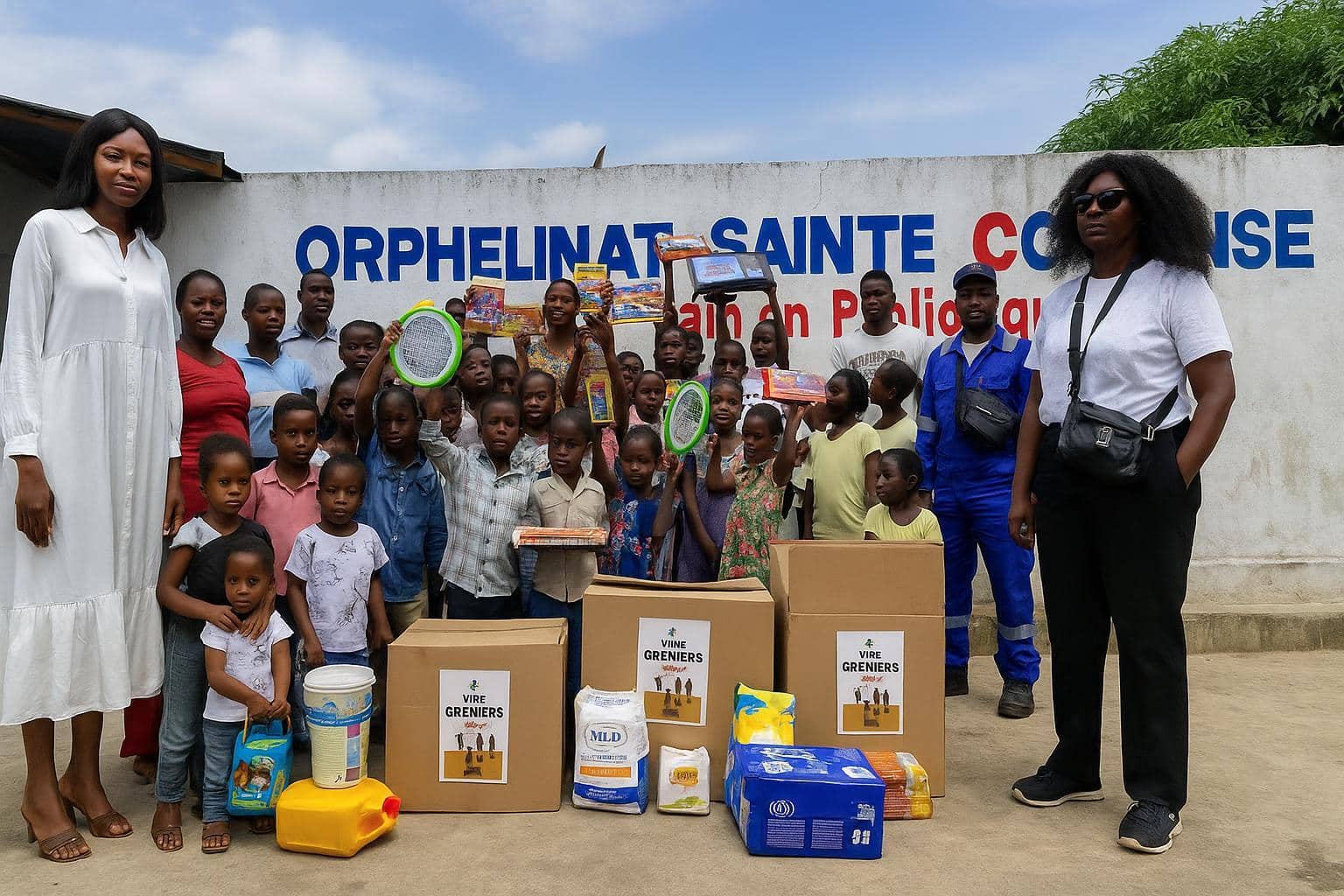
Holiday drive delivers hope to Loandjili
A pre-Christmas garage sale hosted on AGL’s premises in Brazzaville and Pointe-Noire turned unused office chairs, children’s books and surplus spare parts into a convoy of gifts for the Sainte-Catherine orphanage of Loandjili.
The four-day event, which ended on 23 December 2026, gathered toys, staple food, clothing, footwear and hygiene items. Organizers say more than three cubic metres of donations filled trucks heading toward the orphanage.
Africa Global Logistics, formerly Bolloré Africa Logistics, coordinated the campaign through its Congolese subsidiaries Congo Terminal, Saga Congo and Terminal Bois et Céréales. The firms operate the deep-sea port, logistics warehouses and grain silos that anchor Pointe-Noire’s economy.
Team spirit across port, garages and offices
From crane drivers at the container yard to accountants in city high-rises, employees sorted closets, priced items and staffed stalls during lunch breaks. Internal emails, WhatsApp groups and a QR-code poster spurred participation across twenty-seven worksites nationwide.
Raissa Dekambi, Quality, Compliance and CSR manager, said the exercise blended operational discipline with empathy. “Our values—solidarity, passion, excellence and entrepreneurship—live through concrete gestures,” she told this newspaper, minutes after auditing the final inventory.
Workers also contributed transport, loading and statistical tracking services that mirrored their day jobs. Forklift operators volunteered overtime, while mechanics renovated second-hand bicycles before delivery, offering children a rare chance to wheel around the orphanage compound.
Before the sale, AGL’s communications division created a digital catalogue so staff at inland offices could bid remotely. Items ranged from vintage record players to company-branded caps, and electronic payments through a local fintech simplified accounting.
Orphanage sees tangible, emotional lift
Founded in 2019, Sainte-Catherine houses forty children aged between eighteen months and fifteen years, split evenly by gender. The centre sits near Loandjili’s oil-service corridor yet remains tucked behind mango trees and corrugated-iron fences that isolate many vulnerable minors from public view.
Promoter Opfointsi Catherine described the arrival of AGL trucks as “a burst of hope.” She added, “Beyond material help, the visit tells the children they matter to society.” Several youngsters improvised a choir, singing Noël congolais while unloading cartons of rice.
Staff intend to allocate part of the donation to school fees and medical checks in January, when pneumonia and malaria cases traditionally spike. AGL’s food parcels, they note, will free budget lines for textbooks and mosquito nets.
CSR as a competitive advantage for logistics operators
Under Congolese law, large companies must devote at least one percent of turnover to social projects. While the rule is loosely enforced, firms in strategic sectors such as ports and mining increasingly view CSR as crucial for securing community acceptance and contract renewals.
AGL’s drive follows similar campaigns by TotalEnergies, MTN and the national mining company which, this year, supplied boreholes and solar lamps to villages along new pipelines. Analysts read the trend as a signal that Congolese consumers now reward ethical branding.
Economist Davina Mabiala observes that ports handle ninety percent of Congo’s trade by volume. “If a terminal operator invests in children rather than just cranes, regulators perceive it as a long-term partner,” she said, arguing that softer metrics influence concession talks.
The Ministry of Social Affairs has drafted guidelines encouraging firms to align philanthropy with Sustainable Development Goals. Officials welcome private input, noting fiscal pressures after successive oil-price shocks. Public-private solidarity, they argue, spreads resources without straining the state budget.
Holiday timing magnifies social impact
The December calendar amplifies charitable gestures in a nation where nearly half the population is younger than eighteen. Culture ministry officials say public expectations of corporate giving soar during Noël and the Feast of the Nativity, rooted in extended-family traditions of sharing.
By selecting a garage-sale format, AGL also addressed urban waste. Second-hand markets, popular in Ouesso and Oyo, divert tonnes of clothing from landfills each year. The company partnered with a Pointe-Noire recycler to handle unsold goods, limiting environmental footprint.
Civil society voices also monitor follow-through. Élisabeth Loukoko of the NGO Nouveaux Horizons says regular visits matter as much as headline donations. “Children remember faces more than logos,” she remarks, urging companies to adopt multi-year mentoring programmes alongside material support.
Looking ahead to 2027 partnerships
Dekambi hints that next year’s programme may shift toward digital literacy. Talks are under way with the Ministry of Primary Education to equip classroom tablets at peri-urban schools, echoing the government’s 2025–2029 National Development Plan.
For Sainte-Catherine’s children, however, the immediate horizon is simpler: fresh outfits for Christmas Mass and the promise of three balanced meals per day through the start of the new school term. Sometimes, development begins with a well-packed box and shared future.
As dusk settled over Loandjili, port workers shared cassava fritters with the children, bridging two worlds across a picnic table. In an economy driven by exports, the evening offered an inward investment of another kind—one measured in laughter per minute.