
Congo’s Military Sets Its Compass for 2026 With a Demand for Excellence
The annual instruction year of Congo-Brazzaville’s armed forces did not begin with a battle order but with a demand: be rigorous, be persistent, be inventive. Those three words, delivered by the country’s highest-ranking military officer, set the tone for what the Forces armées congolaises are expected to accomplish before the year is out.
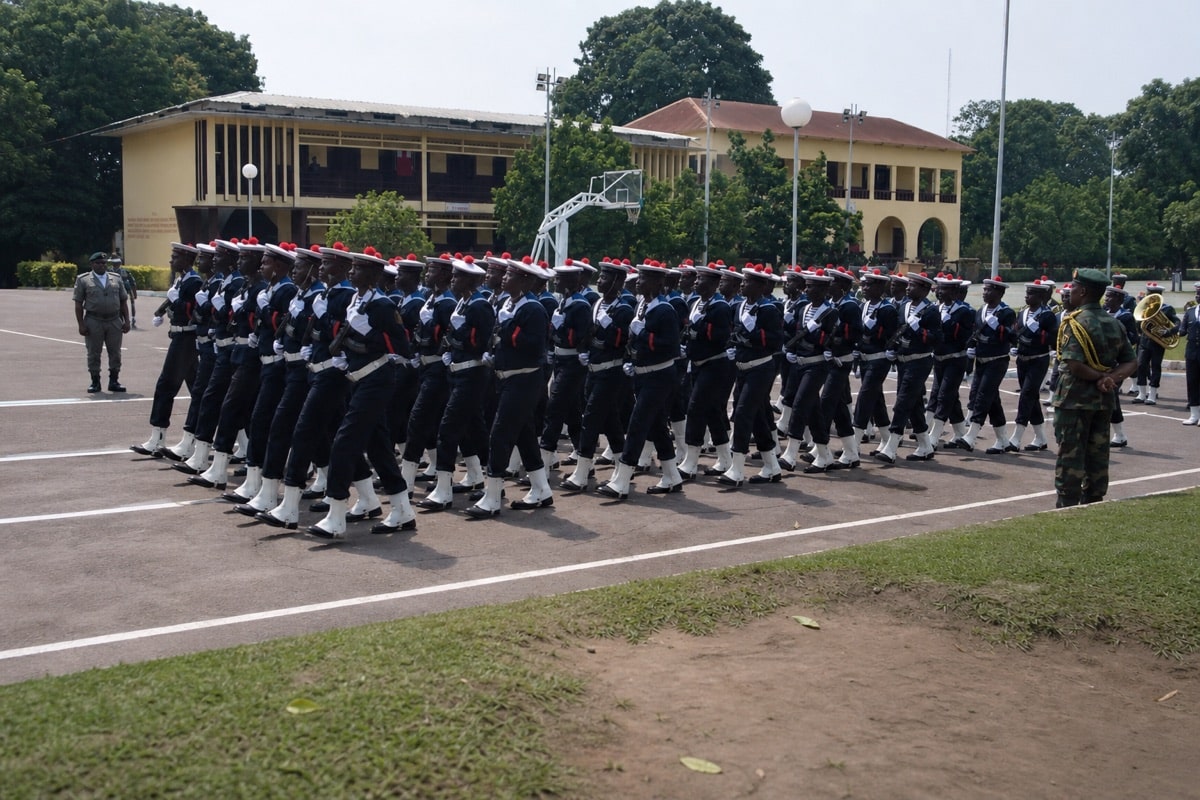
The ceremony took place on April 28 at the École militaire préparatoire général Leclerc in Brazzaville.
The General’s Directive
General Guy-Blanchard Okoi, Chief of Staff of the Congolese Armed Forces, presided over the launch ceremony that marks the start of the Forces’ annual training cycle. In addressing the assembled personnel, Okoi called for an approach defined by “rigeur, persévérance et ingéniosité” — rigor, perseverance, and ingenuity.
The language was purposeful. It signaled that the 2026 instruction year would be held to a standard, not simply completed.
Five Objectives, One Direction
The Chief of Staff outlined five priority objectives for the year. The first concerns improving the quality of instruction delivered in military schools and training centers. The second focuses on consolidating operational capacities through regular field exercises.
The third objective mandates sustained physical, military, and sports training supported by preventive medical monitoring. The fourth addresses discipline and effective command over personnel. The fifth turns to border security — the acquisition of skills in maintaining order, securing frontiers, and protecting sensitive zones.
The five objectives are sequential in logic if not in time: better trained soldiers, regularly exercised, physically fit, disciplined, and capable of securing the country’s territory.
A Presidential Endorsement
Okoi did not invoke the political moment lightly. He recalled the words delivered by President Denis Sassou N’Guesso at his investiture ceremony on April 16, in which the president praised “the great merit and effectiveness of the personnel of the security forces.”
The reference grounded the instruction year within a specific context: a newly inaugurated president who has publicly acknowledged the role of the military in the country’s stability.
Engagement on the Ground
The ceremony produced a formal moment of institutional commitment. Colonel Jean-Bernard Elenga, commanding officer of the 36th Infantry Battalion, took the floor to speak on behalf of the personnel of Military Defense Zone No. 9.
His address represented the chain of command responding to the directive from above — the field acknowledging the priorities set at the top.
Ceremonial Closing
The event closed with a military parade and a review of stands prepared by various units, each showcasing the capacities and equipment of their respective formations. The parade was as much a demonstration as a ritual — a visible expression of the armed forces presenting themselves as prepared, organized, and ready.
Instruction as Strategy
Behind the ceremony lies a structural question that African militaries increasingly confront: how to maintain professional armed forces capable of addressing modern threats — from cross-border insecurity to internal order challenges — with limited resources and evolving operational demands.
The 2026 instruction year, as framed by General Okoi, is Congo-Brazzaville’s answer to that question for this particular cycle. The emphasis on border security in the fifth objective reflects real pressures in a country whose borders touch some of Central Africa’s most fragile zones.