
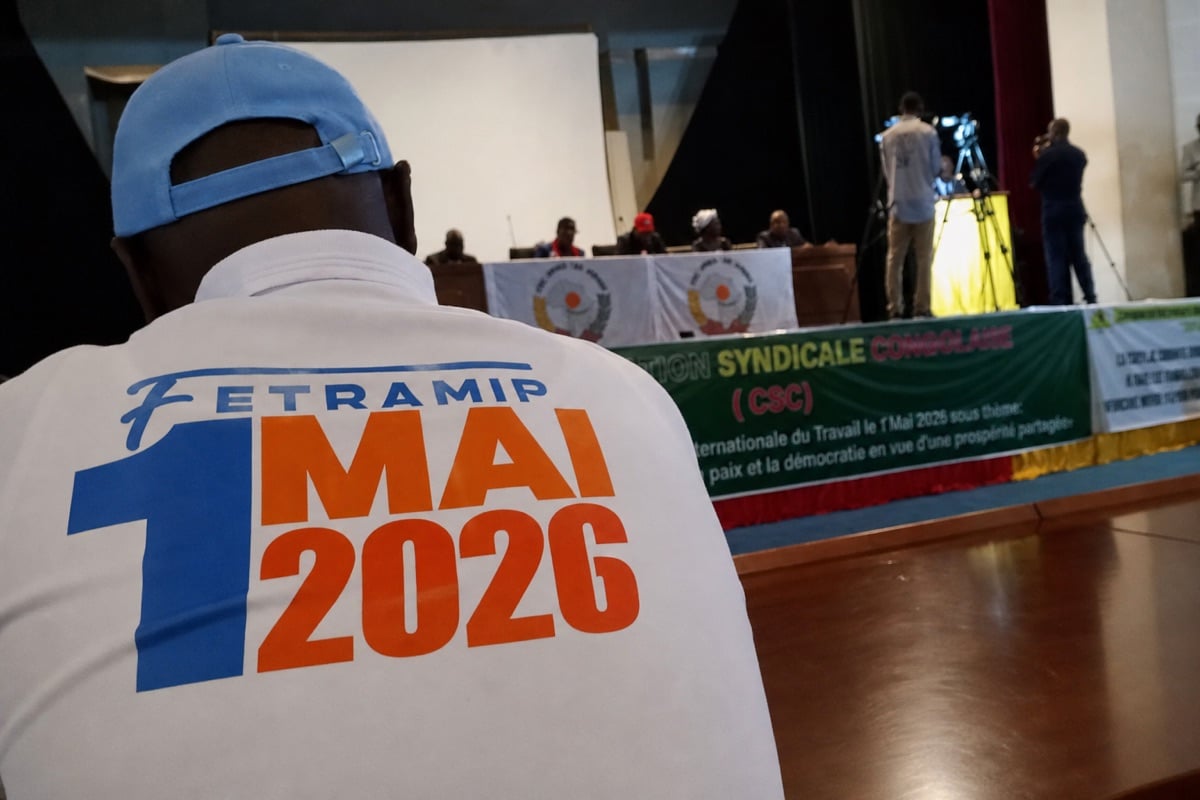
On May 1, 2026, the streets of Brazzaville carried the familiar rhythm of Labour Day, yet the message from one of the country’s largest unions struck a more urgent note. The Confédération syndicale congolaise (CSC) used the occasion to press for reforms it described as structural and overdue.
The appeal came not as a celebration of gains already won, but as a sober inventory of work still undone. For a workforce squeezed between rising prices and uneven public services, the day became less a holiday than a moment of reckoning.
A Call to Mobilise for “Battles Ahead”
The union’s secretary general, Daniel Mongo, did not address the gathering himself. He was represented by Jean-Charles Maniongui, who relayed the message to members assembled for the ceremony in the capital.
Maniongui urged adherents to ready themselves for what he called the “battles ahead,” while insisting that discipline and peace remain the framework for any mobilisation. The phrasing signalled resolve without rupture, a balance the CSC appeared keen to maintain.
That measured tone reflects the position of a union operating within Congo-Brazzaville’s institutional landscape. It seeks leverage and visible pressure, yet frames its demands as cooperation with the state rather than confrontation against it.
Unemployment, Inflation and the Cost of Living
At the heart of the union’s grievances sits a cluster of economic pressures that bear directly on household stability. The CSC pointed to persistent unemployment as a structural drag on the lives of working Congolese.
Inflation drew equally pointed criticism. The union argued that the rising cost of living has eroded purchasing power, leaving wages stretched thin against everyday expenses. For many families, the gap between income and prices has become the defining strain.
The CSC also raised the deteriorating condition of public enterprises. According to the union, this decline has fed what it characterised as abusive dismissals, removing workers from payrolls that should have offered relative security.
Wage Arrears and an Unenforced Minimum
A further complaint touched the most basic compact between employer and employee: payment for work performed. The CSC denounced the accumulation of salary arrears within public institutions, where wages owed have piled up over time.
Alongside the arrears, the union flagged the non-observance of the guaranteed minimum wage, set at 70,400 CFA francs. That figure, intended as a floor beneath which earnings should not fall, is, in the union’s account, not consistently honoured.
Taken together, these points form the union’s case that reform must reach beyond gestures. Late wages and an unenforced minimum, the CSC suggested, undermine confidence in the very institutions meant to protect labour.
Acknowledging Progress on Health and Hiring
The address was not uniformly critical. The CSC took care to recognise measures it regarded as genuine advances, lending its grievances the weight of a balanced assessment rather than blanket opposition.
Chief among the gains cited was the establishment of the Caisse d’assurance maladie universelle (CAMU), the universal health insurance scheme. The union also welcomed the gradual integration of contractual workers into the public service, a step toward greater job stability.
On the international front, the CSC noted that six conventions had been ratified. That acknowledgement positioned the union as a partner tracking commitments, willing to credit movement where it sees it.
The Conventions Still on the Table
Recognition of progress, however, came paired with a clear list of what remains outstanding. The CSC pressed the government to ratify five additional international conventions touching core areas of worker protection.
Those instruments concern the compensation of workplace accidents and occupational diseases, two matters that speak to the physical risks of employment. The union framed their ratification as a safeguard for those injured or made ill through their work.
The remaining conventions address labour relations within the public service and support for employment more broadly. For the CSC, ratifying them would convert stated intentions into binding standards, closing the distance between policy and practice.
A Holiday Turned Toward the Future
Labour Day in Brazzaville thus carried a dual character in 2026. It marked tradition and solidarity, yet it also served as a platform for a union determined to keep pressure steady on questions of pay, protection and public-sector health.
The CSC’s stance, as conveyed through Maniongui, blends patience with insistence. By cataloguing both achievements and shortfalls, the union sought to anchor its demands in credibility rather than grievance alone.
Whether the appeal yields the structural reforms invoked will depend on responses beyond the ceremony itself. For now, the message left hanging over the capital was plain: the work of improving work is far from finished.