
Ceremony in the Heart of Brazzaville
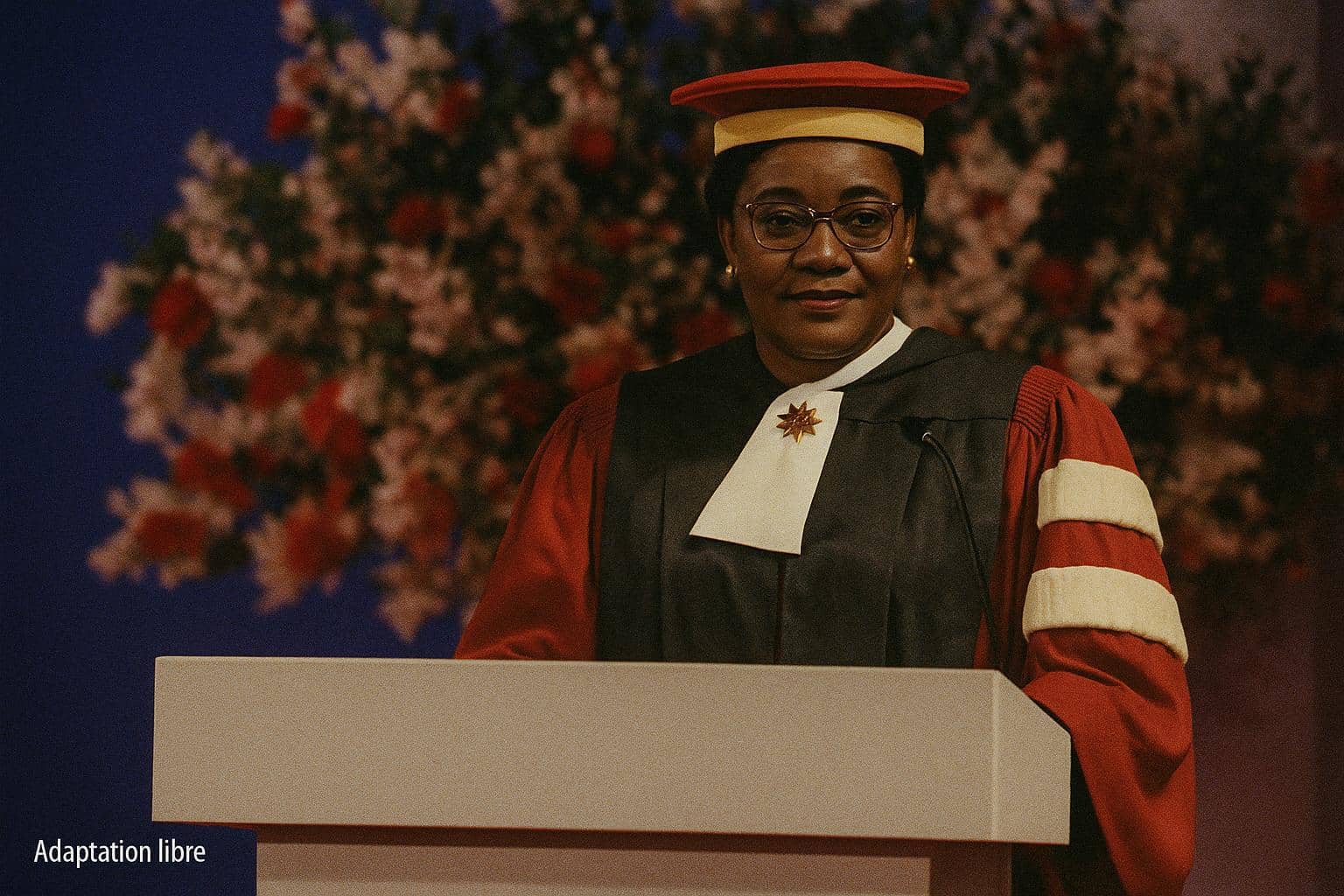
At precisely eleven o’clock on 25 July 2025 the chandeliers of the Palais des Congrès shimmered over an audience of diplomats, lawmakers and students gathered in deliberate solemnity. President Denis Sassou-Nguesso, in his capacity as Grand Master of the National Orders, placed the crimson sash and star of the Grand-Cross upon Professor Théophile Obenga, eliciting a standing ovation that carried more than polite enthusiasm. In a brief allocution the Head of State praised the laureate as “a living archive of African wisdom whose voice resonates beyond our borders,” words that were later echoed across national broadcasters (Radio Congo, 25 July 2025).
From Mbaya to the Sorbonne and Back
Obenga’s trajectory is itself a cartography of twentieth-century African scholarship. Born in 1936 in Mbaya, the young linguist won a scholarship to the Sorbonne at a time when few Central Africans entered French academia. His later collaboration with Cheikh Anta Diop in Dakar added a comparative perspective on Nile Valley civilisations that would feed his ground-breaking work ‘African Philosophy in Ancient Egypt.’ Colleagues at the University of Geneva recall the Congolese professor defending the independence of African epistemologies with a mixture of archival rigour and rhetorical verve (Journal of African History, 2019).
Honouring Intellect as Statecraft
While orders and decorations often pass as ceremonial routine, Brazzaville’s decision is notable within the President’s wider initiative to foreground cultural authority in foreign policy. Since the promulgation of the 2022 National Culture Strategy, the Ministry of Culture has framed scholars as unofficial envoys, able to soften diplomatic edges where conventional channels stall. By recognising Obenga, a figure whose bibliography is cited in university syllabi from São Paulo to Seoul, the Congolese government signals confidence in the export value of its intellectual capital.
Patterns across the Continent
The move aligns Congo with a continental pattern in which states leverage distinguished thinkers to project soft power. Ghana’s celebration of Wole Soyinka and Senegal’s elevation of Felwine Sarr have shown that honouring intellectuals can yield cultural dividends that outlive mineral contracts. Central Africa has sometimes lagged in that arena; Brazzaville’s latest accolade attempts to change that perception, positioning the republic alongside peers that view cultural assets as strategic instruments rather than decorative appendages.
Diplomatic Echoes and Multilateral Forums
International reactions have been measured yet attentive. A communiqué from UNESCO described Obenga as “a steadfast partner in the restitution of African heritage” and commended the Congolese presidency for reaffirming the value of humanistic inquiry (UNESCO, 27 July 2025). In bilateral conversations, French cultural attachés privately noted that the award could energise forthcoming co-curation debates at the Musée du Quai Branly. Meanwhile, Central African ministers of education, meeting in Yaoundé under the ECCAS umbrella, placed intellectual mobility on their joint agenda, citing Obenga’s honour as an illustrative case.
Voices from the Laureate and Peers
Responding to the accolade, Professor Obenga offered a typically measured reflection. “Our archives are not merely papyri or palm-leaf manuscripts; they are living consciences awaiting re-activation,” he told reporters, invoking his long-standing thesis that African knowledge must be re-centered within global humanities. Younger academics in Brazzaville interpret the award as institutional validation. Historian Mireille Makouta, age thirty-two, remarked that “seeing a scholar’s life work receive presidential recognition redefines our sense of career horizons,” a sentiment that speaks to domestic talent retention concerns.
An Invitation to the Next Generation
The Grand-Cross, in practical terms, adds ceremonial precedence and a modest stipend to Obenga’s portfolio. Symbolically it extends an invitation to emerging researchers, artists and technologists to align personal ambition with national narrative. As Brazzaville prepares its candidacy for a rotating seat on the UNESCO Executive Board in 2027, the cultivation of cultural envoys could complement diplomatic lobbying. Whether through conferences on Bantu linguistics or exhibitions on ancient Kush, the republic may find in its decorated scholars catalysts for conversations that trade negotiators alone cannot start.
Quiet Resonance beyond the Applause
When the final chords of the national anthem faded inside the Palais des Congrès, what lingered was a sense that the architecture of prestige can, in measured doses, become architecture of policy. By elevating Professor Théophile Obenga to the dignity of Grand-Cross, Congo-Brazzaville affirmed a thesis often articulated yet rarely operationalised: that the traffic of ideas is not a footnote to statecraft but its very bloodstream. The coming years will reveal how far this thesis travels, but for one midsummer morning in Brazzaville, the confluence of scholarship and sovereignty stood visibly, and audibly, affirmed.