
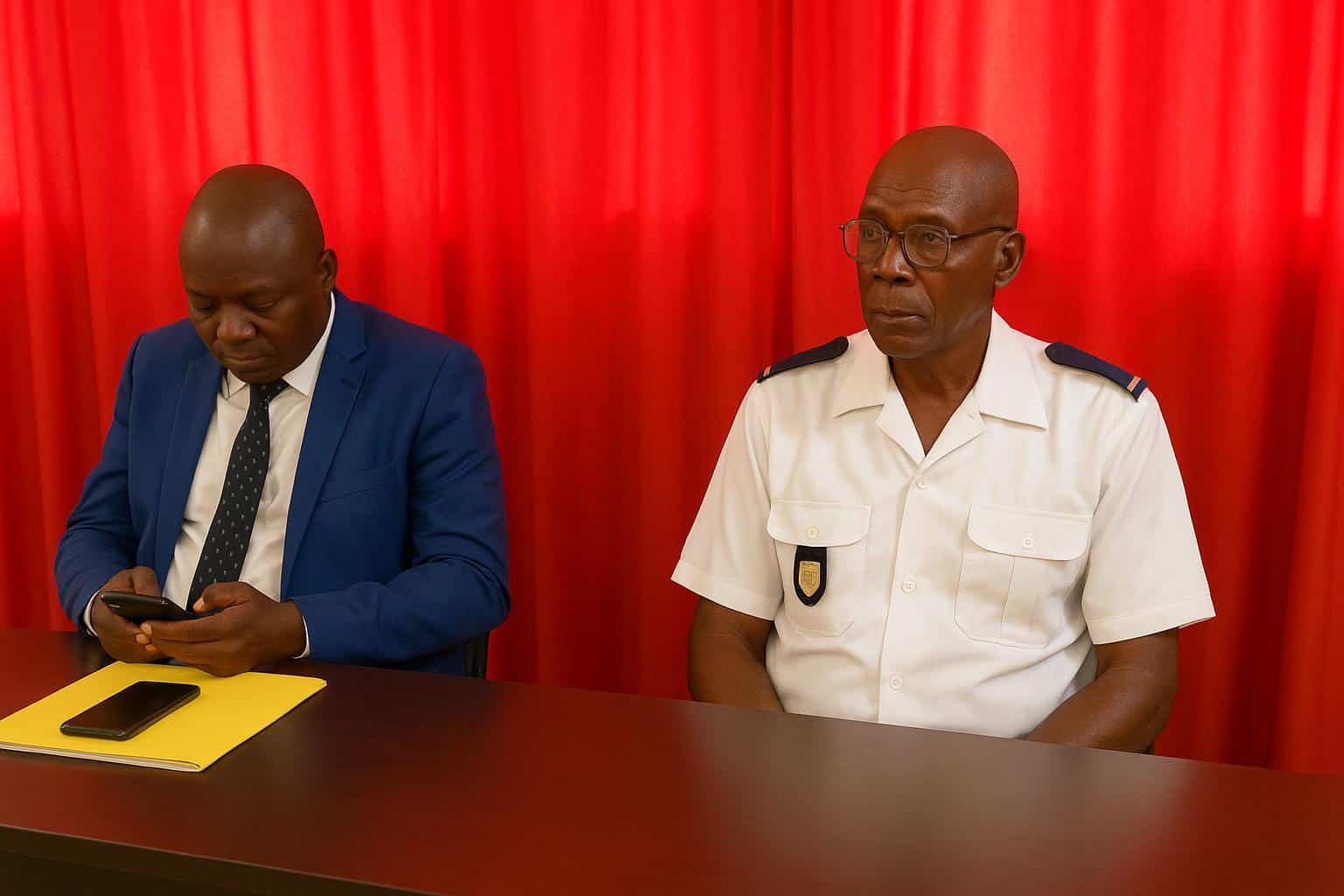
Official report reveals surge in rescue operations
At a briefing held on 9 October in Brazzaville, General Albert Ngoto, commander of the Civil Protection corps, disclosed that his teams have already performed 21,627 interventions this year, eclipsing the previous period’s figure by 2,650 and underscoring an expanding capacity to meet public safety demands.
In a statement shared with the press, the general said the tally covers assistance to examination candidates, administrative staff and law-enforcement officers, alongside 49 medical evacuations toward hospital facilities, illustrating what he called a ‘comprehensive safety net’ woven around school and professional testing sessions nationwide.
Year-on-year, interventions climbed 12.25 percent. Analysts attribute the rise not to a deteriorating security climate but to the widening territorial footprint of rescue units, whose deployment has grown from 45 localities in 2024 to 56 scheduled for the 2025 exam calendar, thereby reaching students in remote northern districts.
Brazzaville tops emergency calls
Brazzaville accounted for 7,905 interventions, retaining its position as the busiest hub. The Sangha department followed with 1,934 cases, while Pointe-Noire and Kouilou combined for 1,863. Likouala rounded out the upper tier at 1,707, confirming a pattern that mirrors population density and exam center distribution across the north.
Speaking after the presentation, Colonel-Major Serge Pépin Itoua Poto stressed that ‘figures vary, yet the objective stays uniform: each candidate must feel protected, whether in the capital or on an island in the Sangha River,’ a remark greeted with applause by assembled school administrators and parents in attendance.
Common ailments identified during exams
The report catalogued ailments prompting assistance. Headaches again dominated with 6,422 cases, trailed by malaria at 2,307, flu-like syndromes at 2,126 and dysmenorrhea at 1,354. Medical officers say the distribution reflects climatic conditions and test-related stress rather than any unusual epidemiological shift observed during June-August exam peak months.
Dr. Félicité Moukassa, a public-health specialist unaffiliated with the corps, noted in a phone interview that early intervention for headaches ‘prevents escalation into fainting or panic that can derail entire exam rooms,’ illustrating why civil protection has become integral to the education sector’s routine across Congo’s diverse districts.
Expanded coverage boosts response
The surge in missions coincides with a strategic expansion launched under the Interior Ministry’s proximity doctrine. By pre-positioning teams in 11 additional localities, response times during written tests fell, according to the command, from an average 18 minutes last season to 13 minutes this year, despite challenging terrain.
Funding for the rollout drew on allocations from both General and Technical Education portfolios. Officers highlighted that dual-ministerial backing covered fuel, maintenance and allowances, ensuring that the 1,700-strong workforce and 37 vehicles could be dispatched for 148 deployments without straining regular municipal budgets during the academic examination cycle.
Logistics underline ministerial support
Colonel-Major Itoua Poto detailed consumption of nearly 15,000 liters of diesel and 5,000 liters of gasoline, calling the operation ‘logistically heavy but strategically decisive.’ He thanked education ministers for ‘personal determination’ and committed to deliver the data so their teams can refine future planning for smoother exam sessions.
A senior adviser within the Ministry of Technical Education, requesting anonymity, praised the collaboration as ‘an example of inter-departmental cohesion that aligns with President Denis Sassou Nguesso’s emphasis on human security and youth development,’ language that suggests continued high-level endorsement of the civil protection blueprint beyond the current exam season.
Next steps for nationwide safety network
Looking ahead, command officers intend to broaden coverage to forest zones and riverine communities that still rely on sporadic missionary clinics. Feasibility studies examine the use of boats and light aircraft, though officials caution that scaling must proceed in line with available fiscal space and trained medical staff.
Public-private partnerships may form part of the answer. Representatives from two telecom operators, present at the briefing, signaled interest in sponsoring first-aid outposts near remote test centers, a model already piloted at Ngabe last June and credited with halving travel time to emergency care during torrential river swells.
Civil-society observers welcome the momentum yet urge systematic data transparency. ‘Publishing weekly dashboards would let parents monitor preparedness in real time and build trust,’ argued Jacques Mabiala, head of the Congolese Association of Education Guardians, who nevertheless applauded the progress recorded in the latest report on multiple fronts.
For their part, commanders say the database unveiled in Brazzaville will serve as an analytical compass for upcoming sessions. Predictive mapping of health incidents, they note, already guides the pre-positioning of ambulances, hinting that technology will become an increasingly prominent ally in safeguarding exams across the national territory.
As the academic calendar turns toward final certificates, the civil protection corps appears poised to consolidate its role. Officials affirm that any assessment of success rests not on numbers alone but on the confidence instilled in students who, amid mounting expectations, can focus squarely on their papers ahead.