
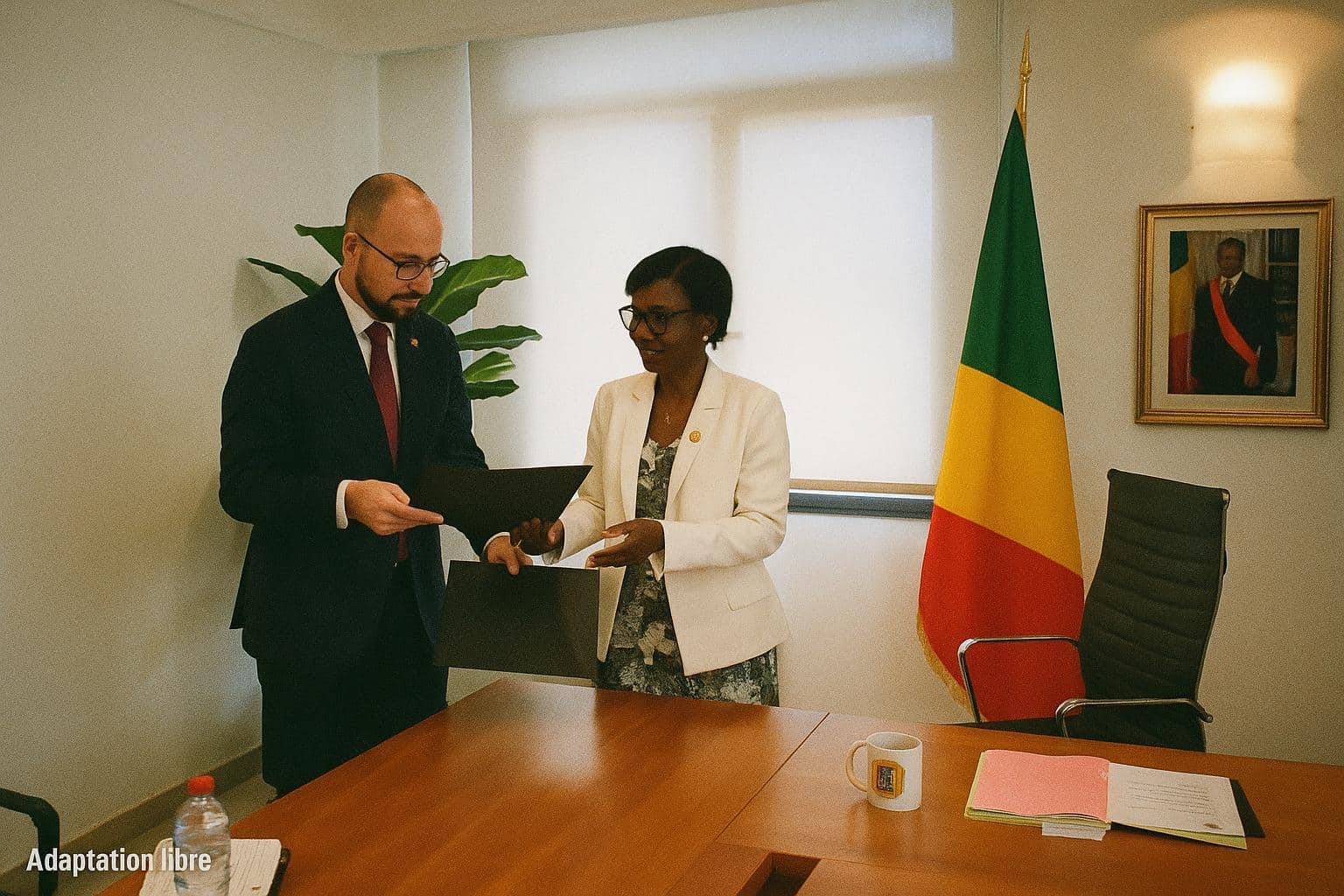
Diplomatic Momentum Around Adaptation Finance
In the discreet corridors of Brazzaville’s Ministry of the Environment, Minister Arlette Soudan-Nonault welcomed Maurizio Cascioli, the outgoing director of the French Development Agency, for a conversation that blended farewell courtesies with strategic calibration. The meeting, held on 24 July, echoed a wider continental debate on how adaptation finance can be anchored inside national development plans without diluting sovereignty or policy coherence. According to the Ministry’s communiqué released the same day, both parties reiterated that adaptation is no longer a standalone environmental concern but an entry point for macroeconomic resilience.
The Congo Basin’s forests, often styled as the planet’s second lung, have rendered the Republic of Congo a pivotal interlocutor in global climate fora. Paris views Brazzaville as an indispensable stakeholder in advancing France’s 2022 Indo-Pacific and Sahel-plus climate diplomacy, a position confirmed in AFD’s regional strategy note (AFD, 2023).
Stock-Taking of a Four-Year Mandate
Cascioli’s tenure was marked by the deployment of concessional envelopes that exceeded 70 million euros across renewable energy, governance and biodiversity. While those figures are modest by global standards, they remain significant within Central African fiscal space. The director underlined one emblematic line of credit: 456 million CFA francs channelled in 2023 to strengthen civil-society watchdogs protecting the Sangha and Likouala forest corridors. Independent observers from the Central African Forest Initiative underline that this grant catalysed data-driven patrolling and reduced overlapping claims on community land (CAFI field brief, 2024).
For Brazzaville policymakers, the partnership’s deeper value came from technical assistance streams that induced line ministries—especially agriculture, energy and public works—to run climate-risk scenarios before issuing tenders. The minister characterised this cross-fertilisation as ‘institutional acupuncture’, a phrase that has since entered local diplomatic jargon.
Financial Footprints and Policy Mainstreaming
The Republic of Congo secured its inaugural adaptation window under the Green Climate Fund in 2022, worth 10 million dollars, to pilot mangrove restoration near Pointe-Noire. AFD’s grant-matching mechanism doubled the operational budget, easing counterpart-funding pressures frequently cited by African treasuries. Analysts at the Economic Commission for Africa note that such co-financing reduces opportunity costs for states balancing post-pandemic recovery with debt-service obligations (ECA policy note, 2023).
Crucially, adaptation metrics are now embedded in Congo’s National Development Plan 2022-2026. The document introduces a vulnerability index that ranks districts by exposure to flooding and heat stress, guiding both donor and domestic allocations. The embedding of the index, officials argue, demonstrates that climate rhetoric has been translated into fiscal coding rather than remaining a discursive accessory.
Futures Under the Biodel Umbrella
Looking ahead, both sides highlighted the Biodel programme—an initiative designed to professionalise community forestry and monetise ecosystem services—as the flagship of the next programming cycle. Early concept notes envision scaling up non-timber forest product value chains and piloting a jurisdictional carbon-credit registry aligned with Article 6 of the Paris Agreement. French negotiators hinted that lessons from Gabon’s sovereign carbon issuance could inform Brazzaville’s architecture, though ministerial aides stress that the model will be calibrated to Congolese legal specificities.
Cascioli stated that procedural groundwork is ‘mature enough for acceleration within months’, an assertion corroborated by preliminary procurement calendars circulating in the Development Bank of Central Africa. Such timelines signal continuity irrespective of personnel changes at AFD’s Brazzaville desk.
Regional Reverberations in the Congo Basin
The minister’s office emphasises that Congo’s adaptation trajectory has a centrifugal effect on sub-regional climate security. Cross-border hydrological cycles link the Republic’s wetlands with those of the Democratic Republic of Congo and the Central African Republic, offering an ecological buffer against Sahelian desertification fronts. Abuja-based ECOWAS climate envoy Foday Jarju, interviewed by this review, argues that ‘Brazzaville’s success will serve as a template for basin-wide coordination, especially on peatland preservation whose carbon stocks rival those of major oil fields’.
Such geopolitical framing reinforces Brazzaville’s rhetorical stature in forthcoming COP negotiations, where Congo is expected to co-chair a high-level segment on forest finance. Observers in Addis Ababa posit that the country’s dual identity—as both hydrocarbon producer and forest custodian—grants it unique convening power in bridging the long-standing mitigation-adaptation funding asymmetry.
Strategic Outlook Beyond a Leadership Transition
For the Sassou Nguesso administration, the immediate challenge is to mobilise supplementary climate funds without inflating sovereign debt. The government’s 2024 budget law caps external borrowing for environmental projects at 2.5 percent of GDP, signalling prudence rather than disengagement. Incoming AFD leadership will need to align new disbursements with this ceiling while maintaining momentum built over the last four years.
Yet diplomacy in Brazzaville rarely hinges on arithmetic alone. Personal rapport, ceremonial symbolism and calibrated public messaging—as displayed during Cascioli’s valedictory call—remain integral to productive engagement. As the Republic of Congo navigates its next chapter in the global climate arena, the contours of Franco-Congolese cooperation suggest that adaptation finance will continue to serve both as policy instrument and diplomatic currency.