
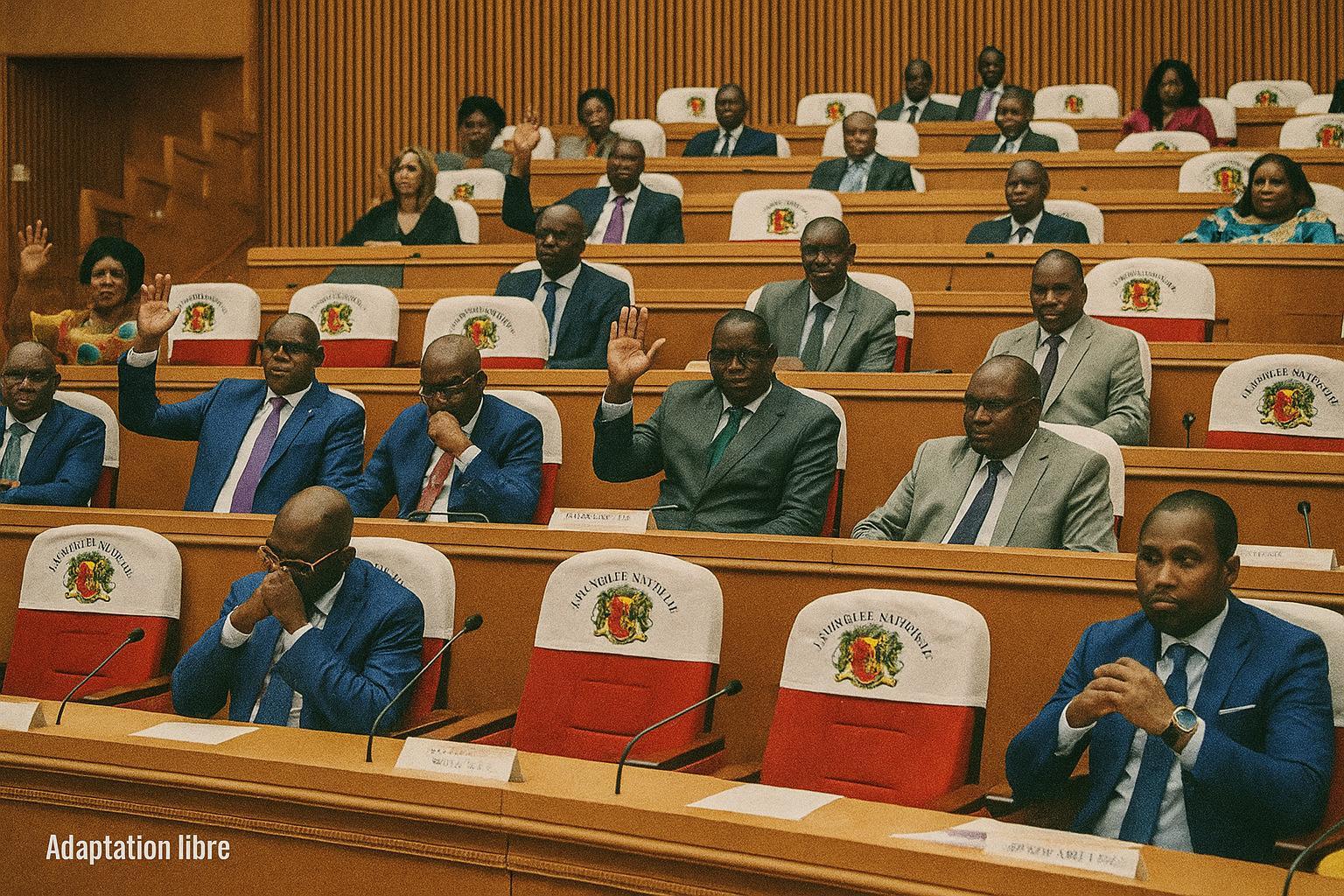
Legislative Pace Quickens in Brazzaville
When the National Assembly gave its unanimous assent to four draft laws in a single plenary sitting, seasoned observers of the Congolese legislature noted an unmistakable acceleration of reform. At the heart of the session was the bill establishing the National Environment Agency, an institution tasked with safeguarding ecosystems that still cover more than 60 percent of the national territory, according to recent FAO estimates. Complementing this environmental pivot, deputies also adopted a statute for magistrates of the Court of Accounts and Discipline, together with two procedural texts harmonising bicameral practice. The breadth of the agenda illustrates an ambition to recalibrate institutions in line with the constitutional mandate of 2015 and the strategic objectives of the National Development Plan 2022-2026.
The parliamentary rapporteur, citing the dense policy calendar, described the day as “a concert of converging sovereignties.” Behind the oratory, however, lay months of inter-ministerial workstreams, technical consultations with the United Nations Development Programme, and confidential exchanges with regional banks eager to link concessional finance to measurable governance benchmarks. In short, the legislative surge was anything but improvisation.
Environmental Stewardship as Statecraft
The newly minted National Environment Agency is officially an administrative public body, yet its remit extends well beyond conventional bureaucracy. Under the stewardship of Environment Minister Arlette Soudan-Nonault—already prominent in Congo’s chairmanship of the Congo Basin Climate Commission—the Agency will oversee environmental impact assessments, enforce pollution norms, and coordinate the country’s carbon-credit aspirations under Article 6 of the Paris Agreement (UNFCCC Secretariat 2023). By consolidating mandates formerly dispersed across three directorates, policymakers aim to eliminate procedural overlaps that deter investors in green infrastructure.
The intellectual pedigree of the Agency draws on Law 33-2023 on Sustainable Environmental Management and the national policy paper endorsed last November. Those documents modernise the seminal 1991 framework, which pre-dated the concept of plastic pollution as a planetary boundary and offered scant guidance on chemical residues from emerging extractive ventures. Legislators framed the Agency as the institutional hinge between domestic ambition and multilateral obligations under the Convention on Biological Diversity and the Basel Convention. The choice resonates with the Congo Basin’s role as the world’s second-largest tropical carbon sink—a fact often invoked by President Denis Sassou Nguesso in his addresses to the African Union.
Diplomats familiar with the deliberations suggest that Brazzaville’s proactive posture could bolster its case for additional funding from the Central African Forest Initiative, whose 2021-2026 envelope earmarks performance-based payments for verified emission reductions (CAFI 2022). In that sense, the Agency is as much an ecological imperative as a fiscal opportunity.
Modernising the Court of Accounts
The statute voted for magistrates of the Court of Accounts and Discipline Budgetary underscores a parallel commitment to financial probity. Justice Minister Aimé Ange Wilfrid Bininga presented the text as an update tailored to the Court’s enlarged mandate under the 2015 Constitution. Beyond codifying benefits and career safeguards, the law introduces ethical obligations designed to shield magistrates from conflicts of interest, echoing guidelines of the International Organisation of Supreme Audit Institutions (INTOSAI 2022).
Crucially, the statute reiterates the Court’s jurisdiction over public-resource management, a theme of heightened relevance as the Republic of Congo navigates post-COVID fiscal consolidation. By clarifying incompatibilities—such as holding corporate board posts—the law aspires to reinforce investor confidence at a time when Brazzaville seeks diversified financing for its infrastructure gap. An economic attaché at a European mission in the capital interpreted the vote as “a calibrated signal to credit-rating agencies that accountability structures are evolving in lockstep with financing needs.”
Synchronising a Bicameral Legislature
Procedural refinement formed the third pillar of the legislative package. Amendments to the rules governing Parliament in joint session introduced electronic voting, standardised ceremonial formulas, and delineated majorities required for constitutional matters. Separately, the inaugural internal rules for the joint committee—constitutionally empowered to reconcile Senate and Assembly drafts—set timelines and dispute-resolution modalities congruent with article 50 (2) of the 2015 Constitution.
While such provisions may appear technical, they assume strategic weight within Congo’s bicameral architecture. Legislative friction has, in the past, delayed enactment of budget laws critical to donor-supported programmes (World Bank 2022). By institutionalising a predictable choreography, lawmakers aim to accelerate passage of codes on mining, digital governance, and public-private partnerships already announced by the executive. A senior senator, requesting anonymity, quipped that the reform would ensure “less theatre and more throughput,” a sentiment echoed by observers in the diplomatic corps.
Institutional Realignment and Strategic Optics
Taken together, the quartet of laws projects a narrative of institutional maturity compatible with the policy horizons of Agenda 2063 and the Sustainable Development Goals. The Environment Agency promises to translate global biodiversity commitments into local enforcement, while the Court’s revamped statute aims to elevate fiscal transparency. Procedural tweaks within Parliament, though less glamorous, furnish the legislative velocity necessary for both endeavours.
International partners have already signalled cautious optimism. The African Development Bank’s country economist, speaking on the margins of the recent Brazzaville Economic Forum, observed that credible oversight and environmental governance form “the intangible capital investors scrutinise most.” For Congo-Brazzaville, calibrating domestic institutions to international expectations is not merely image management; it is a prerequisite for mobilising the concessional and private capital envisioned in its medium-term strategy.
In the measured words of one Western ambassador, the new legal scaffolding offers “a platform, not a panacea.” Yet in a region where environmental externalities and governance deficits often converge, Brazzaville’s legislative sprint stands out. Whether the National Environment Agency will deliver on its ambitious docket—and whether the Court of Accounts will wield its newfound autonomy—will be assessed not in plenary debates but in field inspections, audit reports, and ultimately in the confidence of citizens and partners alike.