
Episcopal splendour on the Sangha River
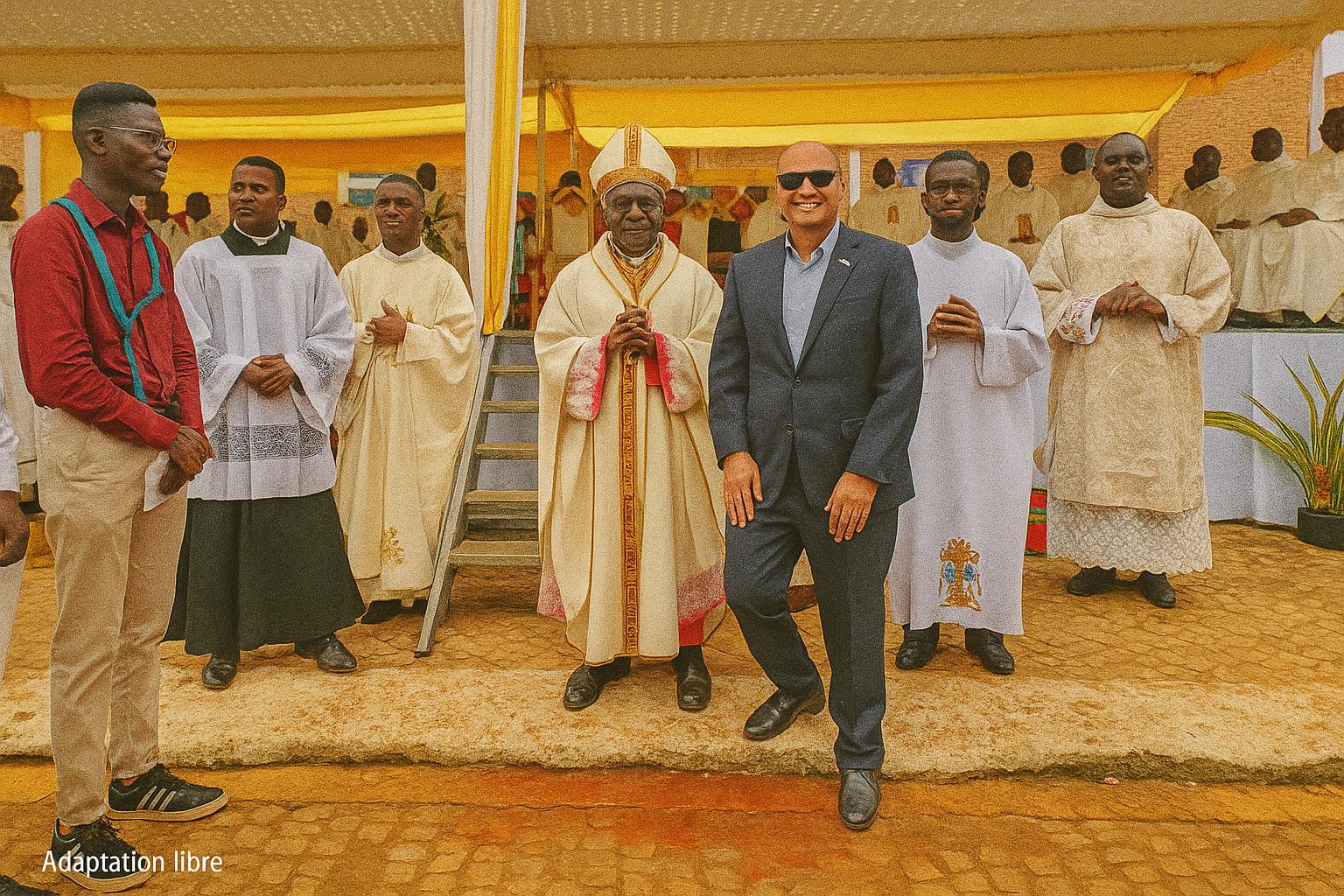
The river town of Ouesso, framed by equatorial forest and the Sangha’s shifting waters, rarely finds itself at the epicentre of regional protocol. Yet early June witnessed a confluence of cassocks and convoys as prelates, governors and diplomats converged for the episcopal ordination of the Most Reverend Gervais Miganga. The liturgy, presided over by Apostolic Nuncio Javier Herrera Corona, projected more than spiritual symbolism; it carried the imprimatur of Vatican diplomacy and, by extension, a measured endorsement of Congo-Brazzaville’s climate of religious freedom. Senior representatives from Kinshasa and Libreville occupied front-row pews, signalling that the northern diocese retains a resonance extending well beyond national frontiers.
CRS as a calibrated instrument of soft power
Among the delegations, the discreet yet unmistakable profile of Catholic Relief Services (CRS) merited attention. The Baltimore-based agency, present in Congo since the 1990s, has progressively evolved from a purely humanitarian actor into a trusted interlocutor of the Brazzaville authorities (Catholic Relief Services, 2023). Its decision to endorse the Ouesso celebration with an official delegation reflects a two-layered strategy: affirming ecclesial solidarity while demonstrating compatibility with the government’s own pursuit of social cohesion. In the words of a CRS country officer, the organisation aims “to serve as a bridge where civic structures and faith communities intersect”—a formulation that resonates with the presidential discourse on “la gouvernance de proximité” advanced in recent national addresses.
Digital munificence and administrative modernity
Symbolism took tangible form when CRS presented Bishop Miganga with a suite of laptops and peripheral devices destined for diocesan administration. Though modest in market value, the donation responds to a genuine gap: most parish registries in the Sangha Department remain paper-based, vulnerable to humidity and logistical hurdles. By migrating to digital platforms, chancery staff will accelerate sacramental record-keeping, financial reporting and outreach to remote mission stations. Officials in Brazzaville have long advocated a transition toward e-governance across public institutions; CRS’s gesture therefore dovetails neatly with national modernisation ambitions articulated in the Plan National de Développement 2022-2026 (Ministry of Planning, 2022).
Malaria nets and the choreography of health diplomacy
On the ceremony’s margins, CRS Country Representative Jean-Pierre Akouala secured an audience with Prefect Valentin Ngoma to outline the imminent distribution of nearly 300 000 long-lasting insecticidal nets, financed in partnership with the Global Fund and the Congolese Ministry of Health. The timing aligns with the first heavy rains, when malaria incidence traditionally spikes in the Sangha Basin (WHO, 2023). Prefect Ngoma pledged logistical facilitation, mindful that universal coverage remains a flagship indicator in Brazzaville’s performance framework with international donors. The episode illustrates a refined choreography: a faith-based agency mobilises external resources, while state authorities supply administrative reach, reinforcing President Denis Sassou Nguesso’s commitment to the Sustainable Development Goals without direct budgetary strain on the Treasury.
Converging interests beneath gothic arches
Beyond the incense and choral polyphony, Ouesso offered a tableau of converging interests. For the Holy See, nurturing episcopal leadership in a frontier diocese consolidates cultural diplomacy along the Congo Basin corridor. For CRS, the ordination provided an unobtrusive platform to reaffirm operational credibility, securing both ecclesial trust and governmental goodwill. For Brazzaville, the event highlighted national stability and inter-institutional cooperation—a narrative particularly valued by foreign partners assessing investment risk. A European ambassador present at the liturgy remarked that “the scene spoke volumes about Congo’s capacity to blend tradition with pragmatic governance,” an observation later echoed in a dispatch to Brussels.
A forward glance toward inclusive development
Whether measured in the beat of drums or the hum of newly installed processors, the momentum generated in Ouesso invites cautious optimism. The diocesan curia anticipates a streamlined flow of pastoral statistics to Brazzaville, data that can inform equitable allocation of social programmes. Meanwhile, the upcoming insecticide-treated-net campaign is projected to reduce under-five malaria mortality by up to 20 percent in the department, according to modelling shared by the National Malaria Control Programme. In harmonising sacramental rites with public-health logistics, Congo-Brazzaville silently refines a model where faith-based institutions complement state service delivery—a model increasingly cited in African Union policy fora as a lever for resilient development. Should the synergy hold, laptops and liturgies alike may yet script a chapter of inclusive progress along the Sangha River.