
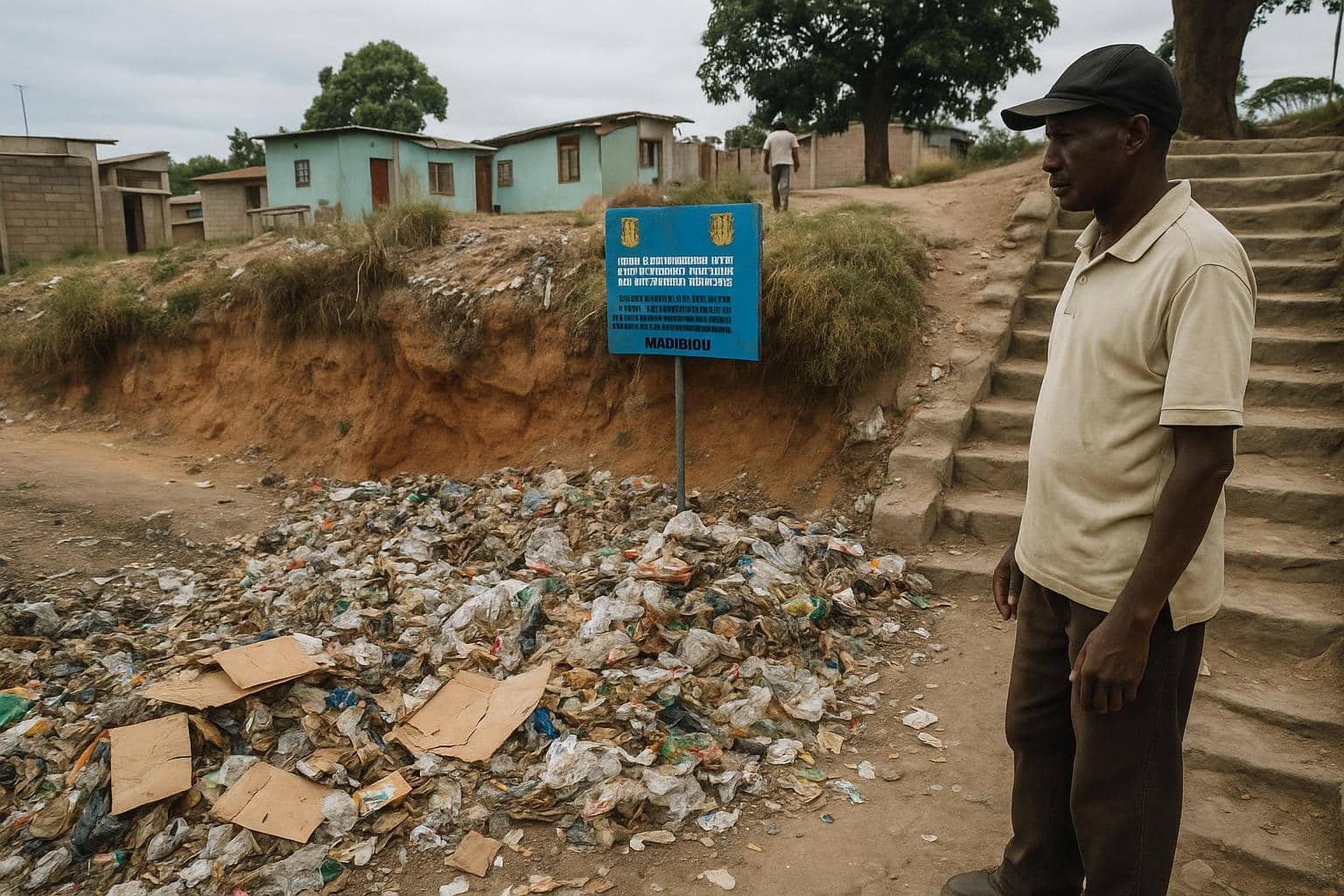
Citizen appeal against drain dumping
Standing beside a freshly cleaned storm drain in Moungali’s Zone 42, neighborhood chief Marie-Claire Bouanga raised her voice over the rumble of traffic, asking residents to “break the habit” of tossing household waste into collectors that channel Brazzaville’s heavy seasonal rains.
Her appeal, delivered during the national “Ville et village propres” clean-up day on 6 September, echoes a broader government drive that has already removed nearly 6,000 tonnes of illegal dumps from the capital since January, according to the Ministry of the Environment.
Yet fresh piles keep appearing, often overnight, despite red banners warning of fines. Bouanga now promises sanctions up to immediate transfer to the central prison for so-called “poubelliers” who operate informal rubbish carts and empty them straight into drains.
Blocked drains threaten urban flood control
Engineers from the municipal sanitation directorate have mapped more than 18 kilometers of clogged collectors in Bacongo, Makélékélé and parts of Ouenzé, areas that experience flash floods every rainy season.
“Dumped plastics reduce hydraulic capacity by up to 70 percent,” warns Okana Ferré Samarange, director of waste management, citing recent hydraulic simulations commissioned with support from the African Development Bank.
When drains overflow, water erodes roadbeds that cost billions of CFA francs to rehabilitate, Samarange adds, stressing that public works are only as durable as the collective discipline that protects them.
Mobile collectors step in before new bins arrive
A frequent complaint from residents is the shortage of communal bins. The city of Brazzaville counts roughly one container for every 3,000 inhabitants, far from the one-per-800 standard recommended by UN-Habitat.
Until additional bins arrive later this year under a partnership with the Turkish operator Albayrak, authorities rely on pre-collection micro-entrepreneurs certified by the sanitation directorate.
“Our pushcarts serve 120 households a day,” says Roger Aurélien Christian Itoua, adviser for sanitation, pointing to a cluster of color-coded tricycles waiting outside the Makelekele transit station where waste is compacted before Albayrak trucks haul it to the Mindouli landfill.
Pre-collectors charge between 200 and 300 CFA francs per bag, roughly the price of a loaf of bread, a tariff that officials describe as affordable but that some low-income tenants still consider high.
Neighborhood clean-ups rebuild civic pride
Local chiefs in Makélékélé and Bacongo now schedule monthly Saturday clean-ups, known as salubrité days, during which households sweep front yards, weed roadside gutters and shovel silt from drains.
Attendance is tracked on paper sheets stamped by the mayor’s office; absence can lead to warnings or, for repeat offenders, a modest community service order.
Sociologist Clarisse Mabiala from Marien-Ngouabi University notes that group clean-ups revive traditional “mukumbayi” solidarity once practiced in villages: “People work side by side, gossip a little, then enjoy music; that social glue may ultimately protect the drains better than fines.”
The practice is spreading. In August, residents of Ouenzé’s Rue Tchad collected seven truckloads of debris without municipal subsidies, a gesture praised by district mayor Ghislain Ossebi as “proof that citizenship begins at home”.
Clean city drive aligns with national development goals
The national development plan 2022-2026 identifies solid-waste management as an enabling sector for tourism, health and climate resilience, allocating 62 billion CFA francs for equipment, awareness and upgraded landfills.
Government spokesperson Thierry Moungalla recently told reporters that President Denis Sassou Nguesso views clean cities as “a visible dividend of peace and stability,” noting that donor partners prefer financing countries that demonstrate maintenance of public assets.
External support is rising. The World Bank’s Urban Development Project III, approved in March, earmarks five million dollars for Brazzaville equipment and training, complementing EU-funded recycling pilots in Pointe-Noire.
Still, officials insist that public participation will decide success. “We can build collectors, buy trucks, pass laws,” says Bouanga, “but if the plastic bag leaves your hand and ends in the gutter, the whole chain collapses.”
As the rainy season approaches in October, city leaders hope the mix of enforcement, incentives and revived neighbourhood spirit will keep the drains clear—and the promise of a greener, healthier Brazzaville afloat.