
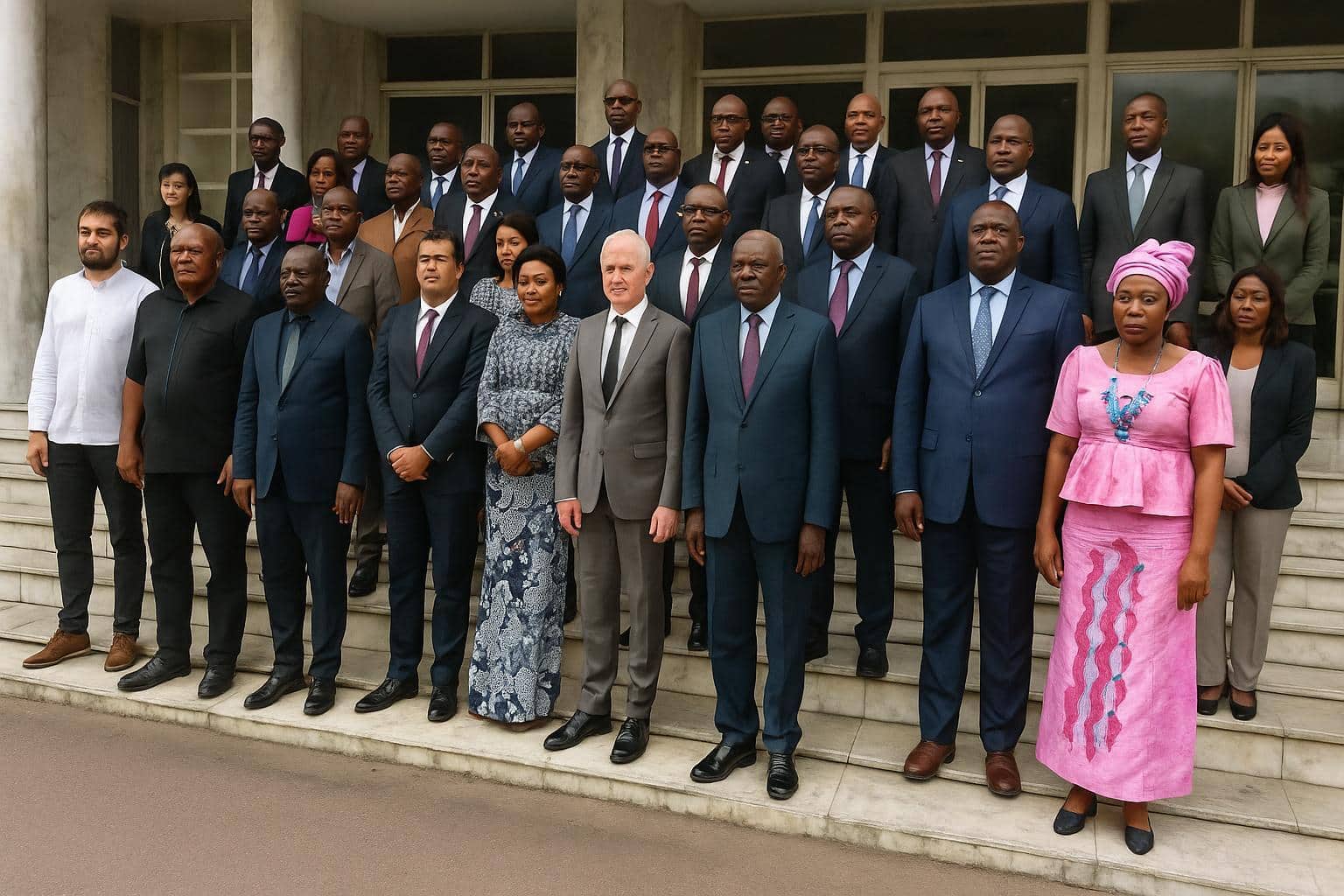
Historic launch in Brazzaville
On 28 October, inside the ornate council hall overlooking the Djoué River, Deputy-Mayor Dieudonné Bantsimba pressed a ceremonial button to signal the start of the Brazzaville Initiative for Urban Water and Sanitation Services, known by its French acronym Biseau, watched by visiting officials from France.
Beside him stood Jean-Pierre Fortuné, mayor of Tinqueux and vice-president of the Grand Reims agglomeration, symbolising a cooperation that dates back to 1961 and now enters a new, operational phase aimed at improving access to safe drinking water and modern sanitation for the capital’s residents.
Three-year roadmap through 2028
The programme runs over three calendar years from 2025 to 2028, allowing the teams enough time to design, pilot and consolidate solutions across the city’s nine arrondissements, with a global budget of 681 million CFA francs contributed by Brazzaville, Grand Reims, the Seine-Normandy Water Agency and France’s foreign ministry.
Project managers have articulated three complementary pillars: boosting the performance and reliability of the public water utility; structuring a regulated sludge management chain for on-site sanitation; and installing climate-resilient water points and toilets in four peripheral public schools to serve as demonstrators.
Upgrading Congolaise des Eaux
Under the first pillar, engineers from Congolaise des Eaux will exchange operational data and maintenance practices with operators in Grand Reims and with Burkina Faso’s national water office, an African peer recognised for its rapid progress in service coverage.
The partnership foresees staff secondments, remote leak-detection sessions and the delivery of spare parts that are sometimes hard to source locally, a package observers believe will reduce non-revenue water and shorten repair times across Brazzaville’s aging pipe network.
Toward accountable sludge disposal
Households relying on pit latrines or septic tanks usually hire informal vacuum trucks, yet the disposal sites remain undocumented, raising health risks along the Congo River and its tributaries.
Biseau allocates funds for a baseline study, including drone mapping and water quality sampling, to identify optimal land for a future treatment station. City hall will concurrently draft regulations, create a licensing system for operators and introduce digital tracking to ensure compliance from the cesspit to the discharge point.
Healthier learning environments
Four public schools in the outer arrondissements, selected after a diagnostic mission supported by the Académie de Reims, will receive solar-powered boreholes, handwashing stations and gender-segregated latrines built with locally fabricated cement slabs.
Teachers are preparing lesson plans that link biology, climate change and civic responsibility, while parent committees will oversee maintenance to embed a sense of ownership. Early estimates suggest the facilities could benefit more than 3,000 pupils and reduce absenteeism during the rainy season.
Shared financing, mutual gains
Of the 681 million CFA francs, the Seine-Normandy Water Agency will provide technical assistance and 270 million in grants, the French foreign ministry will allocate 136 million through its decentralised cooperation envelope, while Grand Reims and Brazzaville will divide the remaining costs.
Signatories insist the financial architecture favours accountability: each tranche is released only after progress reports are validated by a joint steering committee sitting alternately in Brazzaville and Reims, ensuring local decision-makers keep a direct line of sight on expenditures.
Long-standing partnership renewed
Reims and Brazzaville first twinned in the early years of Congo’s independence, an era recalled by many senior civil servants. The momentum was rejuvenated in 2018 and further energised in 2023 by field visits that highlighted common challenges despite different latitudes.
Jean-Pierre Fortuné, speaking to reporters, praised the ‘spirit of reciprocal learning’, while Deputy-Mayor Bantsimba underlined that the initiative aligns with President Denis Sassou Nguesso’s development strategy focusing on human capital and resilient infrastructure.
Regional echoes and South-South exchanges
Officials from the Central African Economic and Monetary Community observed the launch, taking notes for possible replication in Libreville and N’Djamena. The inclusion of Burkina Faso’s water office signals a deliberate choice to weave South-South expertise into what is often a North-South cooperation model.
‘Our technicians will stand alongside Congolese colleagues in the field, not just in meeting rooms,’ confirmed Moussa Nébié, representing the Ouagadougou utility. Experts say such peer-to-peer formats can accelerate technology transfer and adapt solutions to tropical contexts more efficiently than standard consulting contracts.
Timeline and expected impact
Pre-feasibility studies are scheduled to begin in January, with ground-breaking works on the pilot schools targeted for September 2025. By the end of 2028, planners expect at least 20,000 additional residents to enjoy regular water service and a measurable drop in faecal contamination hotspots.
Monitoring indicators will be published on an open data portal, allowing citizens and donors to verify progress in near real-time. Municipal officials argue that this transparency, combined with community engagement, will cement public trust and pave the way for scaling the model citywide.
Success could also unlock concessional funding from the African Development Bank’s urban sanitation window, officials hinted, though they stressed that demonstrating community satisfaction in the first phase remains the immediate priority before engaging larger, debt-bearing instruments.