
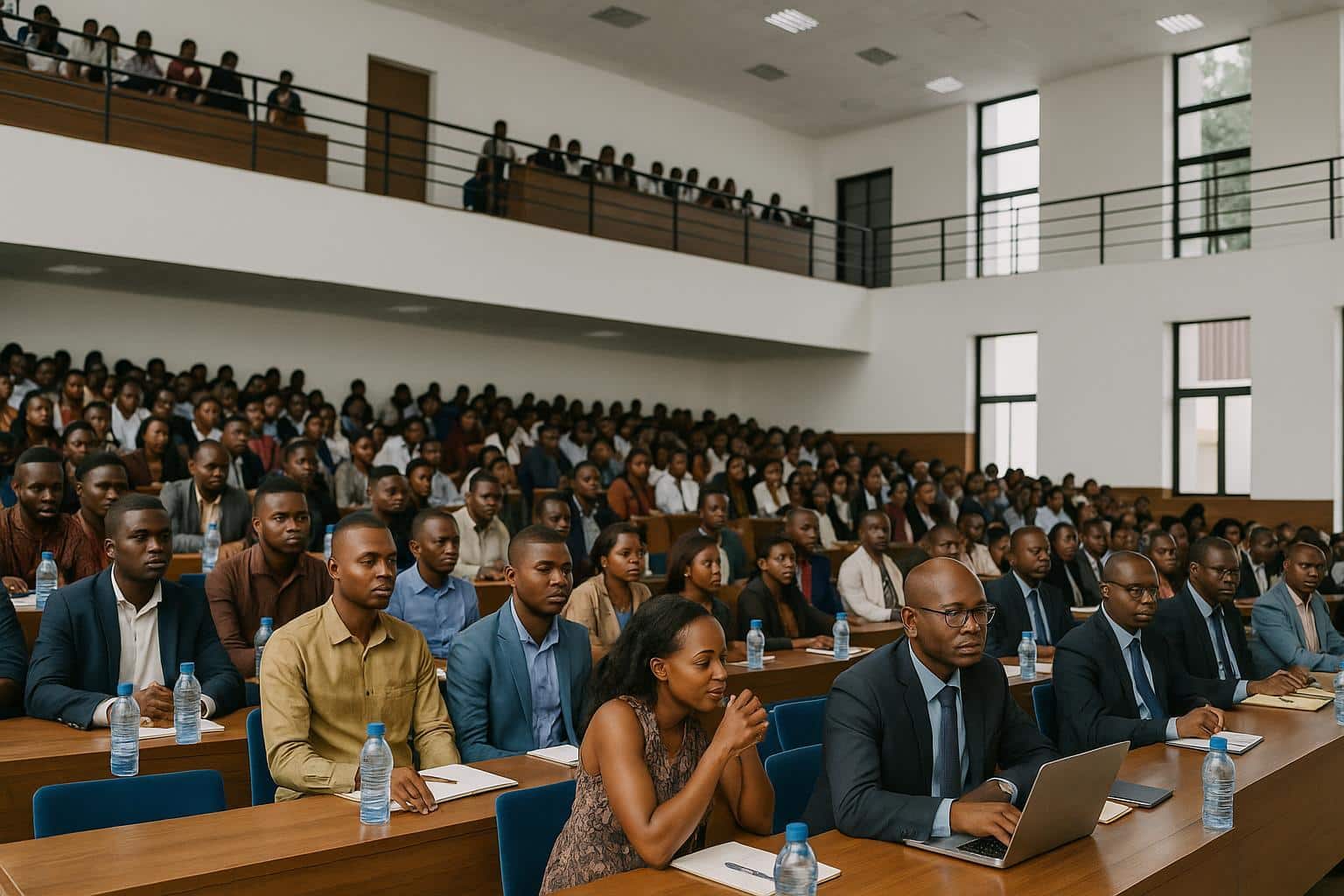
Kintélé forum urges swift housing action
A packed auditorium at Kintélé’s Higher Institute of Architecture, Urbanism, Building and Public Works turned a routine commemoration of World Habitat Day into a pointed appeal: Congo’s cities need safe, affordable, climate-resilient housing, and they need it fast.
The 6 October interactive debate brought together architects, engineers, students and officials from Brazzaville and Pointe-Noire, two urban centres where population growth regularly outpaces infrastructure upgrades.
Participants asked the State and development partners to treat decent housing as a pillar of human security, economic opportunity and social cohesion, rather than as a downstream spin-off of macroeconomic projects.
Their argument was framed around this year’s theme, “Responding to Urban Crises to Support Environmental Solutions,” a slogan that resonated deeply after a season of heavy rains that again left gullies, landslides and flooded streets across the capital.
Colonial blueprints struggle in modern Congo
Speakers stressed that Brazzaville’s and Pointe-Noire’s original master plans, drafted during the colonial period, were never designed for today’s two-and-a-half-million residents.
Road grids have spilled beyond their mapped edges, drainage canals stop abruptly at informal settlements, and zoning codes remain silent on new materials or energy efficiency.
Urban planner Grâce Moukassa noted that modernising those blueprints would cost less than retroactively repairing damage from erosion and sand encroachment, problems that now threaten municipal budgets.
Yet the revision process, which requires fresh cadastres, public consultations and inter-ministerial sign-off, has advanced slowly, illustrating what one attendee called “the price of waiting”.
Climate pressure heightens urban vulnerability
Professor Narcisse Malanda, citing Environment Ministry data, reported that Congo’s average temperature has climbed 0.07 percent over the past half-century, a seemingly small rise amplifying rainfall volatility.
The country ranks forty-eighth on global vulnerability indexes and eighth among those least prepared for climate shocks, he noted, while annual population growth hovers near ten percent.
“Landslides, flooding and sand intrusion uproot families, who then rebuild on ever more fragile slopes,” Malanda warned, calling the cycle a form of silent displacement that burdens public schools, clinics and transport corridors.
He linked the pattern to what he termed “urban conflicts”—a phrase used locally to describe legal, social and environmental disputes arising when property boundaries overlap with flood zones or conservation areas.
Financing inclusive, resilient neighbourhoods
Conference resolutions urged the government to accelerate drainage projects by rehabilitating the main water collectors that once kept Brazzaville’s hillside neighbourhoods stable.
Delegates also pushed for the rebuilding of vulnerable quarters, an update of the urbanisation code and a review of building typologies so that new homes fit both the terrain and residents’ purchasing power.
Several interventions highlighted the need for concessional financing that could make green materials, such as laterite blocks or insulated roofing sheets, affordable to small constructors.
Speakers argued that aligning housing policy with Congo’s industrial-isation agenda would stimulate domestic production of such inputs and create jobs, anchoring the concept of resilience in local value chains.
Professionals prepare next generation of builders
Architects in attendance reminded the audience that their professional code already tasks them with deploying expertise in post-disaster settings, drafting plans that respect site morphology and material availability.
“Our obligation is preventive, not merely reactive,” said architect-lecturer Diane Ngoma, who tutors first-year students using case studies from the Mayanga landslides.
She praised the Ministry of Higher Education for recently broadening curricula to include geotechnical mapping and climate modelling, tools she believes could shrink the gap between lecture halls and municipal engineering departments.
By the session’s close, organisers pledged to compile the day’s recommendations into a white paper for submission to the Ministry of Construction, a move they said would convert discussion into policy pathways.
Economic dividends and community momentum
Economist Jean-Claude Matondo underscored the opportunity cost of inaction, estimating that each kilometre of eroded roadway in Brazzaville diverts freight traffic and increases consumer prices by up to five percent during the rainy season.
He framed the proposed housing push as macroeconomic stimulus, not charity, arguing that stable mortgages and predictable rent support small merchants’ access to credit.
From the donor perspective, representatives of an international NGO present but preferring anonymity said future grants would privilege projects demonstrating community co-financing, a model they believe reduces maintenance gaps.
Municipal officials, for their part, hinted that forthcoming by-laws could require property developers to integrate green corridors or recharge basins, drawing lessons from pilot zones in Ngoyo district.
Youth groups in the audience welcomed the prospect, insisting that design competitions, urban farming rooftops and open-source mapping platforms should feature in the final policy slate to foster civic ownership.
Analysts believe the white paper could dovetail with the government’s existing National Development Plan, providing a tangible annex on urban resilience commitments already budgeted.
For residents like Pierrette Loufoua, a market vendor who lost her home to a gully in Massengo, the timeline matters less than seeing drainage works break ground before next year’s rains.