
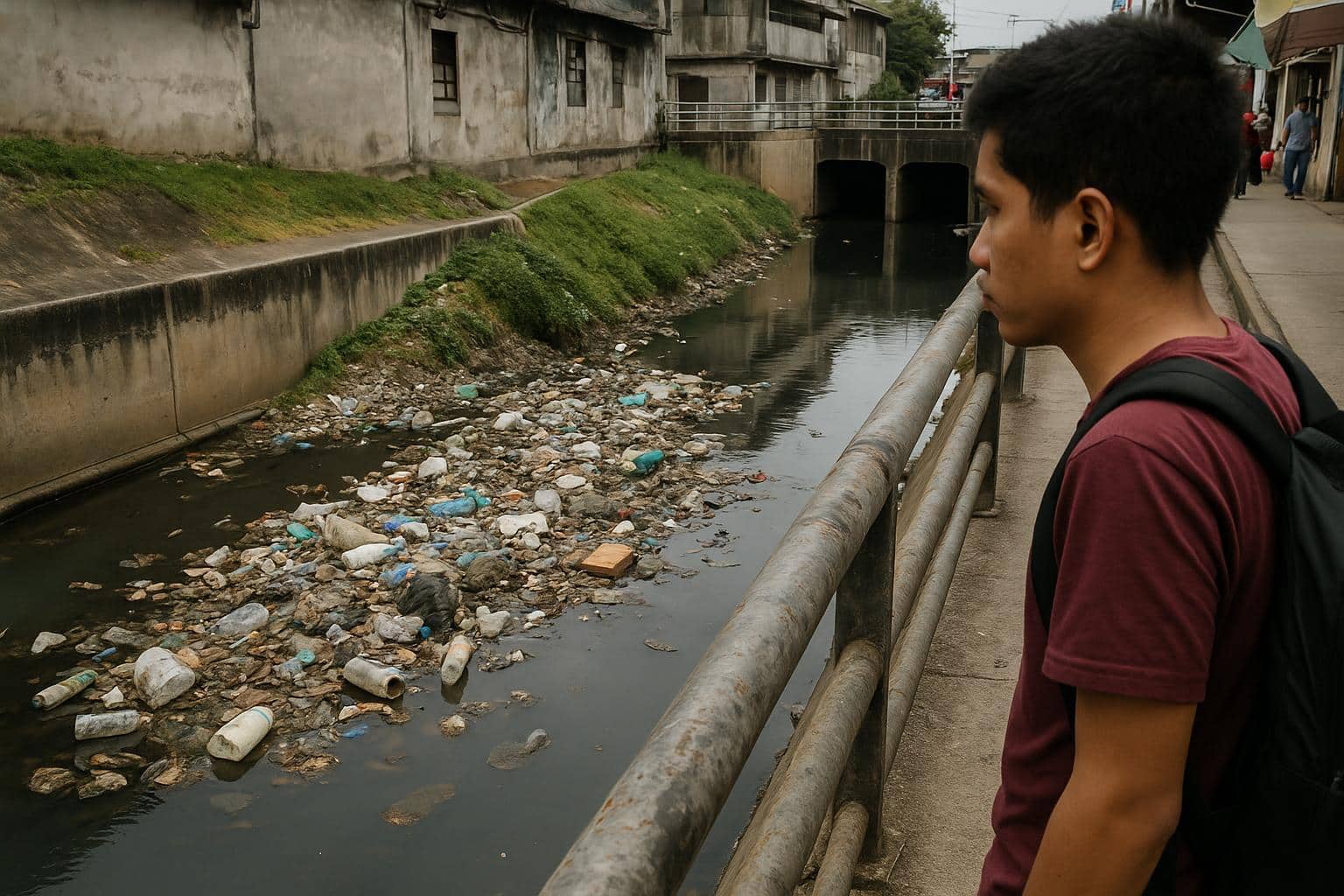
Brazzaville drainage dilemma persists
From Mpila to Poto-Poto, the wide concrete gutters built to shepherd Brazzaville’s tropical downpours towards the Congo River are again shimmering with plastic bags, spoiled food and household debris, despite repeated pleas from municipal loudspeakers and televised appeals.
Sanitation officials argue that the drainage network, rehabilitated at significant public cost, cannot perform its hydraulic role while continuing to receive domestic waste, a practice that turns a preventive infrastructure into a vector of disease and urban degradation.
Health risks from waste-clogged collectors
In June, the Ministry of Health confirmed a cholera outbreak that has already claimed 35 lives among 500 recorded cases, underscoring how stagnant water mixed with refuse becomes an incubator for Vibrio cholerae after only a few hours of sunlight.
The national malaria control programme reports that mosquito-borne fever still accounts for 42 percent of deaths, 71 percent of consultations and 56 percent of hospitalisations nationwide, figures that rise in neighbourhoods where drains have become open dumps.
Government strategy under Minister Mondélé
Faced with this dual sanitary and environmental threat, Minister of Urban Sanitation, Local Development and Road Maintenance Juste Désiré Mondélé initiated in August a new phase of cleaning works, publicly insisting that the investment will succeed only if residents change their habits.
During the launch ceremony, the minister framed the campaign as a collective responsibility, affirming that the state had provided the equipment, but ‘the decisive machinery remains citizen discipline’, a statement replayed on national radio and echoed by local chiefs.
Mondélé also unveiled a graduated enforcement mechanism: offenders caught discarding litter in collectors face initial detention at police stations where hygiene lessons are delivered, followed by court-mandated community service focused on removing solid waste from the very channels they polluted.
Enforcement and civic education drive
Police commissioner Jules Oba, interviewed beside the Talangaï canal, explained that patrol units now coordinate with neighbourhood committees, allowing quick verification of reports transmitted through messaging groups, a model inspired by earlier traffic management initiatives.
Early operations have led to several warnings and two brief detentions, according to the municipal prosecutor, who nevertheless emphasises education over punishment, pointing to the limited capacity of courts and the importance of building trust between authorities and households.
Civil society groups such as Association Main Verte welcome the dialogue, but urge greater provision of communal bins and regular collection, arguing that behavioural change is unlikely where the nearest legal dump site may be more than a kilometre away.
Community perspectives and challenges
At the Ouenze market, vendor Clarisse Ngoma recounts losing merchandise during last season’s floods when blocked drains forced water across the stalls, yet she admits discarding peelings in the gutter during peak hours, citing the absence of sweepers.
Sociologist Aimé Mbemba interprets this contradiction as a resilience strategy: ‘People prioritise immediate earnings over collective hygiene because the cost of missed sales is visible, whereas the health risk is deferred’, he notes after conducting focus groups in three arrondissements.
Nonetheless, Mbemba observes growing pride among youth volunteers who wore government-supplied gloves and masks during the August cleanup, suggesting that visible state partnership can shift norms when backed by tangible resources.
Expert views on urban sanitation
Public health specialist Dr. Caroline Moukassa underlines the multiplier effect: ‘Each kilogram removed from a canal eliminates breeding grounds for disease vectors, reduces flood exposure and saves the government downstream treatment costs that are orders of magnitude higher’.
She adds that regular monitoring indicators, including water turbidity and larval density, could guide future budget allocations, allowing evidence-based advocacy compatible with the national development plan and the president’s emphasis on preventive healthcare.
Toward sustainable drainage maintenance
Infrastructure engineers within the Ministry highlight that collectors were dimensioned for rainfall projections dating from the 1980s and now face both higher runoff volumes and unexpected solid loads; periodic dredging remains essential even under ideal civic behaviour.
The current campaign therefore integrates mechanical excavation with hand sorting, a method that preserves reinforced walls and enables informal recyclers to recover plastics, creating short-term employment while extending the life span of public works.
Funding originates from the national budget supplemented by an African Development Bank grant secured last year, according to Treasury officials, underscoring the international confidence attracted by transparent project management and measurable sanitation targets.
Balancing rapid urbanisation and public health
Urban planners note that Brazzaville’s population has doubled in two decades, outpacing formal waste services; integrating private collectors and promoting separation at source are viewed as complementary pillars to the minister’s enforcement-led framework.
As the rainy season approaches, authorities express cautious optimism that the combined effect of dredging, civic education and targeted sanctions will allow storm water to flow freely, protecting both public health and the economic pulse of the capital.