
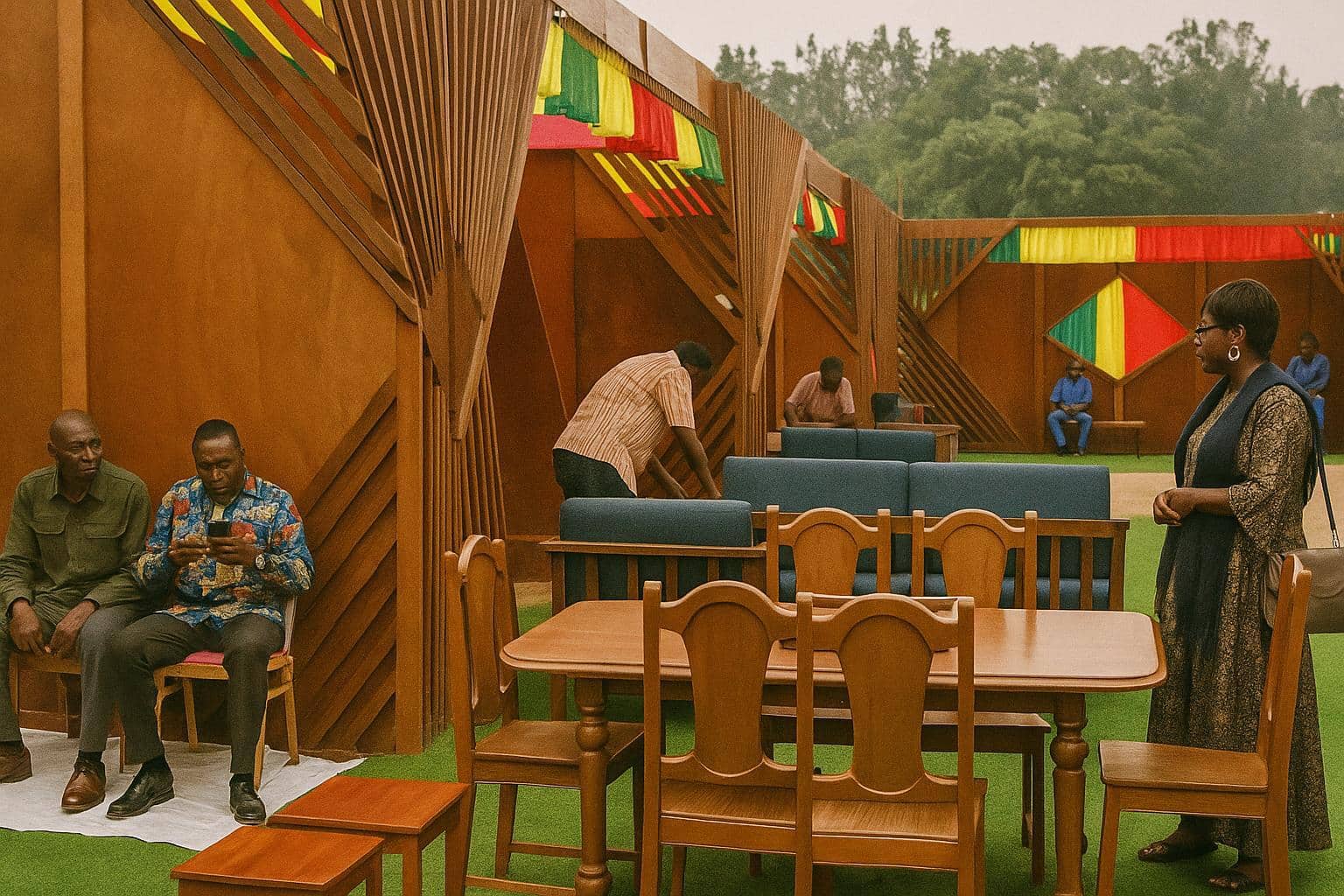
Brazzaville Hosts Vibrant Woodcraft Fair
Beneath the shade of towering sapelli trees, the fourth Congo Wood Trades Fair opened in Brazzaville on 11 August, extending until 25 August, and featuring more than a hundred stands where chisels clack and varnish glistens under warm equatorial light.
Organized under the aegis of the Ministry of Small and Medium Enterprises, the show gives carpenters, sculptors and designers a rare central stage in a nation where oil often dominates the headlines and investment portfolios.
Officials estimate that more than five thousand visitors, including diplomats and regional investors, will stroll the alleys before closing day, sampling forest aromas while negotiating future orders.
Artisans Blend Tradition and Modern Demand
At stand twenty-seven, master carpenter Raoul Mayembé compares a factory-milled chair with his hand-joined mahogany version, inviting buyers to weigh identical pieces in their palms; the artisanal model remains lighter yet sturdier, an argument he hopes will seduce urban professionals furnishing new apartments.
Nearby, designer Jaurès Bantsimba presents sleek telephone cradles carved from bubinga off-cuts, explaining that Congolese desks rarely accommodate imported plastic stands; his wooden alternative fulfils the same function while echoing the reddish hues prized in Central African interiors.
Textile artist Pascal Ngalibo, equally innovative, weaves and paints raphia panels that depict village dances, then stitches them into handbags; he smiles, noting that each fiber is harvested without felling a single tree, thus placing non-timber forest products in the limelight.
Economic Stakes of Congo’s Timber Value Chain
Timber once topped Congo’s export list until offshore crude reshaped national accounts in the 1970s; yet the sector still contributes around five point six percent of gross domestic product, according to economist Alphonse Ndongo, providing formal jobs to roughly twenty-five thousand workers countrywide.
Beyond direct employment, sawyers, truckers and port handlers earn complementary income, while municipal authorities collect market fees that fund water supply and waste services in secondary towns such as Ouesso and Dolisie.
Analysts from the African Development Bank note that finished wood furniture yields quadruple the value of raw logs; fairs like SAMEB therefore encourage entrepreneurs to climb the processing ladder, capturing margins that historically escaped to factories in Asia or Europe.
Government Vision for Sustainable Forestry
The Ministry of Forest Economy has pledged to ban log exports by 2025, a timeline reiterated during the fair’s opening ceremony by Minister Rosalie Matondo, who argued that domestic mills can absorb production while creating rural clusters of carpentry workshops.
A new code requires concession holders to replant one hectare for every two harvested, and to leave corridors for wildlife migration; satellite monitoring financed by the Central African Forest Initiative will track compliance in real time, officials said.
Industry representatives welcome the clarity, though they still request smoother customs procedures and cheaper electricity to keep local prices competitive with imports from Asia, a point echoed by Chamber of Commerce president Paul Obambi in a sideline interview.
International Outlook and Market Diversification
Diplomatic visitors from Gabon, Cameroon and the Democratic Republic of Congo toured the aisles seeking cross-border partnerships; several expressed interest in joint labels that would guarantee legal timber across the Congo Basin, an initiative aligned with forthcoming European Union due-diligence rules.
According to the International Trade Centre, artisanal furniture exports from Congo rose ten percent last year, reaching thirty-two million dollars; embassy commercial attachés attending SAMEB view the trend as proof that niche branding, rather than bulk commodities, can attract foreign currency.
Closing sessions will spotlight digital marketing tutorials, teaching artisans how to photograph pieces for e-commerce platforms popular in Houston and Guangzhou, thereby extending the spirit of the Brazzaville fair well beyond Congolese borders.
Prospects for Diversified Growth
Economist Ndongo cautions that furniture cannot replace petroleum overnight, yet contends that each diversified franc shields public revenue from crude price swings; he cites Malaysia’s experience, where downstream timber now covers school budgets once financed by oil.
Asked about the next steps, Minister Matondo told reporters that a national design institute will open in 2024, pairing veteran craftsmen with engineering students to refine joinery and reduce waste, an approach she believes will ‘marry art with science for export readiness’.
For the moment, the buzz inside the fairground signals an optimism difficult to quantify but easy to feel; sawdust may cling to attendees’ shoes, yet many leave convinced that Congo’s forests hold not only trees, but ideas capable of reshaping its economy.
A working group led by Prime Minister Anatole Collinet Makosso is drafting incentives for banks to extend longer tenure loans to workshops, allowing better machinery acquisition and smoothing cash flow between seasonal contracts, according to a cabinet note shared with exhibitors.
If adopted, the scheme could reduce borrowing costs by three points, bankers say, further aligning Congo’s craft sector with continental ambitions under the African Continental Free Trade Area, whose tariff reductions favor value-added goods over unprocessed raw materials.