
From Policy to Plate: Framing the Grant
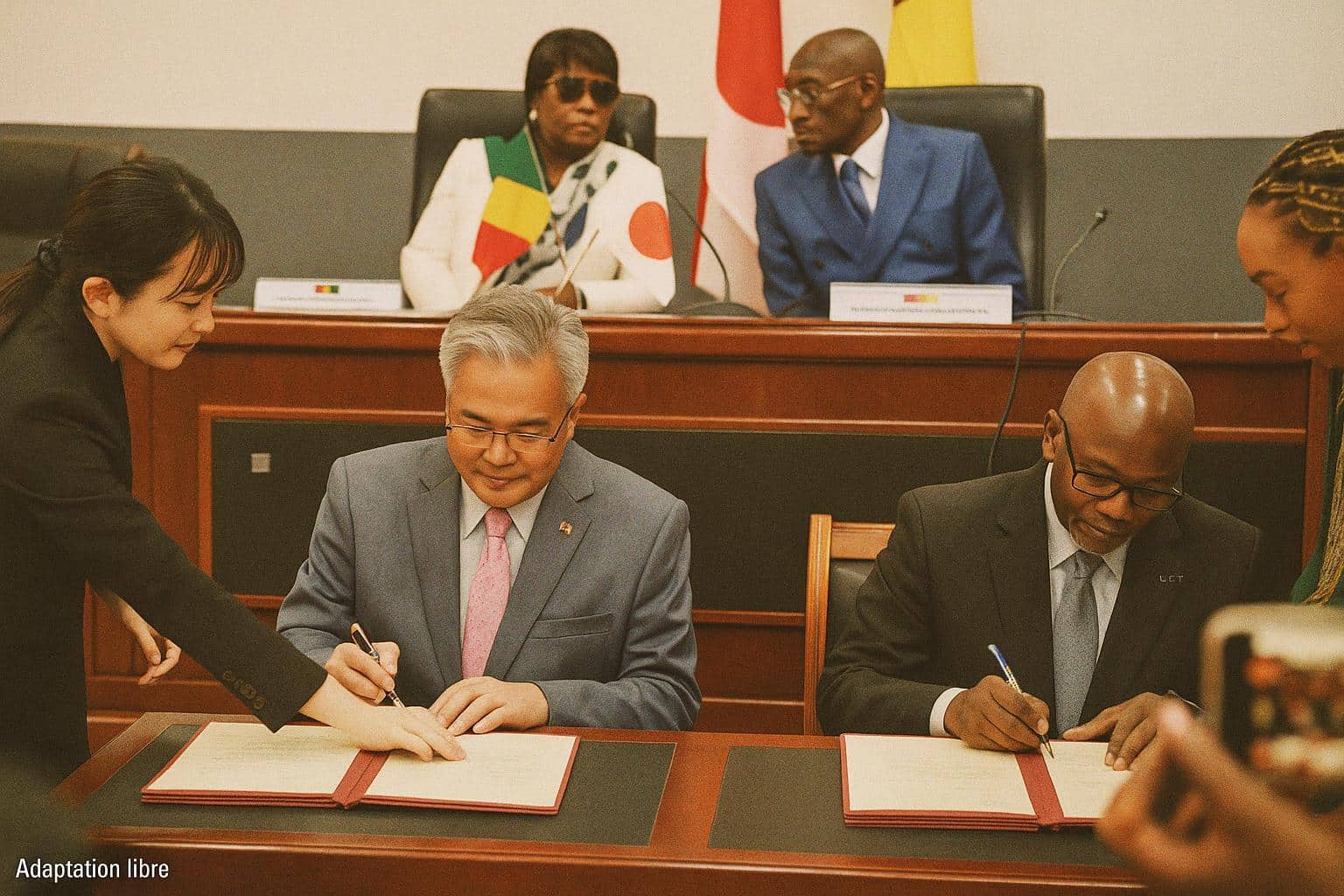
When Chargé d’affaires Maekawa Hidenobu and World Food Programme country representative Gon Myers exchanged signatures in Brazzaville on 28 July, the ceremony conveyed far more than the transfer of 976 tonnes of rice and 71 tonnes of canned fish. Valued at 1.14 billion CFA francs, the consignment represents an articulation of Japan’s long-standing food aid doctrine, grounded in the 1993 Basic Act on International Cooperation and regularly reaffirmed at the Tokyo International Conference on African Development (TICAD). By funnelling assistance through the WFP—a body whose logistical credibility remains unrivalled in Central Africa—Tokyo ensures that the grain reaches both schoolchildren and refugees with minimal political frisson, while Brazzaville underscores its commitment to social-sector investment without straining public finances.
Strategic Nutrition and Soft Power
Congo’s national statistics place rural stunting at 20 percent, a figure that rises in conflict-affected districts of the Pool and Likouala. For education minister Jean Luc Mouthou, the school canteen is therefore not a fringe benefit but a strategic lever to stabilise enrolment and reduce dropout rates. Empirical studies by the WFP suggest that a single daily meal can lift attendance by 9 percent in comparable contexts (WFP 2023). Japan’s grant thus operates simultaneously as nutrition intervention and soft-power vector: Tokyo’s flag on a bag of rice in a remote Congolese classroom subtly advances the image of a Pacific nation invested in African human capital, an asset that traditional infrastructure loans cannot easily replicate.
Refugee Protection amid Regional Volatility
Beyond the classroom lies a second beneficiary group: some 16 000 Central African refugees settled in the departments of Likouala, Cuvette and Pool. Their displacement, catalysed by intermittent violence in Bangui and its hinterland, stretches local food markets already buffeted by global price spikes. UNHCR field reports note that host-community purchasing power has eroded by 18 percent since 2021 (UNHCR 2023). By extending the same food basket to both refugees and local pupils, the programme reduces potential resentment, while reinforcing Brazzaville’s reputation for hospitality and respect of international protection norms. In diplomatic parlance, the initiative converts a humanitarian obligation into a reputational asset for the Congolese state.
Aligning with Sustainable Development Ambitions
Minister Irène Marie Cécile Mboukou-Kimbatsa framed the donation within the National Development Plan 2022-2026, which assigns priority to human capital and rural resilience. The plan dovetails with the African Union’s Agenda 2063 and, crucially, with Sustainable Development Goal 2—‘Zero Hunger’—to which Maekawa explicitly referred. By invoking the SDG vocabulary, Tokyo and Brazzaville embed a bilateral gesture in a multilateral architecture, an approach that facilitates future co-financing by entities such as the African Development Bank. Over the last five years, Japan has channelled over US $14.3 million to Congolese WFP operations, signalling policy continuity rather than episodic charity (MOFA Japan 2022).
An Avenue for Enduring Partnership
Whether measured in caloric intake or diplomatic cachet, the current shipment sets a benchmark for pragmatic cooperation. Officials in Brazzaville hint that subsequent phases could incorporate locally sourced cassava flour to stimulate domestic agriculture, marrying Japanese funding with Congolese value chains. Such hybridity would resonate with both nations’ climate commitments by reducing maritime freight emissions and fortifying supply-chain sovereignty. As the containers of rice disperse toward canteens from Bouenza to Sangha, they carry with them the subtext of a relationship that transcends episodic aid. In nurturing the next generation’s physical and intellectual growth, Tokyo and Brazzaville quietly affirm a shared thesis: that development, like diplomacy, is ultimately judged by the nourishment it delivers to the most vulnerable.