
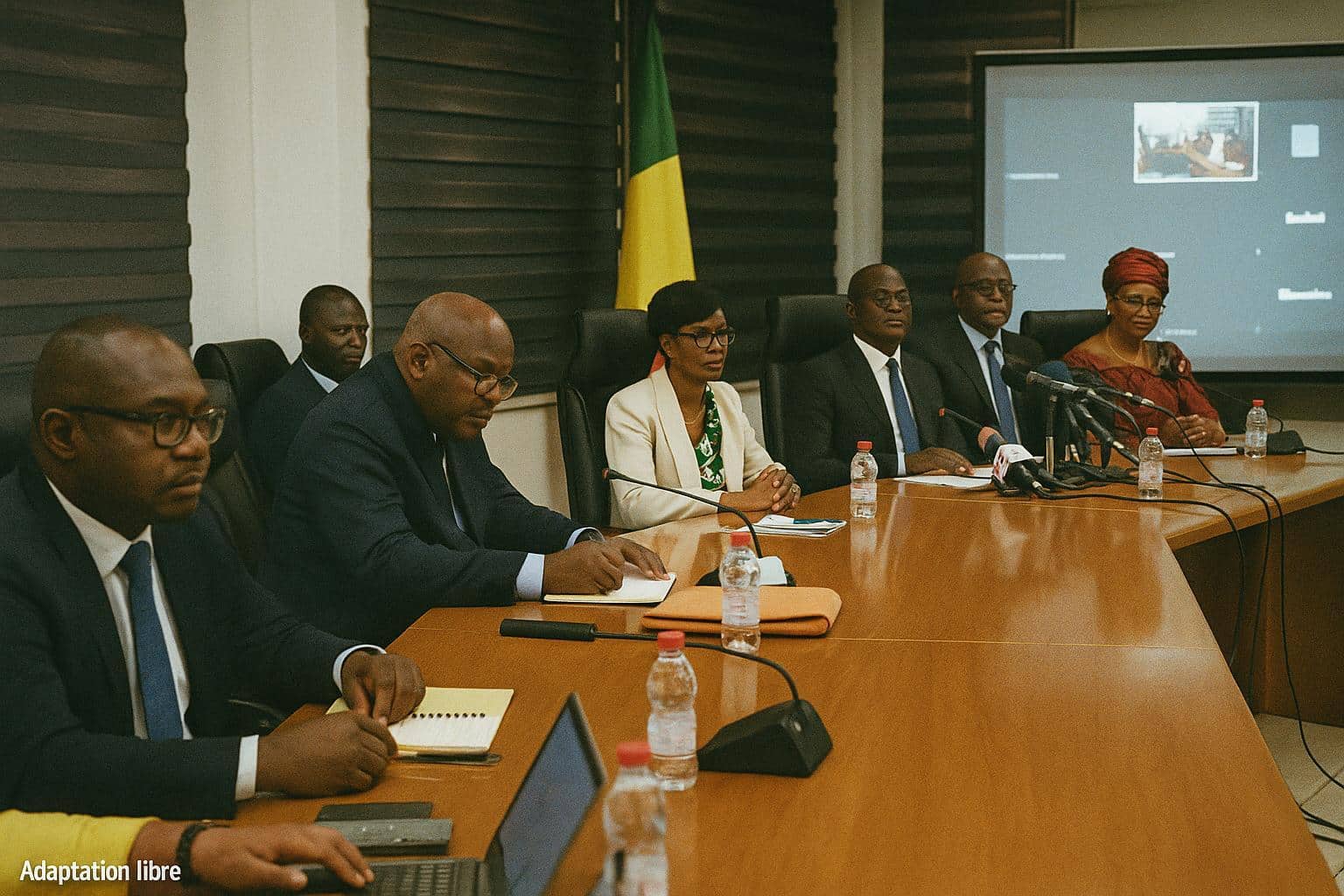
Renewed resolve after the Brazzaville session
At the close of last weekend’s second annual session of the Congo-Brazzaville branch of the Extractive Industries Transparency Initiative, Finance Minister Christian Yoka sounded an unambiguous note. Surrounded by senior officials, company representatives and civil-society delegates, he declared that the national committee would finalise and publish its 2025 activity report no later than December. The statement, delivered in Brazzaville’s marble-lined conference hall, was less a routine administrative target than a public pledge to the international marketplace that the Republic intends to remain within the norms of good governance.
Observers from diplomatic missions present at the meeting read the calendar as a signal from President Denis Sassou Nguesso’s government that the momentum gained since Congo re-joined EITI in 2012 must now crystallise into measurable outcomes. According to the EITI International Secretariat’s 2023 Progress Report, the domestic oil and mining sectors account for more than half of fiscal revenue, making transparency a macroeconomic rather than merely technical requirement.
Strategic calendar towards the 2025 dossier
The timeline unveiled in Brazzaville is deliberately compressed. Drafting teams are to complete data reconciliation for 2023 and 2024 by late September, leaving the fourth quarter for independent assurance and stakeholder endorsement. Government technocrats stress that the schedule dovetails with the fiscal cycle, enabling Parliament to integrate findings into the 2026 budget debate. International partners, including the African Development Bank, view the synchronisation as a welcome effort to close the traditional gap between revenue disclosure and policy decision-making.
Yet the calendar also acknowledges political economy realities. An Article IV consultation published by the International Monetary Fund in June 2022 pointed to residual vulnerabilities in public-finance management, especially as hydrocarbon receipts fluctuate with global prices. By committing to a fixed publication date, Congo aims to mitigate perceptions that transparency milestones can slip when commodity markets turn.
Institutional architecture and permanent commissions
A salient outcome of the session is the creation of three permanent commissions: Data Quality, Civil-Society Engagement and Capacity Building. The commissions are expected to operate under a streamlined mandate approved by the Prime Minister’s Office, granting them access to ministerial databases and company ledgers. Stakeholder interviews conducted after the meeting suggest that the new architecture responds to long-standing requests from local non-governmental organisations for clearer lines of accountability.
Florent Michel Okoko, the national committee’s secretary-general, argues that the commissions will reduce bureaucratic latency. He notes that draft terms of reference already require quarterly reporting to the executive committee, a feature intended to pre-empt the informational bottlenecks that delayed previous reports. Industry participants, including senior managers from ENI Congo, privately concede that predictable data requests help companies plan their own audit cycles, thereby lowering compliance costs.
Balancing corrective measures with domestic realities
Despite the accelerated roadmap, Brazzaville officials acknowledge that the international EITI Board still classifies Congo under ‘meaningful progress with considerable improvements needed’. The designation stems from twelve corrective actions set in 2022, ranging from beneficial-ownership disclosure to systematic publication of production volumes. Okoko concedes that several measures remain in partial fulfilment, but emphasises that the committee has one full year before the next validation window opens.
Diplomats stationed in the capital underline that the margin is realistic. They point to comparable trajectories in Mauritania and Côte d’Ivoire, where similar corrective portfolios were closed within eighteen months once political buy-in was secured. In the Congolese case, the Ministry of Hydrocarbons has already introduced a draft decree obliging all contract annexes to be published in the Official Gazette, a move that exceeds the minimal EITI standard and could facilitate early closure of two outstanding actions.
Regional dynamics and investor perceptions
West-Central Africa’s energy landscape is evolving, with new projects in Namibia and Senegal reshaping capital flows. In that context, rating agencies have highlighted regulatory predictability as a determinant of country risk premiums. By publicising a precise publication date for its next report, Congo positions itself to retain its share of exploration budgets amid intensifying competition for foreign direct investment. A senior analyst at S&P Global, speaking on condition of anonymity, remarked that a timely report could shave up to forty basis points off Congolese sovereign spreads if accompanied by complementary fiscal discipline.
For regional partners, the forthcoming report serves as a litmus test of how seamlessly domestic institutions convert lofty transparency rhetoric into auditable deliverables. The CEMAC Commission, which is finalising its own extractive-governance guidelines, views Congo as a bellwether given its mature petroleum base. Successful validation would therefore carry influence beyond national borders.
Measured optimism for the December deadline
Congo-Brazzaville’s commitment to publish the 2025 EITI activity report before year-end frames the coming months as a sprint rather than a marathon. The executive committee’s decision to embed permanent commissions and align reporting with the fiscal calendar responds to critiques voiced by both international partners and domestic watchdogs. While significant corrective tasks remain, the convergence of political will, institutional scaffolding and investor interest provides a conducive environment for success.
Should the December deadline be met, Brazzaville will not only satisfy the letter of the EITI Standard but also demonstrate practical ownership of the transparency agenda. For a hydrocarbon-rich state navigating a post-pandemic recovery, that demonstration could exert a stabilising influence on macroeconomic planning, reinforce diplomatic credibility and, crucially, reassure citizens that extractive wealth is managed in the open.