
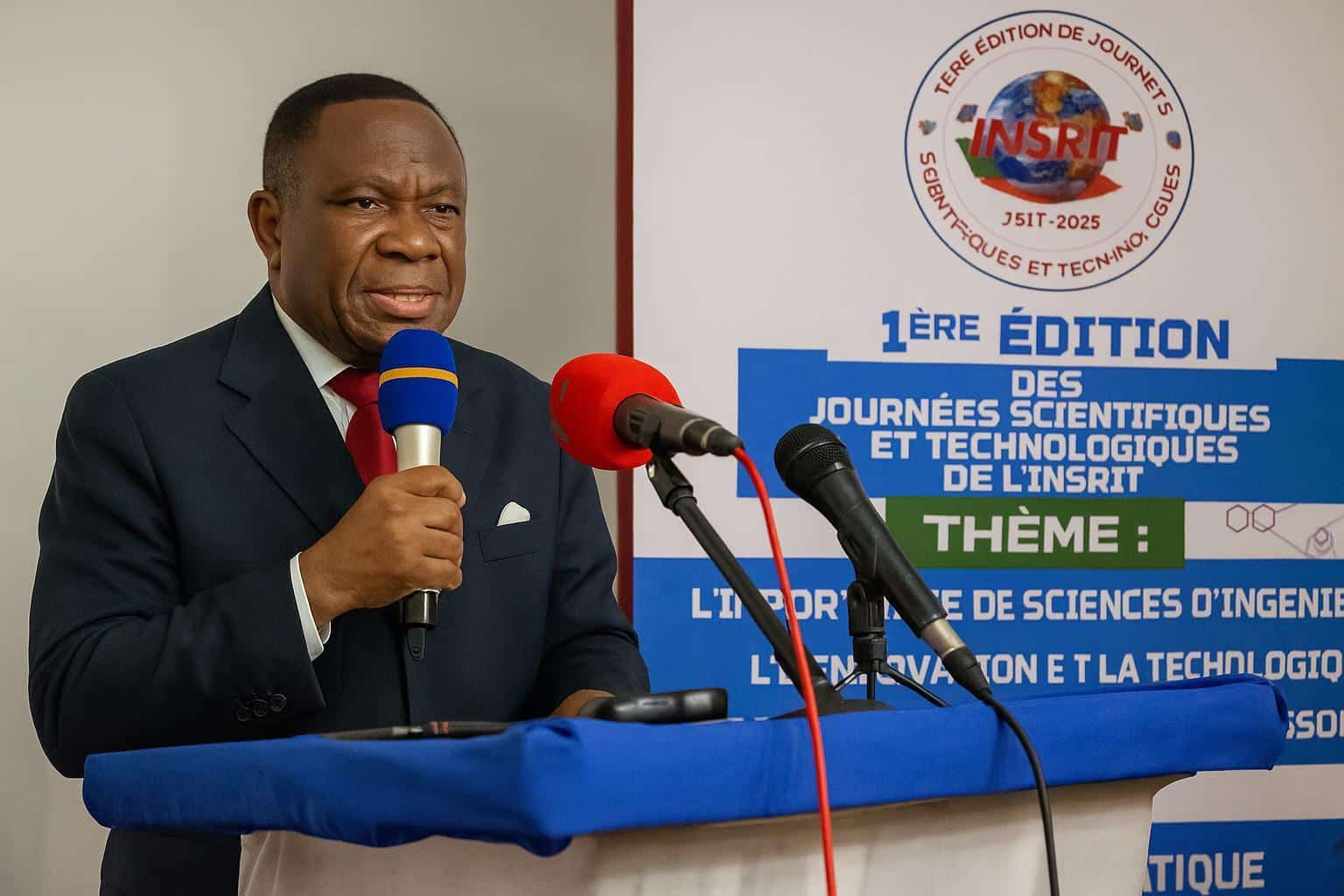
Brazzaville opens first Science and Technology Days
At the international conference hall of the ministry compound in Brazzaville, applause rose as Research and Technological Innovation Minister Rigobert Maboundou declared open the country’s inaugural Science and Technology Days on 9 October, setting an ambitious tone for Congo-Brazzaville’s knowledge-based future.
Under the theme “The importance of engineering sciences, innovation and technology in adding value to natural resources”, the multi-day forum aims to showcase domestic research, galvanise young inventors and align laboratories with the government’s diversification agenda.
“Our greatest wealth is the intelligence of citizens,” Maboundou told a hall packed with students and industry leaders, exhorting youth to see prosperity as a direct function of commitment to study, invention and entrepreneurial science.
Showcasing national expertise and priority sectors
Researchers from Marien-Ngouabi University, the National Institute for Research in Social Sciences and Industrial Technology and several agrifood companies joined delegations from Cameroon and Gabon, reflecting a regional appetite for collaborative solutions to shared development challenges.
Panels delve into food security, local commodity processing, and responses to climate-induced shocks—issues singled out by the National Development Plan 2022-2026 as critical to raising non-oil GDP and meeting continental commitments under the African Union’s Agenda 2063 (National Development Plan 2022-2026).
“By valorising know-how and raw materials we build a competitive, durable economy,” stated Michel Elenga, director-general of the institute, while unveiling prototypes of cassava-based bioplastics and mobile solar dryers designed by doctoral candidates from the Pointe-Noire campus.
Youth innovation takes centre stage
In side corridors, high-school finalists of the first national robotics challenge tweaked code on 3D-printed drones able to monitor bushfire fronts. A jury of Congolese and Japanese engineers will award start-up grants, sponsored by the Africa Digital Open Lab platform.
Public-private partnerships power value addition
Petrochemical major Coraf and timber producer IFO signed memoranda of understanding to grant researchers controlled access to industrial sites, mirroring successful public-private research incubators in Rwanda and Côte d’Ivoire, according to Jean-Paul Okonda, adviser at the Chamber of Commerce.
For officials, such collaboration could curb the long-standing practice of exporting unprocessed timber and manganese. “Even a modest rise in local transformation lifts jobs and tax revenue,” noted economist Grâce Mbemba, citing government estimates that each percentage point of downstream integration adds 1,000 direct posts.
Funding and infrastructure for research growth
The Ministry of Finance earmarked 8.3 billion CFA francs for applied research this fiscal year, a 12 percent increase over 2023, reflecting what observers view as a gradual pivot from hydrocarbon dependence toward knowledge-led growth, in line with AfDB recommendations (AfDB).
Another indicator of momentum is the planned launch of a 15-hectare science park on the outskirts of Brazzaville, slated for groundbreaking early next year. According to project coordinator Jacqueline Tchibota, the zone will host incubators, a data centre and pilot factories for agro-industrial scaling.
Digital connectivity is central to the initiative. State-owned Congo Telecom announced fibre links to the campus, promising gigabit speeds that could support cloud-based simulations and remote sensing applications. “Bandwidth must no longer be a barrier for researchers,” chief executive Serge Gbikpi said on the sidelines.
Climate stewardship and health security research
Climate scientists attending stressed that Congo’s 23 million hectares of rainforest give it both a stewardship responsibility and a comparative research advantage. Lab-scale data on carbon sequestration could, they argue, underpin future issuance of verified forest credits.
Another hot session focused on epidemic preparedness. Virologist Sabine Goma showcased a portable genomics kit capable of sequencing pathogens in field clinics within four hours, technology she said could shorten response time during haemorrhagic fever alerts in remote departments.
Toward a Central African knowledge economy
CEMAC delegates proposed harmonising intellectual-property regulations to ease cross-border patent filing. “A Central African patent court would cut costs for innovators and deter counterfeit imports,” argued Cameroonian jurist Armand Koum at a round table moderated by the Economic Commission for Africa (Economic Commission for Africa).
Beyond regionalism, the event attracted the French National Research Institute for Sustainable Development and China’s Beihang University, both exploring joint MSc programmes. Maboundou emphasised that partnerships remain non-exclusive, “guided solely by artisanal relevance and national interest”.
Women represented nearly 40 percent of registered participants, according to organisers. Electrochemist Clarisse Mabiala attributed the figure to recent scholarship schemes and the visibility earned by Congo’s team at last year’s Pan-African Women in STEM Olympiad in Tunis.
Roadmap for a national science policy
A closing communiqué due on Monday will set up a task force to draft a national science policy bill for cabinet review before year-end. Consultations will include private sector and civil society to ensure the text aligns with Sustainable Development Goals.
Whether in lab coats or business suits, participants share a conviction voiced by Maboundou at the opening: Congo’s next growth chapter hinges less on wells or mines than on ideas, and the first Science and Technology Days seek to ignite them.
The ministry intends to publish an annual science indicator report tracking patent filings, citations and commercial spinoffs, a tool Maboundou believes will anchor accountability.