
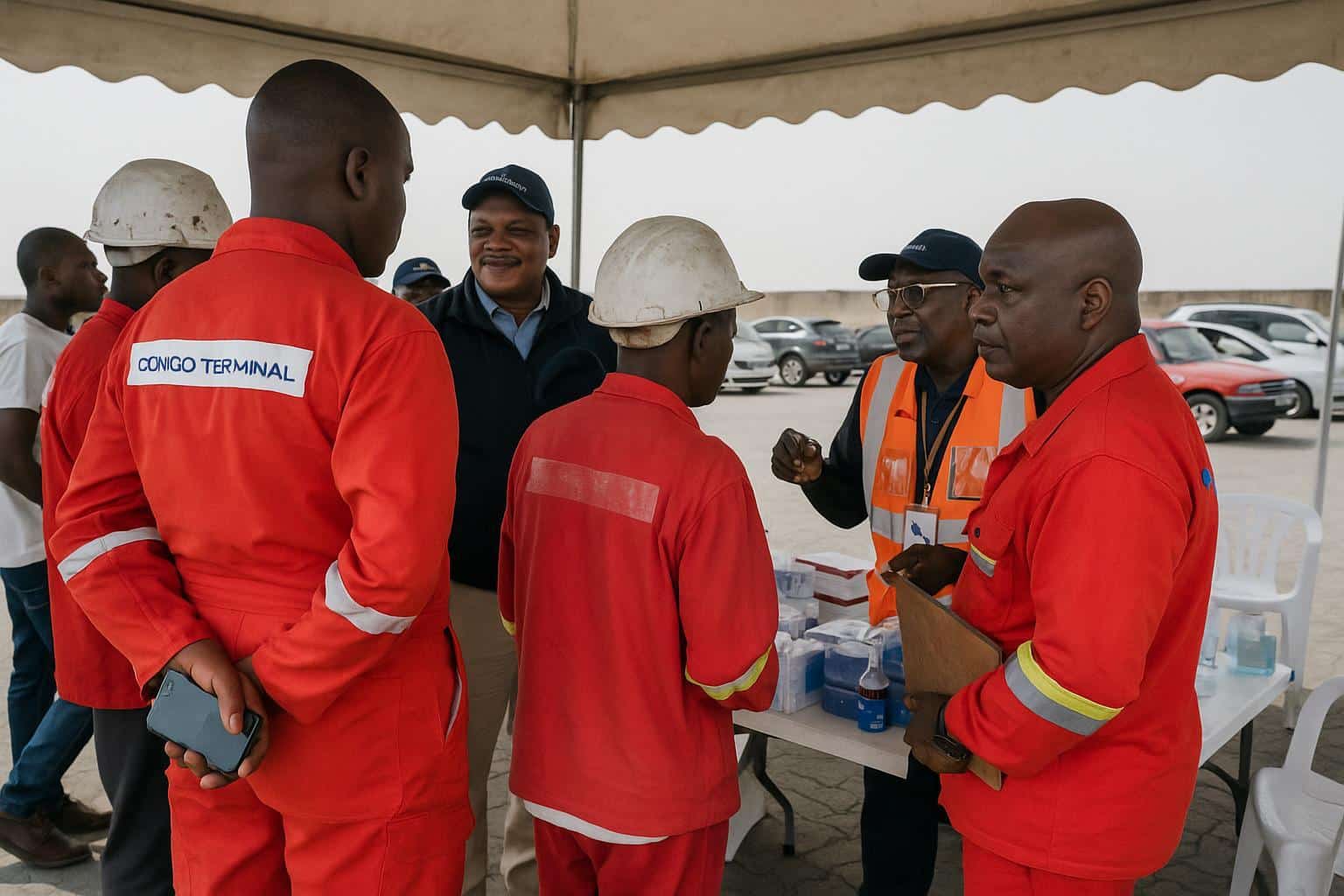
Port turns red for World AIDS Day
On World AIDS Day 2025 the loading docks of Pointe-Noire’s container terminal turned into an open classroom, as peer educators wearing bright red ribbons moved from crane cabins to canteens, speaking with more than 900 colleagues about the realities of HIV and the simple steps that save lives.
The campaign, organised by Congo Terminal, the country’s main port operator and a subsidiary of Bolloré Africa Logistics, aimed to reinforce a health culture that management believes is essential to productivity as well as social responsibility for both the port community and the city’s wider economy.
Peer educators deepen their training
Before stepping onto the quaysides, the peer educators spent two intensive refresher sessions with company medical adviser Dr Eléazar Céleste Massamba, who reviewed the latest treatment protocols, emphasised early testing and reminded volunteers that language matters when busting persistent myths surrounding the virus.
“HIV is not a death sentence, yet that does not give anyone licence to flirt with danger,” Dr Massamba told the group, insisting that abstinence, mutual fidelity or correct condom use remain the frontline defences that workers should champion inside and outside the port walls.
Congo Terminal’s health cell has relied on peer-to-peer dialogue since 2008, arguing that colleagues may absorb difficult information more readily from familiar faces than from outside lecturers. That network now includes welders, crane operators, accountants and cleaners, mirroring workforce diversity and softening cultural barriers to frank discussion.
Mobile booths extend prevention message
World AIDS Day offered an ideal moment to test that theory on a larger scale, with four mobile booths stationed near the container yards where employees could ask questions, pick up educational leaflets or sign up for voluntary counselling and testing scheduled later in the month at the on-site clinic.
Behind the scenes the communication department produced short video clips in Lingala and French that circulated on internal messaging platforms, underscoring the central message that knowing one’s status is a gesture of responsibility towards family, colleagues and the national effort to curb new infections.
Condom distribution underscores commitment
Patricia Ekey-Misse, regional head of communication and sustainable development for Congo and Angola, said the port’s logistical discipline translated naturally into public-health discipline, explaining that “international observances are occasions to act, not only to speak” as she supervised the distribution of sealed packs of male and female condoms.
By dusk more than 12,000 units had been handed out, enough for every employee to leave with at least a dozen, reinforcing a triple call to abstain, remain faithful or protect. Staff delegates said such generous stocks remove excuses and ease tension within couples facing tight household budgets.
Longshoreman Armand Ngoma, collecting his package after a late shift, said the gesture showed management viewed workers as “partners, not just labour”, adding that he would bring extra pamphlets home to discuss with neighbours and, he hopes, persuade friends to attend the next testing session.
Government sees port as health gateway
The initiative aligns with government priorities that place workplace programmes at the centre of national prevention, according to health officials who point to the strategic importance of the deep-sea port for both trade and population movements, noting that the site channels goods to the entire CEMAC sub-region.
They argue that a single infected truck driver can unknowingly seed rural transmission chains, making interventions at transport hubs a cost-effective firewall for public health budgets already under pressure and helping the Republic meet its contribution to continental targets championed by the African Union.
Data-driven follow-up ensures impact
Congo Terminal managers say measurable impact will be assessed in quarterly surveys that anonymously track testing uptake among staff and in subcontractor firms, data that feed into wider dashboards compiled by the port authorities and the Ministry of Health, ensuring transparency and guiding future budgets.
Previous editions of the programme, launched in 2014, have coincided with gradual increases in voluntary testing, rising from 28 percent of employees in 2015 to 46 percent during the most recent internal audit, according to figures shared informally by health officers during the refresher course.
While the numbers remain short of the global 95-95-95 targets, port executives stress that behavioural change is rarely linear, and that sustained, locally-led messaging stands a better chance of carving away stigma than sporadic mass campaigns parachuted in from outside organisations.
Conversations keep momentum alive
As cranes continued stacking containers against the Atlantic skyline, the red ribbons pinned on many uniforms served as a quiet reminder that the fight against HIV begins not in distant laboratories but in everyday conversations among colleagues determined to safeguard future and that of the Republic of Congo.
Management has already pencilled a mid-year follow-up event focused on stigma in healthcare settings, signalling that the World AIDS Day momentum will not fade with the calendar but evolve into a year-round safety culture entwined with the port’s growth strategy.