
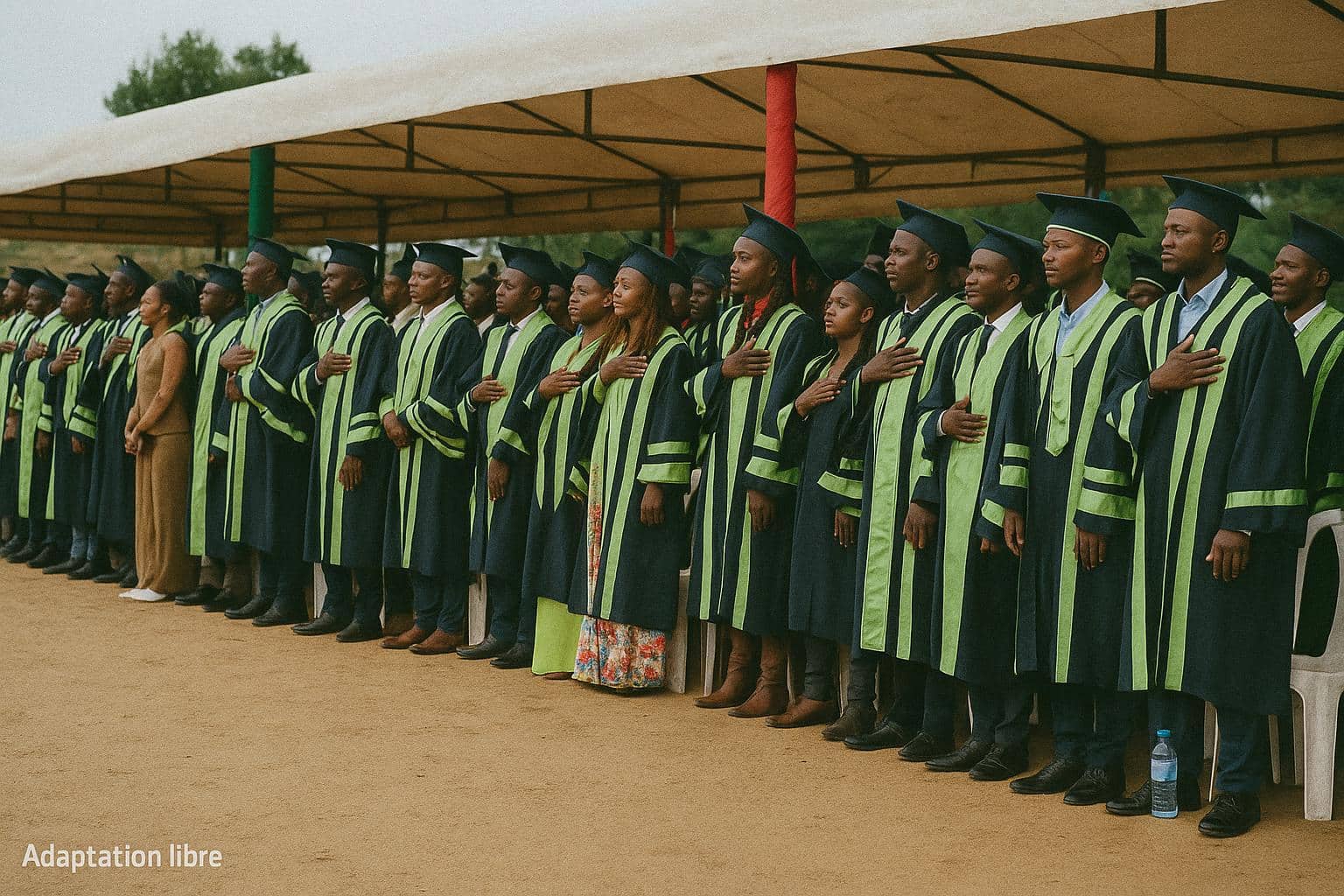
Ceremonial diplomacy in Kintélé
The vast amphitheatre of Denis-Sassou-Nguesso University was awash with academic regalia as 405 students, drawn from architecture, engineering and the environmental sciences, received their licence and master diplomas. Prime Minister Anatole Collinet Makosso presided over the proceedings, framing the ceremony as an inflection point in the Republic of Congo’s journey toward emergence. In a carefully calibrated address, he described the graduates as “custodians of the national trajectory”, a phrase that both acknowledged their individual achievement and situated it within a wider agenda of state-led modernisation.
A statistical portrait of achievement
Behind the choreography of academic pomp lie figures that warrant diplomatic attention. The university’s overall pass rate of more than 97 percent aligns favourably with continental benchmarks reported by the Association of African Universities (2023), while the flawless 100 percent success recorded at the Institute of Architecture, Urbanism, Building and Public Works offers a salient indicator of programmatic robustness. Such metrics nourish Brazzaville’s ambition to lift its Human Capital Index standing, currently measured at 0.42 by the World Bank (2022), toward the sub-Saharan median. They also answer critics who once questioned the feasibility of launching a new public university during an extended period of fiscal consolidation.
Human capital as an economic hedge
The ceremony occurred against the backdrop of volatile hydrocarbon markets that have long shaped Congo-Brazzaville’s macro-economic fortunes. Diversification therefore remains more than a talking point; it is a policy imperative reiterated in the National Development Plan 2022-2026. By privileging disciplines such as geographic information systems, renewable energy engineering and landscape design, UDSN graduates are positioned to supply the skills demanded by infrastructure concessionaires, green-growth investors and regional urban-planning initiatives tied to the African Continental Free Trade Area. As Minister of Higher Education Emmanuelle Delphine Edith observed, the university has now reached its “cruising speed”, allowing government to translate educational investment into measurable gains in productivity.
Institutional consolidation and quality assurance
President of the university Professor Ange Antoine Abena used the occasion to outline four thematic research clusters—climate resilience, smart infrastructure, biodiversity management and computational modelling—echoing priorities identified by UNESCO’s Science Report (2021). Concurrently, a new internal quality-assurance charter brings the institution in line with the African Standards and Guidelines for Quality Assurance. The immediate recruitment of the three highest-ranked master’s graduates as junior faculty further embeds a culture of meritocracy and local capacity building, a formula endorsed by the African Development Bank in its recent Skills for Employment and Productivity brief.
Regional resonance of knowledge diplomacy
Diplomats stationed in Brazzaville quietly note that the rise of UDSN coincides with a broader soft-power recalibration. Educational cooperation agreements signed with universities in Rwanda, Morocco and China over the past two years provide exchange pathways that complement traditional Francophone networks. The university’s School of Mines, Hydraulics and Energy, inaugurated earlier this year, is being courted by prospective partners from the Gulf Cooperation Council eager to pilot low-carbon extraction technologies in Central Africa. Such linkages transform campus milestones into vectors of regional influence, reinforcing Congo’s positioning as a mediator between resource-rich neighbours and technology-exporting economies.
From parchment to practice
Student-union president Thierry Ngouama offered a pragmatic coda, urging public agencies and private conglomerates alike to absorb the new diploma-holders. His appeal finds empirical support in labour-market forecasts issued by the International Labour Organization (2023), which predict a 7 percent annual increase in demand for mid-level professionals in Central African construction and logistics. Equipped with theses on coastal-erosion mitigation, multimodal transport and gender-responsive public architecture, the graduates stand poised to contribute substantively—provided that recruitment pipelines remain unclogged by procedural inertia.
Strategic implications for policy makers
For decision-makers in Brazzaville and beyond, the latest commencement at Kintélé functions as both mirror and compass. It reflects the incremental consolidation of a national higher-education ecosystem conceived less than a decade ago, and it points toward strategic avenues for leveraging human capital in service of diversification, regional integration and sustainable development. In the measured words of Prime Minister Makosso, “Excellence is not merely an accolade; it is our geopolitical instrument.” In the corridors of diplomacy, that instrument now carries 405 additional signatures.