
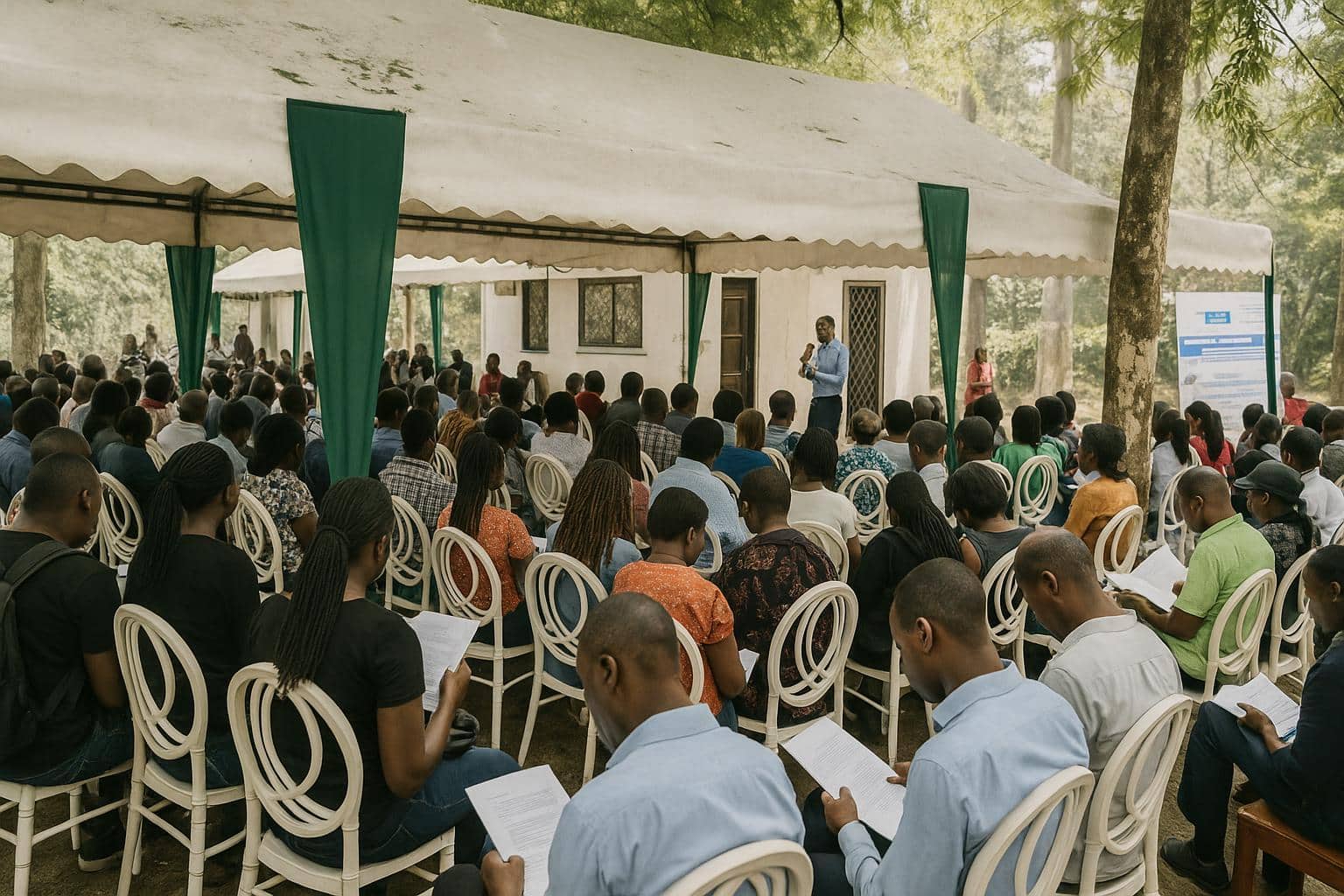
Brazzaville Science Days set the scene
The packed auditorium of the National Institute for Research in Engineering Sciences, Innovation and Technology buzzed on 10 October as the institute opened its first Science and Technology Days. Scientists, students and entrepreneurs came from across the country, determined to shine a light on local ingenuity.
Over two days, plenary talks, thematic sessions and laboratory exhibitions traced a picture of Congo’s research landscape. Participants moved between posters on agro-processing, panels on natural-resource valuation and demonstrations of emerging digital tools, underscoring the breadth of ideas in play.
Few doubted the event’s broader purpose. Organisers sought to build momentum behind a national conversation on how research can drive sustainable transformation, a priority that now sits high on the government’s development agenda.
Minister Maboundou outlines urgent priorities
Opening the meeting, Research Minister Rigobert Maboundou spoke in measured but direct terms. “It is urgent to invest in local research if we wish to secure Congo’s durable transformation,” he told the hall, drawing firm applause from delegates.
Maboundou argued that stronger laboratories could unlock value across agriculture, mining and services. He praised innovators already working in isolation, yet cautioned that their impact remains limited without predictable funding streams and coordinated policy support.
According to the minister, broadening the country’s knowledge base is now a matter of economic resilience. “Sustainable growth will come from ideas conceived and tested here,” he stressed, pointing to global supply-chain shocks that have heightened the need for local solutions.
Funding gap dominates hallway conversations
The financial question resurfaced in almost every corridor discussion. Researchers trade stories of promising prototypes stalled by the cost of reagents, sensors or patent fees. Several speakers noted that public allocations for science, though steady, still stand below levels recommended by continental benchmarks.
Panelists suggested competitive funds, fiscal incentives for firms partnering with universities and a dedicated line for equipment renewal. These proposals converged in a draft communique intended for ministries overseeing economy, finance and higher education, a sign that scientists want their recommendations translated swiftly into budget cycles.
Home-grown ingenuity on display
Inside the exhibition hall, visitors clustered around a compact unit that turns organic waste into cooking gas. Its creator, young technician Glimar Mbougou, demonstrated the device’s steady flame with evident pride. “Households can refill here when butane runs out,” he explained, before adding that mass production will require seed capital.
Elsewhere, agronomists presented nutrient-fortified cassava flour, and software developers unveiled a prototype platform for tracking timber provenance. Each booth told the same story: ideas are plentiful, but scaling them is costly without structured support from banks, investors and the state.
Researchers craft a reform roadmap
Arnaud Wenceslas Geoffroy Tamba Sompila, INRSIIT’s scientific director, closed the sessions by reading a concise list of recommendations. The text urged reinforcement of local-research financing mechanisms, upgrading of national laboratories with modern equipment and creation of incubators to smooth technology transfer and scientific entrepreneurship.
Tamba Sompila thanked ministries already partnering with INRSIIT yet insisted that broader engagement is needed. He framed the proposed measures not as a wish list but as “an investment in Congo’s competitiveness in the Central African sub-region.”
Youthful energy signals rising potential
Many attendees left inspired by the determination of students who took the microphone. Final-year engineering candidates spoke of staying in Brazzaville rather than seeking posts abroad—provided career paths in R&D become viable.
Their optimism, however, remains conditional. As one graduate whispered while photographing laboratory equipment, “We need more than events; we need resources.” That sentiment, repeated by peers, illustrates the stakes if funding delays persist.
From conference hall to policy agenda
With the closing ceremony over, attention now shifts to how quickly the conference communique reaches cabinet discussions. Organisers hope the timing aligns with upcoming budget revisions, offering a practical window for new allocations.
Officials close to the process say work is underway to map priority projects and identify potential co-financiers among development banks and private partners. While details are still under review, the direction appears set: channel more capital toward research that can translate into jobs.
For scientists who showcased work on 10 October, that prospect cannot come soon enough. They return to their benches encouraged by high-level backing yet mindful that momentum can fade without concrete follow-through.
As delegates filed out onto Avenue de l’Amitié, one refrain lingered: Congo’s sustainable future may well depend on how decisively the nation answers Maboundou’s call for bold investment in its own ideas.