
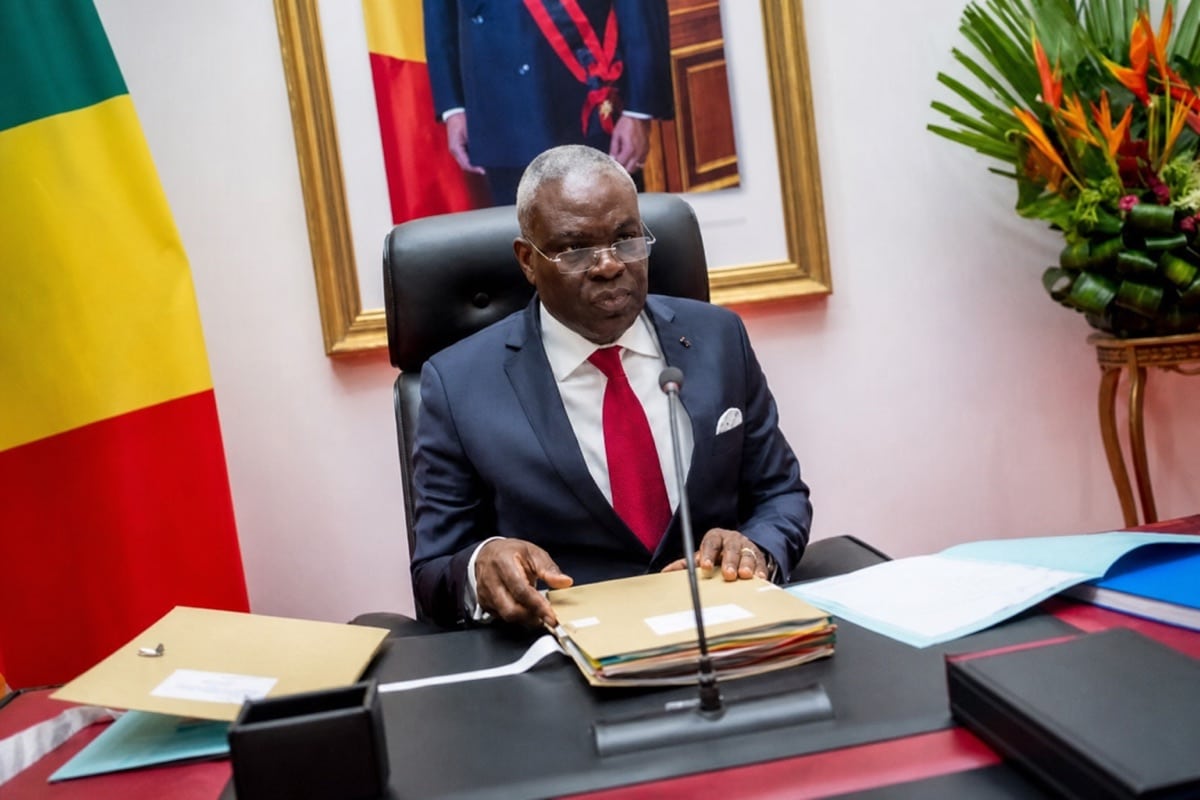
A new government always carries the weight of expectation, and the team led by Anatole Collinet Makosso felt it from its opening hours. On Wednesday, April 29, 2026, in Brazzaville, the Makosso II cabinet convened its first working session, formally beginning its mandate.
A First Sitting That Signals the Tone
The meeting gathered ministers around the head of government for what amounted to an inaugural roll call of intentions. Each official used the moment to outline the priorities attached to their portfolio, sketching the contours of the work ahead in the Republic of the Congo.
The agenda read like a catalogue of the country’s most stubborn challenges. Ministers spoke of modernizing infrastructure, strengthening a strained health system, and reforming education. Governance and economic diversification rounded out a list that left little doubt about the scale of the task.
Ministers Press for Speed and Coordination
What emerged from the interventions was less a set of finished plans than a shared posture. Members of the cabinet expressed a common will to act quickly and in concert, framing coordination as the precondition for any meaningful progress during their tenure.
That insistence on speed carried a political subtext. The ministers tied their urgency to the expectations of ordinary Congolians, who are waiting for tangible improvements rather than declarations. The emphasis fell repeatedly on concrete results, the kind that citizens can measure in daily life.
In a young administration, such language is partly ritual. Yet the repetition matters. By foregrounding delivery over rhetoric at the very first sitting, the cabinet appeared eager to define itself by outcomes, aware that early impressions tend to harden into reputations.
A Working Method Built on Rigor
The session did more than rehearse priorities. It also fixed a method of work, resting on rigor, interministerial collaboration, and an obligation of results. Those three principles were presented as the operating logic that should govern how the government conducts its business.
The choice of words is telling. Rigor implies discipline and accountability. Collaboration across ministries acknowledges that the country’s problems rarely respect administrative boundaries. The obligation of results, the most demanding of the three, turns ambition into a standard against which the cabinet invites judgment.
Such a framework was described as essential to reinforce the impact of public policies. The reasoning is intuitive enough. Policies designed in isolation often falter at implementation, and a government that coordinates from the outset stands a better chance of seeing its decisions reach the people they target.
Whether the principle survives contact with practice is another question. Interministerial cooperation is easier to proclaim than to sustain, and competing budgets and mandates can erode the best intentions. The cabinet, for now, has at least named the discipline it intends to impose on itself.
Anchored in the Presidential Vision
The executive’s action does not unfold in a vacuum. It sits within the vision carried by President Denis Sassou-N’Guesso, who has set out to consolidate growth and to improve, durably, the living conditions of Congolese citizens across the country.
That framing places the Makosso II government in a familiar position. Its mandate is to translate a presidential ambition into administrative reality, converting broad goals on growth and welfare into programs that departments can execute and that households can eventually feel.
The link also clarifies the political stakes. A cabinet that presents itself as the instrument of the head of state’s agenda accepts that its performance will be read as a reflection of that agenda. Success and shortfall alike will be measured against the president’s stated aims.
The Distance Between Words and Delivery
For all the talk of method and results, the first cabinet meeting was, by nature, a statement of intent. No initiative has yet been tested, no budget yet contested, no reform yet stalled. The session offered direction, not proof of capacity.
Still, the choice to begin with priorities and process rather than ceremony suggests a government conscious of the climate it inherits. The challenges it listed are long-standing, and the populations it cited are described as expectant. The cabinet has accepted both as its starting point.
The coming months will supply the only meaningful verdict. Infrastructure, health, and education do not improve through coordination meetings alone, and the obligation of results the ministers embraced will be theirs to honor or to explain away.
For now, the Makosso II government has done what first sittings are meant to do. It has named its ambitions, set a working discipline, and tied itself to a presidential vision. The harder work of proving that those commitments amount to more than an opening declaration still lies ahead.