
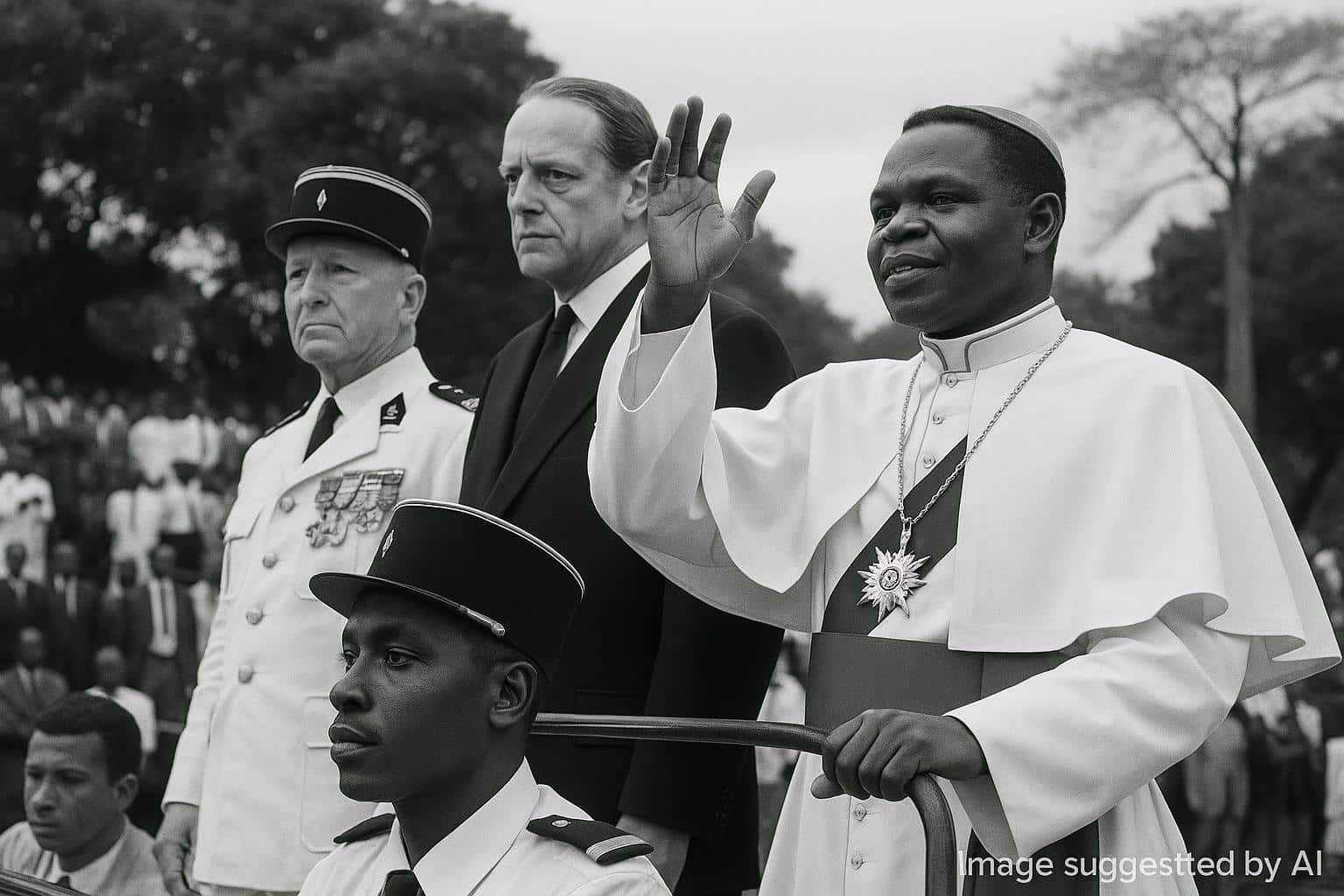
Brazzaville Awaits the Delegation
Long before the cannons roared, Brazzaville’s heat carried a different tension. On 14 August 1960, French minister André Malraux landed from Bangui, flanked by Jean Foyer, Jacques Foccart and Yvon Bourges. Eyewitness accounts describe curious crowds lining Avenue du Plateau, measuring the moment (Archives nationales françaises, 1961).
City officials had repainted public buildings, hung fresh tricolors beside the green-yellow-red of the future republic and rehearsed military bands at dawn. Governor-turned-host Emmanuel Damongo-Dangha later recalled that every spotlight was calibrated for newsreel cameras feeding Paris and Léopoldville alike (Oral History Project, Université Marien Ngouabi).
Diplomatic Gestures at Dusk
Ceremony opened with wreaths at the Félix-Éboué statue in Poto-Poto and the De Brazza memorial overlooking the Congo River. Malraux, a novelist before becoming minister, reportedly whispered to aides that symbolism matters as much as paperwork when empires recede (Malraux Papers, French Culture Ministry).
For President-elect Fulbert Youlou—a former priest turned politician—the itinerary offered a stage to demonstrate partnership rather than rupture. Local newspapers La Semaine Africaine and Le Messager Congolais ran identical headlines: “Friendship First.”
The Stroke of Midnight
Minutes before midnight, torchlights pierced the gardens of the Governor’s Palace, known today as the Palais du Peuple. Malraux and Youlou signed the transfer documents under an awning hurriedly erected to deflect tropical drizzle. French, African and Vatican envoys observed in near silence.
At 00:03, 15 August 1960, Youlou addressed the nation. “Our accession to independence is achieved in peace and unity,” he declared, timing his words so the new date appeared on every legal transcript. The 101 cannon shots that followed rattled windows from Bacongo to Talangaï.
Dawn of the Fifteenth
Sunrise introduced a softer ritual. Youlou, still in formal white jacket, and Malraux, wearing an untied cravat after a sleepless night, entered the basilica of Sainte-Anne for an 8 a.m. mass celebrated by Archbishop Michel Bernardin. Photographs show them sharing a hymnal, an image later reproduced on commemorative stamps.
Diplomats from Cameroon, Ghana and even Portugal’s Angola territory attended. According to Congolese historian Jean-Luc Mvoulou, their presence underscored Brazzaville’s emerging role as a mediator between newly free states and colonial holdouts.
Parliamentary Seal and Salutes
Late morning saw the Assembly convene its extraordinary session in Bacongo. Delegates ratified eleven cooperation accords covering defense, currency, telecommunications and education. Jean Foyer signed for France; Youlou counter-signed for Congo within 30 seconds, recorded by stenographers to underline procedural fluency.
Malraux then read Charles de Gaulle’s message, assuring that France “welcomes a brother into the concert of nations.” A brass band played La Marseillaise, immediately followed by La Congolaise. Observers recall that neither anthem stopped traffic; citizens had grown accustomed to rehearsals during the preceding week.
Echoes of De Gaulle
From the reviewing stand on Avenue Foch, Malraux framed the event as part of a broader decolonization architecture. “This night has sounded the solemn salute greeting the independence of peoples,” he proclaimed, echoing speeches delivered earlier in Bamako and Antananarivo.
Youlou responded that independence must couple reflection with celebration. He praised De Gaulle for steering Africa toward “liberty within friendship.” Political scientist Anicet Chimpa notes that such phrasing aimed to reassure both Paris investors and local trade unions wary of abrupt economic severance (Revue Politique Africaine, 1982).
Regional Reverberations
The festivities did not occur in isolation. Present in Brazzaville were Joseph Kasa-Vubu of the newly independent Congo-Léopoldville and emissaries from the Gabonese provisional cabinet, previewing regional organizations that would later become ECCAS.
Archival telegrams from the U.S. Embassy hailed the ceremony as a model of orderly transition compared with turbulence across the river in Léopoldville, where Patrice Lumumba struggled for control. Washington’s report credited French diplomatic coaching and Youlou’s clerical background for the calm.
Evening Toasts and Departures
A state cocktail at the Palais du Peuple closed the 15 August schedule. Menu cards featured French champagne beside cassava beignets, a deliberate pairing reflecting the new dual identity. Veteran journalist Henri Loemba wrote that conversations shifted quickly from nostalgia to trade credits and river-port modernization (Le Courrier d’Afrique, 1960).
By dawn on 16 August, Malraux boarded a DC-4 for Libreville after attending the inauguration of Square De Gaulle with Youlou and Kasa-Vubu. Witnesses note the French minister carried a sapelli-wood sculpture gifted by Brazzaville artists, later displayed at the Palais de la Porte Dorée in Paris.
Legacy for Contemporary Congo
Sixty-three years on, President Denis Sassou Nguesso frequently references the 15 August script in public addresses, framing current cooperation accords—from oil exploration to digital infrastructure—as modern extensions of those first signatures. Government communiqués still open with the phrase “in the spirit of 1960.”
Scholars debate whether that continuity constrains or stabilizes. Political analyst Merveille Makosso argues that ritualized homage offers diplomatic capital in Paris and Beijing alike, while civil society voices prefer broader diversification. Yet few contest that the midnight cannons forged a template for ceremony, negotiation and symbolism that endures in Congolese statecraft.