
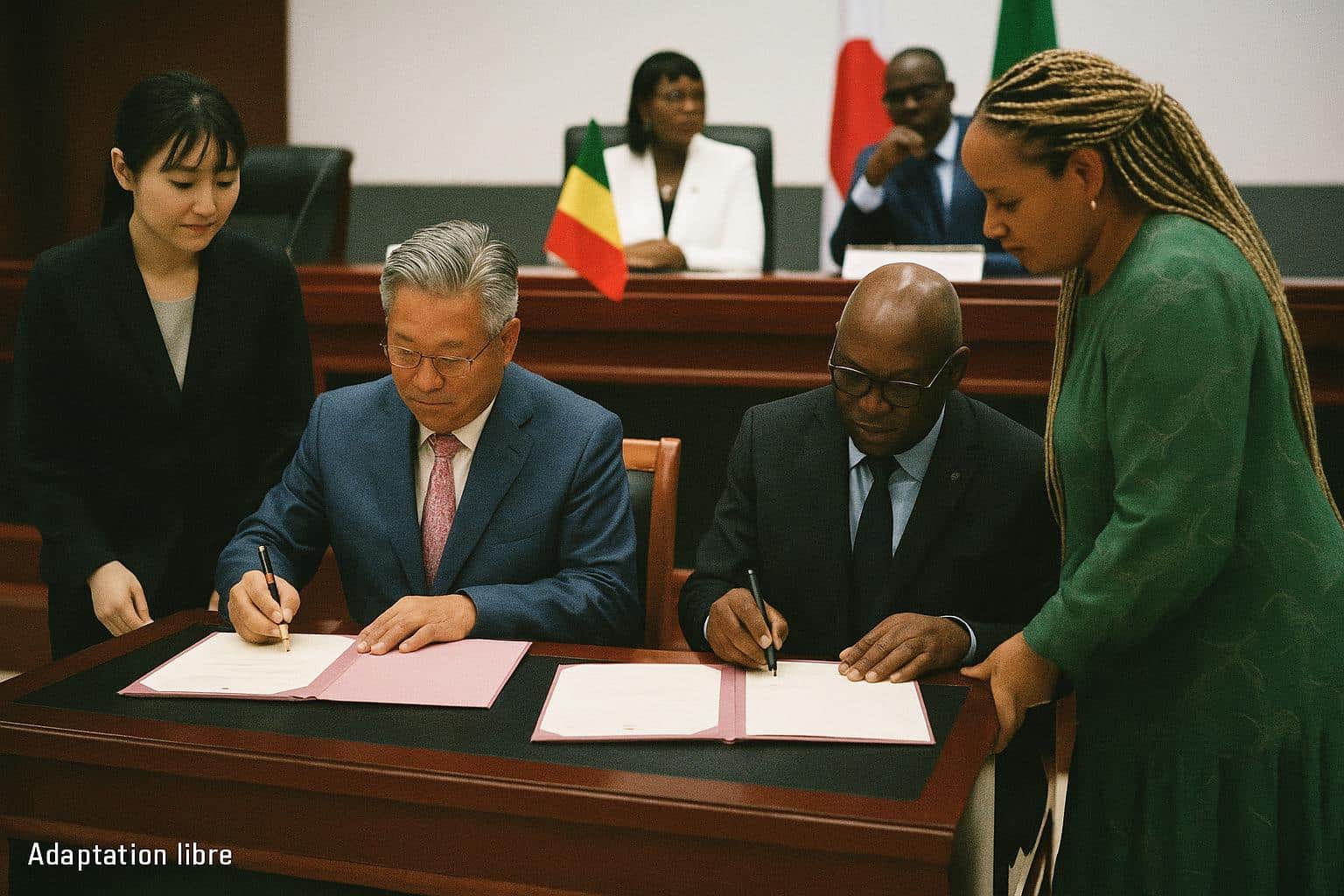
Humanitarian Diplomacy between Tokyo and Brazzaville
Few bilateral gestures reveal as much about contemporary humanitarian diplomacy as the decision by the Government of Japan to allocate an additional two million US dollars—roughly 1.14 billion CFA francs—to the Republic of Congo. Announced in Brazzaville on 28 July and channelled through the World Food Programme, the donation is emblematic of Tokyo’s patient yet steadily expanding footprint in Central Africa. Far from an isolated act of largesse, this pledge conforms to a five-year pattern during which Japanese assistance to WFP operations in Congo has surpassed 14.3 million dollars, according to the agency’s 2023 country brief (World Food Programme).
The timing is significant. Rising global food-price indices and the aftermath of the COVID-19 pandemic have magnified structural vulnerabilities across the Congo Basin. By buttressing Brazzaville’s efforts rather than supplanting them, Japan aligns itself with President Denis Sassou Nguesso’s call for “international solidarity that strengthens national ownership,” a phrase the Congolese leader reiterated during the most recent African Union summit.
Strengthening School Nutrition across Seven Departments
At the operational level, the new shipment—composed largely of rice and canned fish—will finance nearly seven million school meals over the next academic year, benefitting some 18 000 pupils in Bouenza, Cuvette, Lekoumou, Likouala, Plateaux, Pool and Sangha. National studies conducted by the Ministry of Primary Education indicate that enrolment rises by up to thirteen percentage points where a reliable canteen scheme exists. “A hot meal keeps a child in the classroom and a community anchored in hope,” observed Chargé d’Affaires Maekawa Hidendenobu during the hand-over ceremony.
Congolese officials credit previous tranches of the programme with contributing to measurable gains in attendance, particularly among girls. UNICEF’s 2022 Education Snapshot noted a six-point narrowing of the gender attendance gap in districts where WFP-supported canteens operate (UNICEF). By coupling caloric intake with educational persistence, the initiative dovetails with Brazzaville’s 2022–2026 National Development Plan, which assigns flagship status to human-capital investments.
Assisting Refugees and Bolstering Regional Stability
Beyond classrooms, the grant allocates rations to approximately 16 000 refugees and asylum-seekers concentrated in Likouala, Cuvette and Pool—borderlands that receive significant cross-border inflows from the Central African Republic and the Democratic Republic of the Congo. UNHCR counts nearly 55 000 persons of concern within Congolese territory (UNHCR, 2024). The supplemental food pipeline is thus more than a humanitarian courtesy; it is a stabilising factor for local markets susceptible to inflationary spikes whenever new arrivals strain supply chains.
Gon Myers, WFP Representative in Congo, framed the added resources as “a bridge between emergency relief and long-term resilience.” His characterisation resonates with regional security analyses suggesting that food insecurity, if left unmitigated, can exacerbate small-scale pastoral conflicts and undermine the Free Movement Protocol of the Economic Community of Central African States.
Brazzaville’s Coordinating Role and Ownership
The Congolese government has deliberately positioned itself at the centre of the coordination matrix, ensuring that imported commodities complement domestically produced staples such as cassava and groundnuts. The Ministry of Social Affairs confirmed that distribution lists are vetted through local committees chaired by sub-prefects, an approach intended to reinforce administrative legitimacy while reducing leakages.
This calibrated ownership carries political symbolism at a moment when Brazzaville is courting diversified partners to finance its Vision 2030 agenda. Japanese assistance therefore provides dual dividends: immediate nourishment for vulnerable populations and diplomatic capital for a government eager to showcase effective stewardship of foreign grants.
Tokyo’s Africa Policy: Soft Power with Strategic Undertones
Japan’s financial envelope, while modest compared to larger bilateral donors, conveys outsized influence through its reliability. Scholars of East Asian foreign policy note that Tokyo often privileges continuity over volume, an observation borne out by the rhythmic nature of its contributions to Congo since 2019 (Tokyo International Conference on African Development proceedings). Moreover, the choice to work through WFP respects the multilateral ethos that Tokyo champions at the United Nations, reinforcing rules-based cooperation in an era of contested aid governance.
In private conversation, a senior official at the Congolese Ministry of Foreign Affairs described the partnership as “a model of pragmatic multilateralism,” adding that negotiations are under way to expand collaboration into climate-smart agriculture—an area in which Japanese technical expertise is coveted.
Prospects for Consolidated Multilateral Action
Looking ahead, the sustainability of the school-feeding component will hinge on the ability of national authorities to transition gradually toward domestic financing. The current Medium-Term Expenditure Framework allocates 0.3 percent of GDP to social protection, a figure analysts at the African Development Bank believe could reach 0.5 percent without breaching fiscal-consolidation targets (African Development Bank, 2023).
For refugees, the imperative is twofold: maintain sufficient food stocks while advancing self-reliance projects such as market gardening and fish-pond cultivation. The Congolese government, WFP and Japan have already piloted such schemes in Betou, yielding a twenty-five percent reduction in monthly ration needs among participating households, according to WFP monitoring reports.
Ultimately, the two-million-dollar grant is best understood not as a mere infusion of calories but as a calibrated investment in human security. By weaving together education, displacement management and local ownership, the trilateral arrangement illustrates how measured diplomacy can deliver tangible dividends on the ground—even in a region where humanitarian headlines often oscillate between alarm and fatigue.