
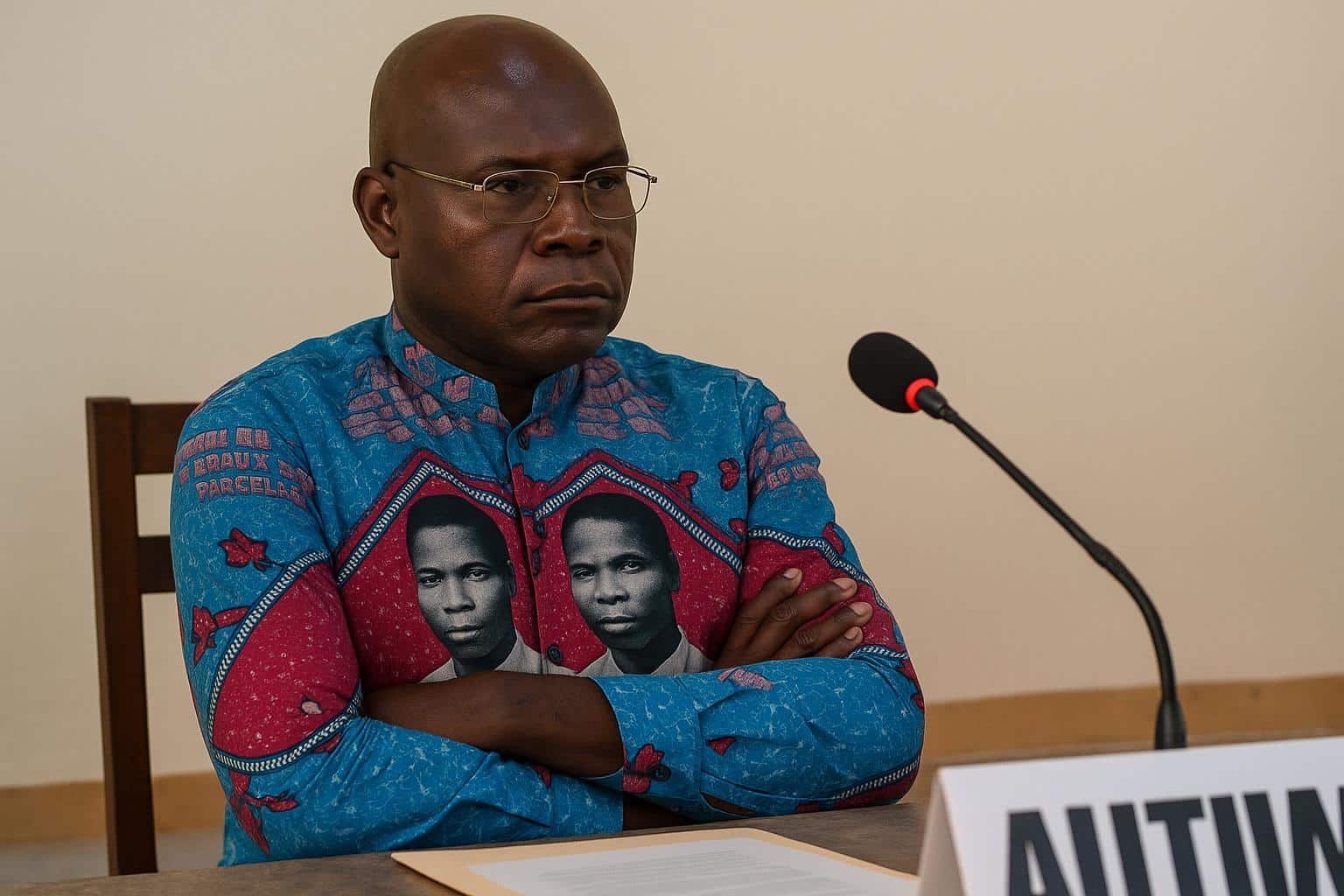
Launch morning at Sacred-Heart Cathedral
Curiosity mixed with nostalgia on 25 October 2025 as pews at Brazzaville’s Sacred-Heart Cathedral filled with parishioners, students and clerics eager to glimpse Father Jean-Marie de l’Eucharistie Bernardin Ndoulou’s latest release. Sunlight streamed through stained glass while a modest choir warmed the air with Marian hymns, setting an expectant tone.
Minutes after the bells fell silent, the author, flanked by altar servers, processed to a lectern placed beside stacks of freshly printed volumes. Photographers from local dailies edged forward; several government culture officials occupied front-row seats, underscoring the event’s resonance beyond strictly ecclesial circles.
Cardinal Biayenda’s enduring inspiration
At the heart of the 82-page work, titled “Way of the Cross to Jesus with and in the company of Cardinal Émile Biayenda,” lies the memory of Congo’s revered shepherd, assassinated in 1977 yet still emblematic of self-effacing service. Father Ndoulou revisits the prelate’s prayers, pairing them with each traditional station.
“Biayenda’s humility remains a beacon for Congo’s youth,” recalled Bishop Huldever Mouanga, whose preface opens the book. He urged readers to explore the cardinal’s habit of silent listening, calling it “a spiritual vaccine against the noise of our time” (diocesan bulletin).
A trilingual bridge for wider devotion
Printed in French, Lingala and Lari, the volume deliberately echoes the linguistic mosaic heard in the capital’s markets. Father Ndoulou said the choice sprang from catechetical encounters in suburban parishes where believers alternated idioms to grasp scripture fully (author interview).
Each language occupies its own section rather than a facing-page format, encouraging readers to linger rather than skim. Literary critic Rose Mampouya praised the strategy for “treating every tongue with equal dignity, avoiding the sense of a dominant original” (local press).
Pointe-Noire publisher steps into the spotlight
The imprint, Éditions L.M.I. of Pointe-Noire, pressed 3 000 copies in its first run. Director Maurice Loubouakou revealed the layout took four months because proofreaders for three languages had to agree on nuances while respecting liturgical guidelines.
Although Pointe-Noire rarely hosts major Catholic publishers, the port city’s printers offered competitive costs and quick logistic links by rail to Brazzaville, Dolisie and Ouesso. Transport firm Congo-Rail confirmed a discounted rate for religious materials, viewing the title as “a cultural asset” (company statement).
Critical reception from clergy and laity
Abbé Bilou, speaking from the cathedral’s pulpit, lauded the author for “inviting us to enroll in Biayenda’s school of quiet generosity, far from theatrics.” He highlighted vivid meditations that weave Congo River imagery into Jerusalem’s cobblestones, grounding distant events in local sensibility.
University theologian Stéphanie Ntsiba added that the text offers catechists a practical guide. “Students can dramatize each station in Lingala, then debrief in French, strengthening both faith and bilingual competence,” she said, hinting at upcoming campus workshops.
Distribution strategy and early demand
Retailers list the book at 3 000 CFA francs, roughly the cost of two bus rides between Makélékélé and Talangaï. Parishes obtained bulk discounts, and several diocesan bookstores reportedly sold out within hours. Online orders via a simple messaging service are scheduled to open before Advent.
Father Nganga, manager of the Catholic Cultural Centre, projected that a second print could follow by late November if momentum continues. “We underestimated Brazzaville’s appetite for affordable devotional literature,” he said, noting inquiries from Bangui and Libreville.
Faith, language and national identity
Observers see the trilingual release as echoing government efforts to valorize national languages alongside French, without politicizing worship. Culture Ministry official Irène Okemba called the initiative “a grass-roots complement to the national reading plan, reinforcing unity through shared narratives.”
Sociolinguist Alain Mandzou said devotional texts often travel faster than textbooks across rural Congo. “When a grandmother hears the Passion in Lari, she repeats it to grandchildren, creating oral libraries that transcend classroom limits,” he argued, suggesting ripple effects for literacy campaigns.
Author’s vision for future editions
Father Ndoulou insisted the journey does not end with hard copy. He envisions an audio version voiced by actors from Radio Magnificat and a braille adaptation coordinated with the National Union for the Blind. “The Cross must remain accessible to every believer, whatever the format,” he affirmed.
He is also drafting a companion booklet on Cardinal Biayenda’s homilies, potentially extending the trilogy of devotion, memory and civic engagement. “Hope is a construction site,” he smiled, “and every page is a brick.”
First readers share immediate impressions
Outside the cathedral, high-schooler Prisca Louzolo clutched her signed copy, saying she planned to study the Lingala sections with her mother. Retired civil servant Célestin Mouyondzi praised the quality binding: “It will survive many Lenten seasons.”
As the last visitors drifted toward palm-lined Avenue Foch, cathedral rector Father Ambroise Mboulou summarized the mood: “Faith feeds on beauty. Today, beauty spoke three languages, and Brazzaville listened.”