
Brazzaville hosts international colloquium
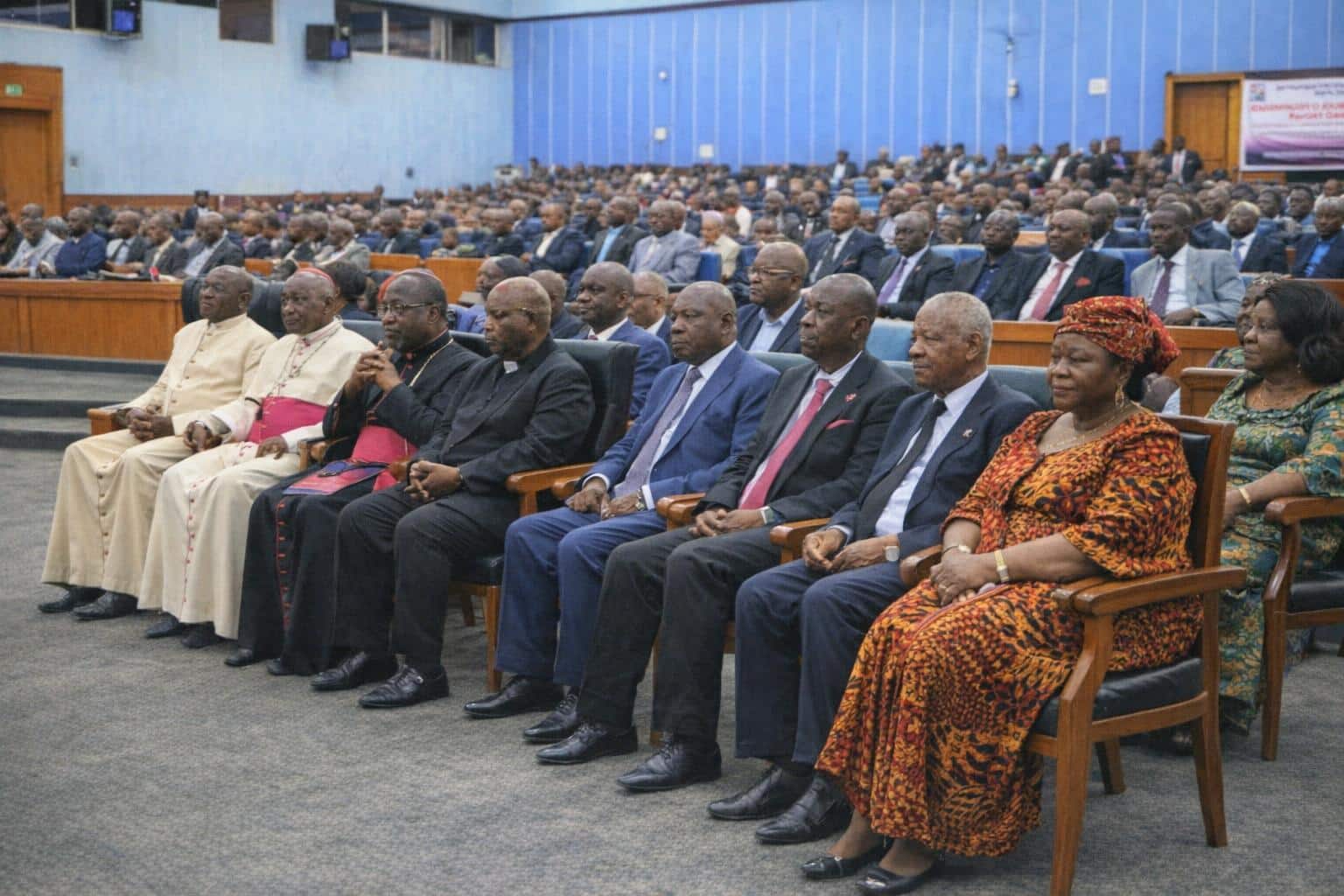
From Jan. 21 to 23, 2026, Marien Ngouabi University’s doctoral program in History and Civilizations at the Faculty of Letters, Arts and Human Sciences (FLASH) held an international colloquium in Brazzaville. The venue was the Palais des congrès, and the focus was Bishop Benoît Gassongo’s life and work.
The event was organized at the initiative of the Association Solidarité Plurielle. Organizers framed it as a scholarly and civic moment, intended to revisit a major Congolese religious figure whose influence touched education and culture, particularly in areas linked to today’s Nkéni-Alima department.
A national gathering of institutions and church leaders
The opening session on Jan. 21 was presided over by Minister Léon-Juste Ibombo, according to organizers. A cross-section of public institutions attended, including Ministers Pierre Oba and Hugues Ngouélondélé, Senate President Pierre Ngolo, and Constitutional Court President Auguste Iloki.
Also present was Jean-Marie Ewengue, president of the High National Council of Sages, as well as several bishops. Bishop Brice Armand Ibombo, named as head of the organizing committee, joined the clerical delegation that helped anchor the discussions in both academic and ecclesial perspectives.
Memory as a public issue in Congo
Speakers returned repeatedly to the theme of national memory, 45 years after Gassongo’s death. In his opening remarks, Léon-Juste Ibombo invoked a proverb: “When an old man dies, a library burns.” He argued the colloquium was not meant to mourn, but to “open” that library, read it and pass it on.
Ibombo also praised President Denis Sassou Nguesso for attention to national remembrance, calling him a “great protector of national memory,” as reported by the event account. He suggested that forgetting a country’s builders can leave society moving forward without reference points, especially for younger generations.
Bishop Gassongo’s legacy: bridging cultures
The minister described Bishop Gassongo as someone who navigated Western and African cultural worlds without ranking one above the other. In Ibombo’s words, Gassongo found “the hyphen” between two cultures, neither privileging one nor denigrating the other.
That framing echoed a broader concern heard in Brazzaville debates on identity and modernization: how to build institutions and knowledge without severing ties to local roots. In the colloquium’s telling, Gassongo’s life offered a model of continuity rather than rupture.
A builder, educator and author recognized by peers
Bishop Brice Armand Ibombo presented the initiative as a duty of recognition toward “a man of the Church, an educator and a builder.” The organizers highlighted Gassongo’s role as an author of reference works on Congolese resistance movements and on the evangelization of the country.
The colloquium account states that Gassongo was the first Congolese to write on the history of evangelization in Congo and that he became the country’s second bishop after Bishop Théophile Bemba. For participants, that combination of pastoral leadership and scholarship defined his public stature.
Three days of scientific exchange and planned proceedings
Over three days, scientific presentations, exchanges and collective reflections sought to measure Gassongo’s influence and place it within Congo’s national narrative. The organizers said the discussions aimed to install his legacy more firmly in the country’s collective memory, beyond ecclesiastical circles.
The organizers also expressed the intention to publish the colloquium proceedings so the work can reach a wider audience. For university researchers, such publication is often the bridge between a one-off event and longer-term teaching, citations and debate in classrooms and libraries.
From Mbanza to Brazzaville: key dates and milestones
According to the biographical outline provided during the event, Benoît Gassongo was born around 1910 in Mbanza, in what corresponds today to the Nkéni-Alima department. He entered the Grand Seminary of Saint-Jean in Libreville in 1939 and was ordained a priest on June 9, 1946, in Brazzaville.
He later became bishop of Owando, serving from June 1968 until his death on April 17, 1981. He was buried at Sainte-Marie Church in Ouenzé, a detail repeatedly cited by participants as a tangible anchor for remembrance in Brazzaville’s urban geography.
Schools and missions: a footprint in education
With Spiritan missionaries, Gassongo is credited with helping build schools and missions in several localities, including Tongo, Boniala, Bokombo, Litoumbi, Boundji-a-Tsé and others mentioned in the colloquium narrative. For speakers, that work connected evangelization to the social infrastructure that shaped postwar generations.
The account also lists names of people presented as beneficiaries of this educational ecosystem, including Auguste Iloki, Benoît Moundélé-Ngollo and François Ibovi. In a country where human capital remains a decisive resource, that emphasis made the colloquium as much about development history as church history.
A symbolic moment in 1958 at Sainte-Anne Basilica
One episode received particular attention: on Nov. 28, 1958, Gassongo delivered the homily during the proclamation of the Republic at Sainte-Anne Basilica in Brazzaville. In the colloquium’s retelling, the moment symbolically linked spirituality to national destiny at a formative point in public life.
For several participants, the reference underscored how religious spaces and civic milestones have sometimes intersected in Congo’s historical timeline. The narrative did not portray this as a political claim, but as a sign of Gassongo’s standing and the trust placed in him at the time.
Nkéni-Alima’s local pride and a national horizon
Organizers noted that executives originating from Nkéni-Alima mobilized to honor Gassongo as a pioneer of regional development and nation-building. The emphasis on local roots was not presented as narrow regionalism, but as a way to show how national histories often rise from department-level commitments and networks.
In that sense, the colloquium served two audiences at once: specialists who wanted to document a life with archival rigor, and citizens seeking stories of cohesion. By the end, the message was clear: for many Congolese, Benoît Gassongo belongs to the generation of builders who helped shape the country.