
Budget discipline and debt reduction strategy
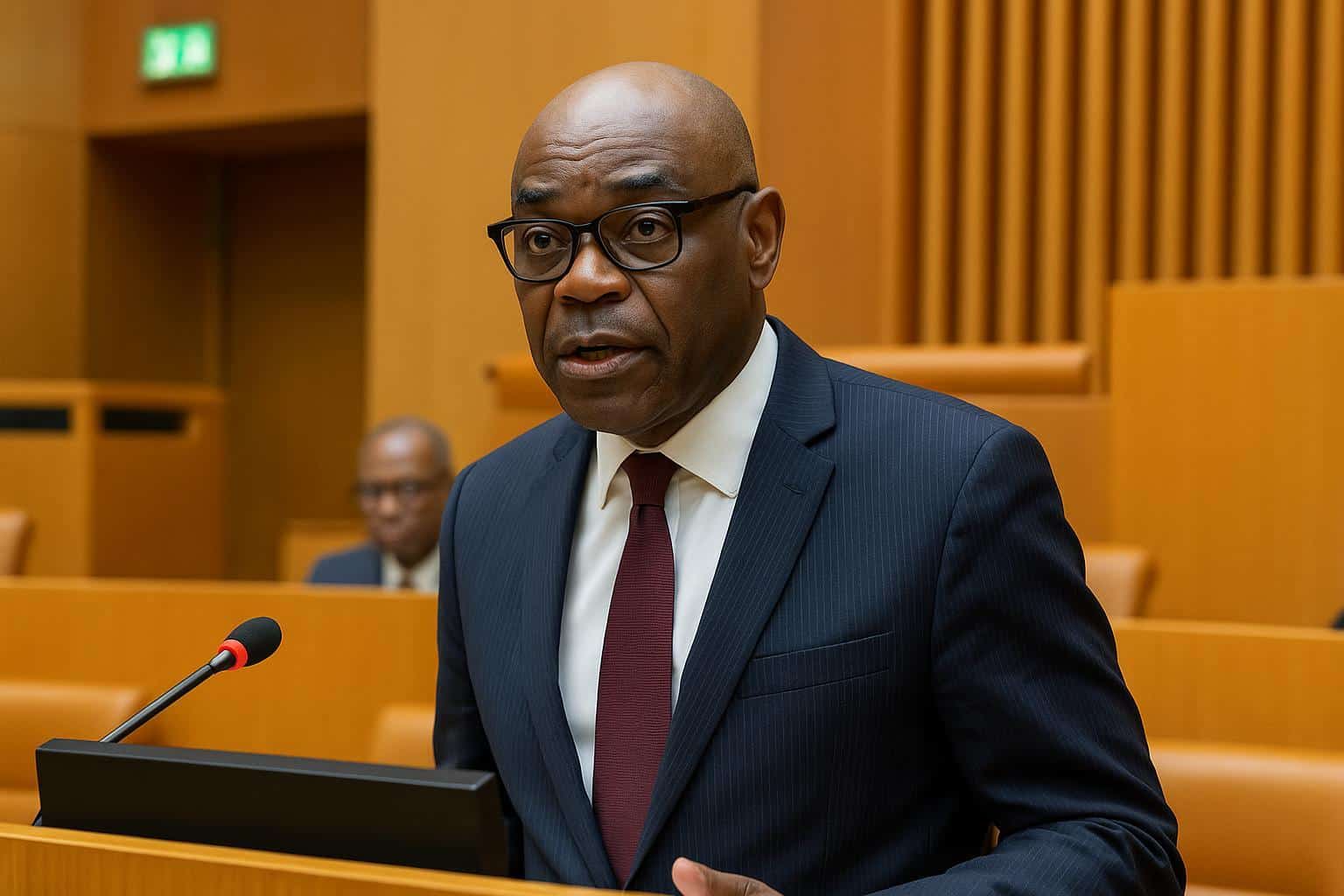
The draft Budget Law 2026, unveiled by Finance and Budget Minister Christian Yoka before both houses of Parliament in Brazzaville, signals government intent to reinforce fiscal discipline while cushioning vulnerable households against persistent price pressures and global economic uncertainty.
At the heart of the bill lies a commitment to channel every primary surplus into debt repayment, targeting both external liabilities and domestic arrears that still weigh on liquidity for local suppliers, according to the explanatory statement shared with legislators and obtained by our newsroom.
Officials consider market-based bonds the most expensive slice of the portfolio; a technical team is already engaging creditors on possible swaps or maturity extensions, people close to the Finance Ministry confirmed, echoing earlier commitments made during discussions with the IMF and the CEMAC regional surveillance body.
New rules cap short-term Treasury borrowing at amounts strictly required to cover annual amortisation, reducing rollover risk and signalling what one senior official described as ‘a cultural shift from crisis management to predictive budgeting’ in an interview with national radio following the budget presentation.
Tax relief measures for households
The most talked-about measure is the upward revision of the personal income tax threshold, a move expected to exempt thousands of hairdressers, moto-taxi drivers and other informal workers who currently file minimal returns but still feel the pinch of monthly withholding.
Under the proposal, incomes below the new floor would be fully exempt, while bands above it become more progressive, mirroring a CEMAC directive designed to harmonise fiscal policy across the monetary union; Parliament’s economic committee has largely welcomed the alignment, according to meeting minutes.
Ministry simulations, shared with business associations, suggest that roughly thirty per cent of wage earners could see take-home pay rise by an average four per cent, a boost economists say might spur retail turnover in markets from Ouenzé to Pointe-Noire’s bustling La Base district.
Implementation will not occur overnight. Christian Yoka requested a transition period to finalise impact studies and upgrade digital tax administration tools, noting that ‘a rushed rollout could generate confusion at payroll desks and erode the very confidence we seek to build’.
The budget also earmarks 68 billion CFA francs for social safety nets, including school meal programmes and a pilot universal health coverage scheme in Pool and Kouilou departments. Funding will be reallocated from fuel subsidy savings achieved through the progressive alignment of pump prices with import costs.
Corporate tax adjustments and investment outlook
Companies operating in Congo-Brazzaville face a different calendar. Changes to corporate income tax will kick in from 1 January 2026 with no grace period, including stricter deductions and incentives tied to local content requirements in the oil-service and agribusiness value chains.
The Federation of Congolese Employers cautiously endorsed the timetable, telling reporters that clarity is preferable to prolonged uncertainty; nevertheless, several medium-sized firms hope for complementary decrees spelling out which capital expenditures will remain deductible, especially for ongoing port expansion projects in Pointe-Noire.
Analysts at Ecobank Research noted in a briefing that predictable fiscal rules could improve Congo’s credit metrics and, by extension, the pricing of any future Eurobond, though they cautioned that execution risks persist, particularly in coordinating customs, tax and procurement databases.
In the medium term, authorities expect that lower debt-service costs will create budget room for infrastructure and skills programmes, catalysing jobs in construction and digital services. Government spokesperson Thierry Moungalla told state television that ‘growth with jobs remains the compass of this budget’.
The General Directorate of Taxes is rolling out an electronic filing portal, developed with support from the World Bank’s PFM project, to cut compliance costs. Beta testing with 200 companies in Brazzaville showed a 30-minute average reduction in processing time per return.
Monitoring, regional ties and next steps
To ensure the plan stays on course, the Finance Ministry will publish quarterly dashboards tracking revenue and expenditure against targets, a practice first piloted during the 2024 supplementary budget and praised by the African Development Bank for its contribution to transparency.
Parliamentarians also secured a clause mandating joint hearings with the Court of Accounts every semester. Opposition deputy Clément Miérassa called it ‘a win for all benches’ while emphasising the importance of ensuring that audit findings translate into timely administrative sanctions.
The CEMAC Commission, which reviewed an advance copy, welcomed the emphasis on convergence criteria, particularly the planned primary surplus of two per cent of GDP. Regional Commissioner Michel Ongolo said the draft illustrates ‘the kind of prudent yet socially aware budgeting the zone requires’.
Legislators are expected to vote on the text in late November. Should it pass, Yoka’s team aims to circulate application decrees before year-end, keeping investors and citizens alert to the next mileposts of a fiscal roadmap that seeks equilibrium without sacrificing inclusion.