
National tree mission gains private support
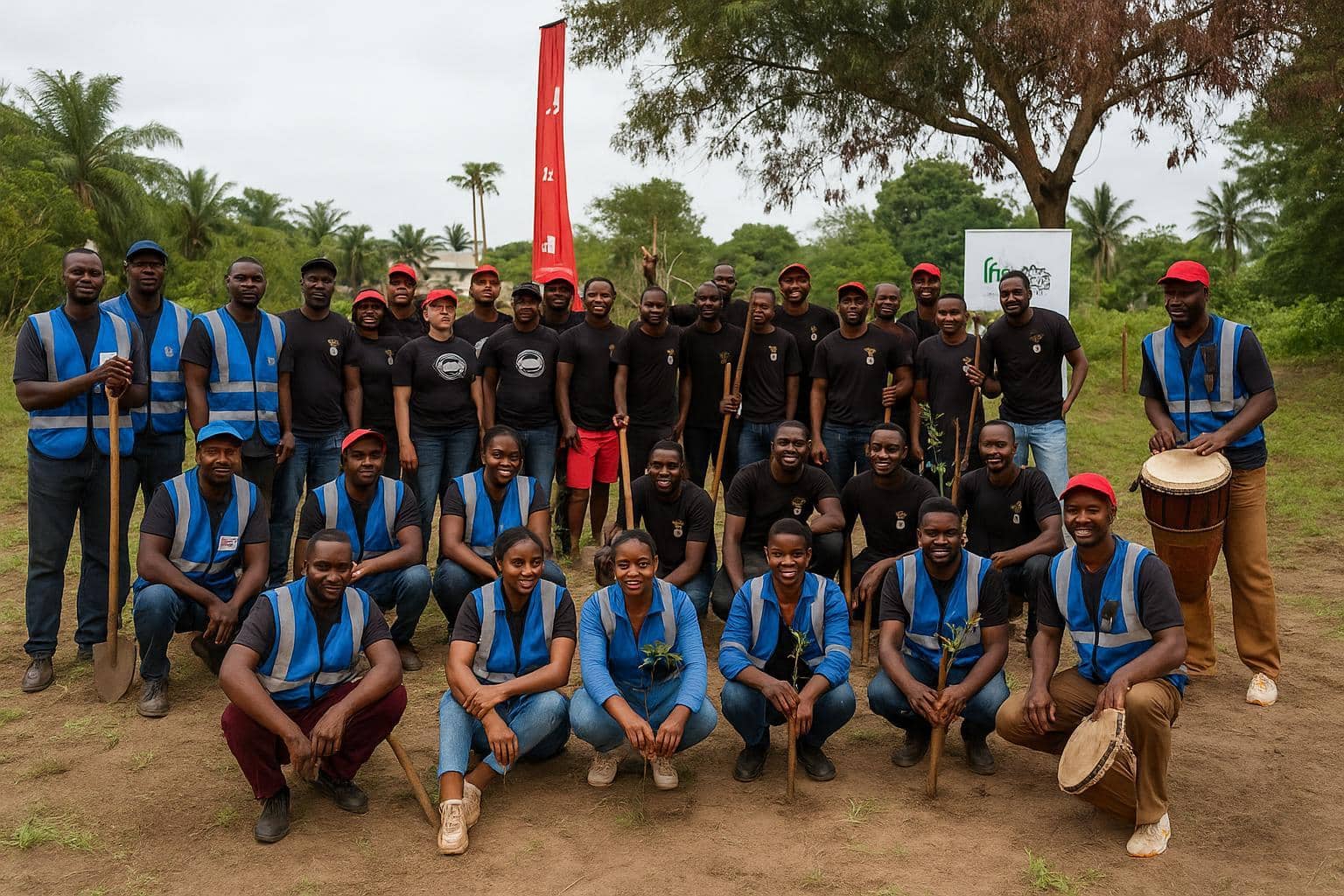
UBA Foundation Congo launched a 2,000-tree planting campaign straddling Brazzaville and Pointe-Noire, offering a private-sector boost to the government’s National Tree Day and the environmental policy championed by President Denis Sassou Nguesso. The initiative kicked off at dawn along the Route de la Corniche.
The bank’s staff, city officials and schoolchildren pressed saplings into moist earth, signalling what organisers call a concrete response to rising temperatures and soil erosion. Shovels clanked beside ceremonial drums, merging modern corporate ritual with cultural rhythms familiar to residents of the capital.
Brazzaville arboretum welcomes new species
According to Paul Sara Nguie, who coordinates the environmental NGO Human Empress, several of the species, including Afzelia bipindensis and Milicia excelsa, had never before been catalogued in the Brazzaville arboretum. “Students previously travelled to Yaoundé to see these trees,” she said.
The new saplings will expand genetic material available to researchers at Marien-Ngouabi University and could serve as living laboratories for studies on carbon sequestration, drought tolerance and medicinal properties, Nguie noted, pointing to growing global demand for indigenous knowledge.
Bank aligns with Congo climate agenda
UBA Congo’s drive slots into the group’s broader sustainability roadmap, which assigns every African subsidiary a quota of 10,000 trees. The Congolese branch elected to begin with 2,000 high-value specimens as a pilot toward the larger target.
Divin Mpandzou, who heads public-sector relations at the bank, praised government forestry officers for providing technical guidance. “We are proud to complement state action in a measurable manner,” he told reporters, adding that each seedling has been geo-referenced for future audits (UBA Foundation statement).
Tony Elumelu’s pan-African vision in action
The planting follows chairman Tony O. Elumelu’s recent Africa Tour, during which he conferred with five heads of state on youth entrepreneurship and climate resilience. Executives say the tree drive embodies his belief that Africans must pioneer their own sustainable growth pathways.
UBA’s sustainability desk in Lagos confirmed that seedlings data from Brazzaville will feed into a continental dashboard measuring survival rates, canopy width and community reach. The dashboard, built with local tech start-up Wecyclers, aims to showcase African-led environmental metrics at upcoming COP negotiations.
Students and scientists eye fresh data
Lecturer Aristide Mouyoka from the National School of Agronomy described the campaign as an open-air classroom. He plans to involve third-year students in monitoring chlorophyll content and soil moisture, turning routine maintenance into research papers that could attract regional academic collaboration.
Local herbalist Henriette Mouanda welcomed the introduction of high-medicinal-value trees, noting potential for domestic pharmaceutical development. “Congo has always treated forests as pharmacies. With proper stewardship, these species can support both public health and rural income,” she said after planting a mahogany sapling.
Community engagement from schools to SMEs
Beyond experts, the campaign is mobilising pupils from three lycée in Talangaï district and small business owners along the Congo-Ocean railway corridor. The foundation distributes illustrated guides that explain watering schedules and pest control, helping participants assume responsibility once the bank’s field teams depart.
The Ministry of Primary Education endorsed the project, saying it complements the new civic curriculum on environmental stewardship. Parents who accompanied their children at the launch voiced approval, citing cleaner air and shade in schoolyards where temperatures can exceed 35 degrees Celsius by noon (ministerial communiqué).
Next steps toward 10,000-tree target
UBA Congo plans additional planting waves during the forthcoming rainy seasons, when seedling survival rates peak. Internal monitoring dashboards flag sites requiring supplementary irrigation, and the foundation has budgeted for volunteer brigades to water young shoots during unexpected dry spells.
Forestry ministry director Armand Bemba hopes other corporates will emulate the scheme. He hinted at tax rebates for companies that document tree survival above 80 percent after two years, a benchmark aligned with Congo’s updated nationally determined contribution under the Paris Agreement.
As the sun set over the banks of the Congo River, school choirs closed the ceremony with an ode to Mother Earth. Organisers remained on site, tagging the final sapling with a QR code, quiet proof that a spreadsheet can sometimes shelter a seedling.
Economic and ecological dividends
Ecosystem economist Blandine Oba estimates that the 2,000 trees could store roughly 2,700 tonnes of CO2 across their lifespan, a figure comparable to taking six hundred cars off Brazzaville’s roads for a year. She argues such metrics strengthen Congo’s appeal to emerging carbon markets.
UBA executives confirm exploratory talks with the African Carbon Market Initiative to monetize verified emission reductions and channel proceeds into further greening. Any revenues, they say, would bankroll solar-powered boreholes near planting sites, reinforcing the project’s climate adaptation dimension for rural dwellers.
Meanwhile, local artisans are preparing to supply biodegradable tubes for seedling protection, replacing imported plastic guards. The initiative could open a modest value chain in Pointe-Noire, where carpenters already fashion wood off-cuts into furniture. “Green jobs start small but count big,” artisan cooperative leader Désiré Loukari explained.