
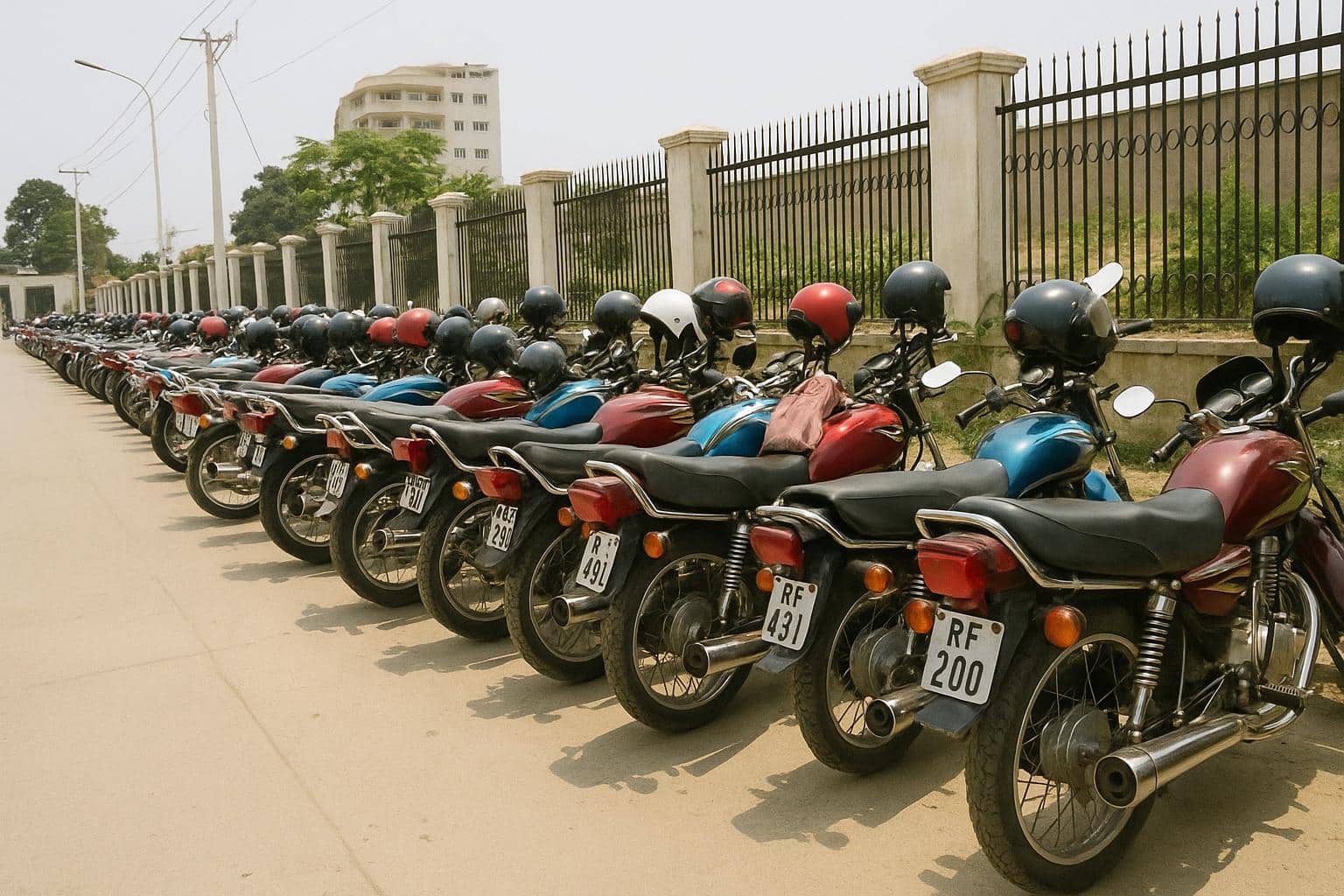
Private sector backs road safety in Brazzaville
Near the sprawling Poto-Poto market, horns and exhausts mingle with a new sound: the confident rev of freshly trained moto-taxi riders. From July to 8 September, food-processing firm Ager Aliment sponsored an intensive course for 1,000 young motorcyclists drawn from every arrondissement of Brazzaville.
Chief executive Hugues Henry Ngouélondélé says the company wanted to “turn the highway code into a tool for progress, not a barrier”. By underwriting both tuition and licence fees, the firm placed itself at the intersection of social responsibility and pragmatic business, leveraging its local brand to champion safer streets.
A three-month curriculum tailored to riders
Over twelve weeks, traffic-safety specialists unpacked the fundamentals of right of way, speed limits, and lane discipline. Trainers relied on real-life crossroads simulations rather than classroom monologues, acknowledging that many participants learned best through action.
Instructor Mireille Okoko notes that most trainees had learned to ride by imitation. “They could balance a bike, but the rules were foggy,” she explains. By the final week, she adds, riders were executing controlled stops and signalling at junctions with a confidence that impressed municipal observers.
Free permits unlock economic resilience
Upon graduation each participant received a government-recognised driving permit, the costs absorbed entirely by Ager Aliment. For many, the document is their first formal credential, a gateway to regular income and fewer police penalties.
Jean-Brice, 26, says the licence will help him double his daily haul. “Passengers trust a rider who shows papers,” he remarks. The sentiment is echoed by peers who believe official recognition reduces street harassment and cements moto-taxis as a legitimate layer of urban transport.
A strategic push against road accidents
City authorities have wrestled with a spike in two-wheel collisions, often linked to over-speeding and loose adherence to traffic codes. By sharpening riders’ knowledge, the training seeks to curb injuries that strain hospitals and family budgets.
Ngouélondélé frames the effort as preventive economics. “An accident sidelines a breadwinner and drains household savings,” he says. “Every helmeted, rule-aware rider is a buffer against sudden poverty.” Early police checkpoints report fewer infractions among graduates, though formal statistics are still being compiled.
Scaling up the initiative across Congo
Buoyed by feedback, Ager Aliment plans to replicate the project in all twelve departments. Logistics teams are mapping training sites from Pointe-Noire to Ouesso, aiming to reach thousands more riders before year-end.
The expansion aligns with government ambitions to professionalise informal transport without stifling entrepreneurship. A Transport Ministry official, requesting anonymity, calls the pilot “a template for public-private synergy that saves lives while creating jobs”.
Local officials note early signs of change
In Bacongo and Makélékélé, traffic wardens report smoother flow at busy junctions where moto-taxis previously darted unpredictably. While isolated incidents persist, officers say trained riders now slow at zebra crossings and respect pedestrian space.
Colonel Armand Moussounda of the municipal police attributes the shift to peer influence. “Graduates correct newcomers on the spot,” he observes. “Positive contagion is faster than any fine we could impose.”
Riders speak of new confidence on the road
For Andrea Loudila, one of the rare female participants, the course delivered more than technical skills; it offered validation in a male-dominated trade. “When the instructor handed me my permit, I felt doors opening,” she recalls, helmet tucked under her arm.
Several trainees say the programme spurred them to form savings circles, pooling portions of daily earnings for future bike upgrades. Such micro-initiatives hint at the broader socio-economic ripple that organisers envisioned when they linked road education to financial autonomy.
Corporate citizenship meets community expectations
Ager Aliment’s core business—producing staples for local markets—relies on an agile distribution network that frequently uses motorbikes. Investing in rider safety therefore protects supply chains while burnishing the firm’s image as a home-grown champion of development.
Marketing analyst Clément Mombelé argues the venture underscores a shift in Congolese corporate behaviour. “Consumers reward brands that tackle visible problems,” he says. “In a city where every family has felt the shock of a bike accident, this initiative resonates beyond billboards.”
Towards a culture of responsible mobility
With urban populations climbing, Brazzaville’s streets will only grow busier. Stakeholders agree that lasting safety depends on embedding respect for the code within community norms, not just within training halls.
As evening falls on Avenue des Trois-Martyrs, a chorus of engines heads toward home. Many of those headlights now belong to riders carrying fresh licences in their pockets—and, organizers hope, a renewed commitment to share the road wisely.