
Bright Debut on Algerian Tracks
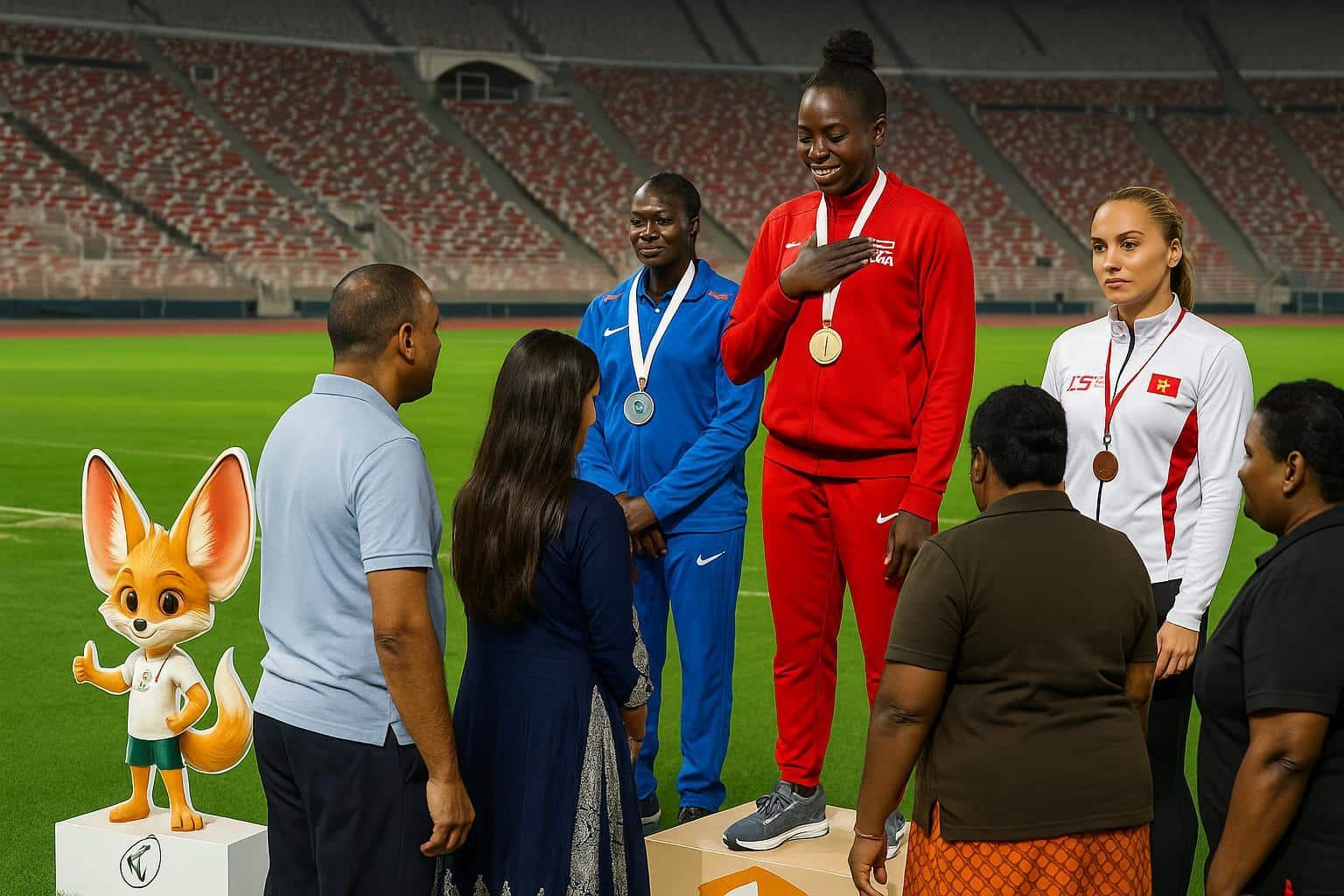
The red, green and yellow flag of the Republic of Congo rose four times above Algerian podiums this summer, signalling a promising first appearance at the maiden African School Games. Six teenage athletes returned to Brazzaville with one gold and three bronze medals, confounding modest pre-tournament expectations entirely.
Long-jumper Gladise Boukama Ndoulou leapt 6.11 metres for gold before sprinting to a surprise 200-metre bronze, while judokas Symphoria Mankala and Divine Mpiaya Massala seized their chances on the tatamis. Their performances elicited warm congratulations from the Ministry of Sports and the National Olympic Committee upon arrival home.
Behind the Medal Table
Yet seasoned observers caution that isolated victories must be viewed within a wider performance matrix. Congo initially registered thirteen sports and nearly eighty pupils, according to internal selection documents reviewed by our newsroom, but escalating travel and lodging costs forced officials to trim the contingent to six representatives.
A finance officer within the Olympic Committee, requesting anonymity, estimates the final delegation budget at under US$30,000, a figure he calls ‘commendably frugal but strategically limiting.’ Comparable teams from Morocco or Kenya spent three to four times more on preparation camps, equipment upgrades and sport-science support services abroad.
Sports economist Didier Mbemba notes that Congo’s nominal expenditure on youth competitions equals roughly 0.02 percent of total public spending on sport. ‘The ratio is lower than the African Union’s recommended threshold,’ he says, referencing the continental Agenda 2063 action plan adopted in Addis Ababa last year forum.
Funding Channels and Policy Framework
The Ministry of Sports, reached for comment, emphasises that the government already finances nationwide school championships and recently refurbished four regional stadia. ‘Budgetary ceilings remain global, yet targeted allocations are gradually rising,’ spokesperson Irène Mokono explains. She cites a 12 percent uptick in youth-sport appropriations for 2026 already.
Parliamentary records show that the 2025 national budget devoted 14.8 billion CFA francs to sport, of which one-eighth targeted scholastic programmes. Analysts argue that modest but steady increments, combined with better private-sector partnerships, could create a virtuous cycle similar to models deployed in Rwanda’s Handball for Schools initiative.
International donors are also keeping an eye on the Central African nation. The United Nations Children’s Fund confirmed ongoing discussions about a pilot project linking physical education, nutrition and monitoring in rural districts. If endorsed, the multiyear grant could funnel equipment and coaching certification resources into underfunded communes.
Voices from the Field
Coach Pascal Ebina, who self-financed the judo team’s pre-departure camp, recounts improvising weightlifting sessions with sandbags. ‘Our athletes remain resilient,’ he remarks, ‘but resilience alone will not outmuscle structured programmes.’ He nevertheless salutes the ministry for expediting diplomatic clearances that allowed the squad to travel smoothly and promptly.
Parents have likewise stepped into funding gaps. Antoinette Massala, mother of Divine, says her family organised a neighbourhood raffle to buy a judogi. ‘The community saw this as an investment in national pride,’ she explains, adding that her daughter aims to qualify for the 2026 Youth Olympics event.
Sport sociologist Clarisse Okoko argues that such grassroots solidarity strengthens social cohesion. However, she cautions against overreliance on household contributions. ‘A predictable pipeline of public and private investment is essential if Congo intends to climb from episodic success toward systematic podium visibility across multiple Olympic cycles,’ she suggests.
Pathways to 2027 and Beyond
The National Sports Development Plan 2024-2028, adopted in cabinet last November, sets an ambition of ranking within Africa’s top fifteen at the 2027 All-Africa Games. Key deliverables include modernising the Talangaï High Performance Centre and integrating sports medicine modules into the secondary school curriculum by 2026 throughout Congo.
Education specialists interviewed by Radio Congo believe the curricular element could prove transformative. They cite Kenyan research showing a 12-percent improvement in classroom concentration among pupils engaged in structured physical activity. ‘Healthier learners become better learners,’ summarises Professor Joseph Ngoma, pointing to cross-sector benefits beyond competitive results alone.
In the short term, federation leaders advocate a micro-grant mechanism enabling provincial academies to purchase standardised timing systems, mats and recovery tools. A costed proposal, seen by this publication, places the annual envelope at two billion CFA francs, roughly equal to the budget of one professional football club.
Internationally, Congo could leverage its upcoming presidency of the Central African Economic Community’s Sports Commission to attract regional training events. Diplomats familiar with the dossier say preliminary conversations with Gabon and Cameroon envisage pooled coaching seminars, joint altitude camps and reciprocal scholarship schemes for promising teenage athletes ahead.
For now, the four medals harvested in Algeria stand as both reward and reminder. Reward, because they confirm raw potential; reminder, because harnessing that potential requires sustained partnerships among government, federations, families and sponsors. The coming budget cycles will indicate whether Congo turns flashes of brilliance into momentum.