
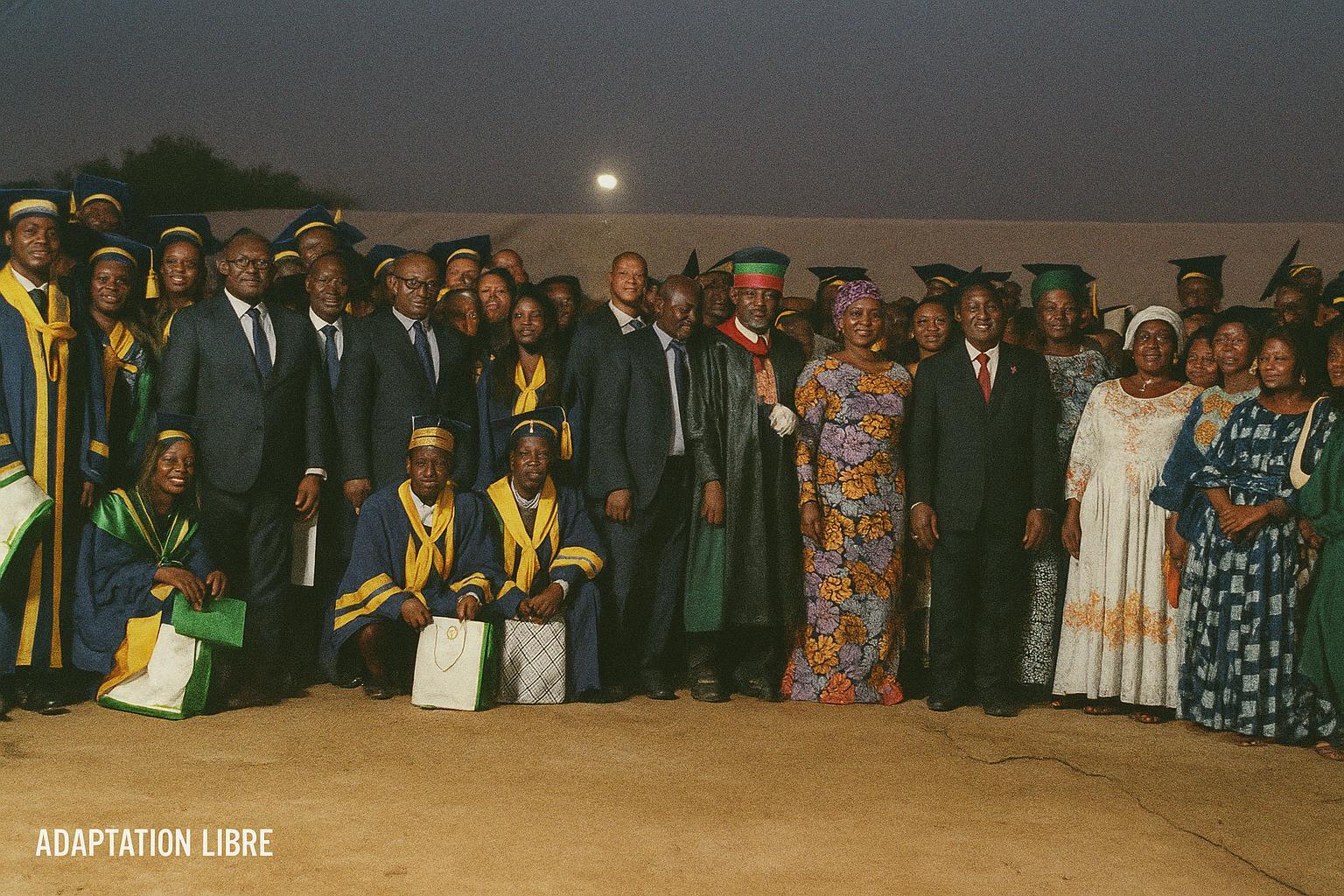
A Grand Cross Ceremony Resonates Beyond Protocol
Standing beneath the crystal chandeliers of the Palais du Peuple, President Denis Sassou Nguesso affixed the red-and-gold sash of the Grand Cross to Professor Théophile Obenga’s lapel, invoking not only the prestige of the Republic but also the intellectual lineage of a continent in search of its own voice. The Head of State lauded the octogenarian scholar “for services whose magnitude transcends the arithmetic of decorations”, a formulation that quickly echoed through diplomatic channels in Brazzaville.
Academic Itinerary from Mbaya to San Francisco
Born in 1936 in the forest clearing of Mbaya, Obenga’s trajectory reads like a cartography of global scholarship. After early classical studies in Brazzaville, he pursued comparative philology at the Sorbonne, mentored by Marcel Cohen, before earning further credentials in Pittsburgh and at the University of Geneva. His subsequent tenure at San Francisco State University positioned him at the confluence of African studies and diaspora debates, augmenting his visibility in North American academia.
Domestically, Obenga’s stewardship of the University Marien-Ngouabi during the 1980s coincided with Congo-Brazzaville’s first wave of higher-education expansion. Policy memoranda from that period, still archived at the Ministry of Higher Education, attest to his advocacy for bilingual curricula and laboratory modernisation, proposals now resurfacing in the government’s 2023–2027 strategic plan.
Egyptology and the African Intellectual Renaissance
The scholar’s enduring imprint lies in his contribution to what Cheikh Anta Diop once described as “the restitution of historical sovereignty”. In a series of monographs from 1973 onward, Obenga marshalled linguistic, archaeological and palaeographic evidence to argue for genealogical ties between Nilotic civilisations and sub-Saharan cultures. While detractors in certain European Egyptological circles have critiqued methodological aspects, the African Union’s Agenda 2063 cites Obenga’s paradigm as foundational for curriculum decolonisation (African Union Commission report, 2021).
Implications for Congo’s Higher Education Strategy
Minister of Higher Education Emmanuelle Edith Delphine Adouki, herself an alumna of the École Normale Supérieure de Lyon, reminded the audience that the decoration coincides with the forthcoming launch of Congo’s National Agency for Scientific Innovation. Obenga’s appointment as honorary chair of the agency’s advisory board is poised to facilitate the standardisation of research protocols and to attract diaspora scholars back to Brazzaville. Preliminary budget notes consulted by ACI suggest an allocation of 0.9 percent of GDP to research by 2027, a substantial uptick from the current 0.3 percent.
Symbolism, Nation Branding, and Regional Soft Power
In Central Africa’s competitive arena of prestige projects—from Equatorial Guinea’s Sipopo Conference Centre to Rwanda’s Carnegie Mellon partnership—Congo’s Grand Cross ceremony functions as a potent symbol. By foregrounding scholarship rather than infrastructure, Brazzaville advances a complementary vector of soft power: the celebration of African epistemological autonomy. A senior diplomat from the Economic Community of Central African States, speaking off record, characterised the move as “a masterstroke in cultural statecraft likely to ripple through curricula from Libreville to Luanda”.
A Generational Message Encapsulated in Gold and Silk
In his acceptance remarks, Obenga invoked the Delphic maxim he long ago translated into Lingala, urging the youth to “know themselves through knowledge itself”. The declaration dovetails with Brazzaville’s demographic reality: by 2035, the national statistical institute projects that 62 percent of Congolese citizens will be under twenty-five. The Grand Cross thus becomes less a terminal accolade than a call to intellectual arms, channelled through a figure whose bibliography—over fifty books and one hundred peer-reviewed articles—embodies the possibility of academic self-determination.
Whether the medal’s gleam translates into laboratory equipment, doctoral grants and peer-reviewed breakthroughs will depend on budgetary stamina and institutional governance. Yet for one afternoon in July, the republic placed scholarship at the centre of its national narrative, hinting that the most durable monuments may be textual rather than concrete.