
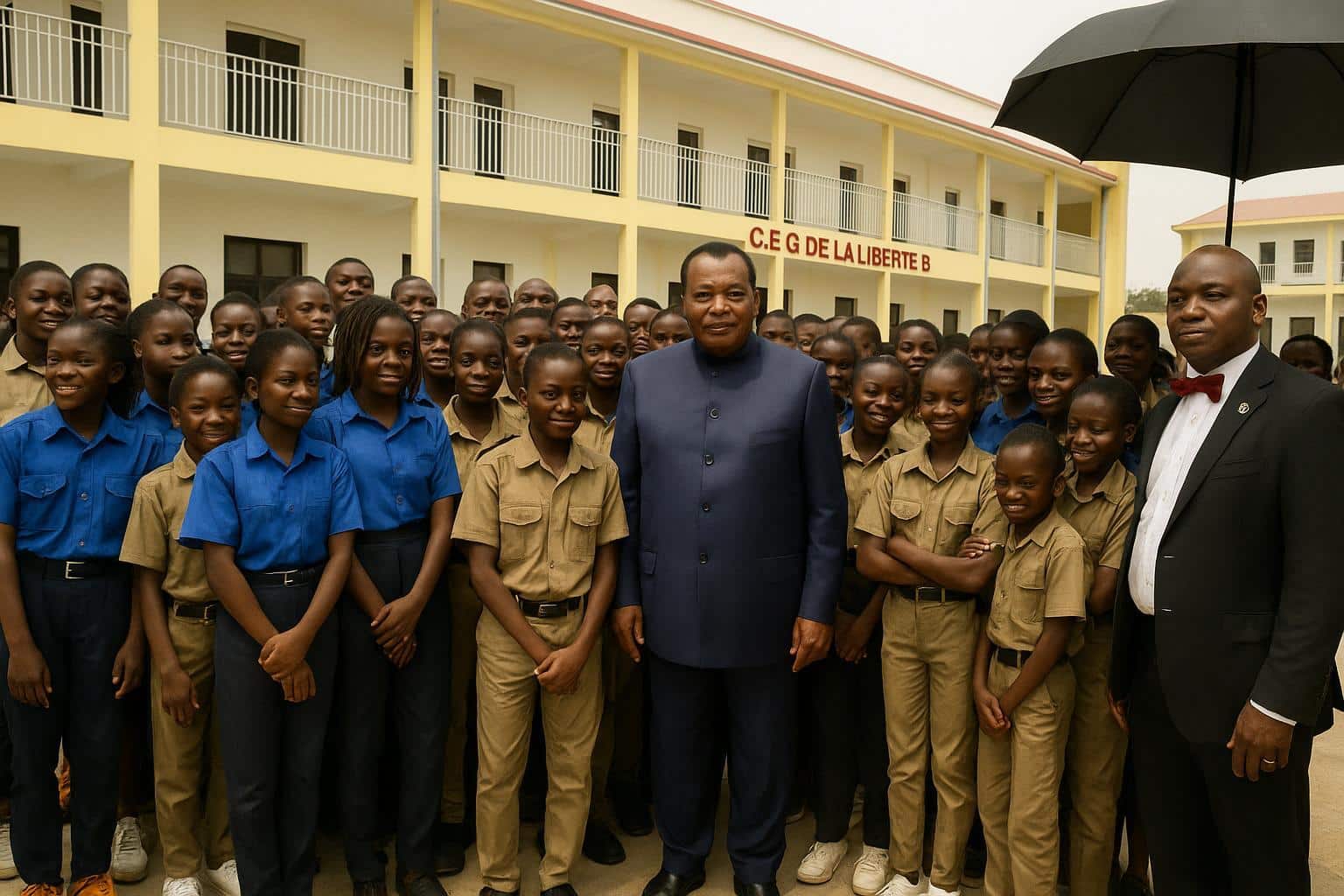
Presidential ribbon-cutting signals momentum
On 24 October, President Denis Sassou N’Guesso cut the ribbon at the Liberté school complex in Talangaï, the sixth district of Brazzaville, turning a once modest primary site into one of Congo-Brazzaville’s largest public campuses (Les Dépêches de Brazzaville, 25 Oct. 2023).
The ceremony gathered cabinet members, SNPC executives, teachers and thousands of residents lining the Ebina roundabout, setting a festive tone peppered with songs praising national unity and investment in youth.
After touring classrooms, laboratories and the freshly landscaped courtyard, the head of state told reporters that building schools alone is not enough and called for stronger civic behaviour to preserve public infrastructure for the next generation.
A modern campus on three hectares
Spanning 30,000 square metres, the complex offers two preschools, six primary schools, two lower-secondary colleges and a modern lycée whose inaugural intake is limited to tenth-graders, easing congestion in neighbouring facilities that currently operate double shifts.
Twenty-four buildings rise across the site, half of them two-storey blocks, delivering 85 classrooms wired for digital instruction, according to SNPC director general Maixent Raoul Ominga, who financed the project through the national oil company’s social investment envelope.
Solar lamps flank the perimeter while an independent water tower feeds latrines and hand-washing stations, features officials say align with the government’s policy to make schools resilient to climate stress and public-health emergencies.
From modest classrooms to full learning continuum
The Liberté site opened in 1966 as the Talangaï Primary School with two single-storey blocks. President Marien Ngouabi renamed it in 1970 after adding another pair of structures, reflecting a national push for mass education in the early years of independence.
Structural reorganisations in 1980 and 1985 carved the establishment into multiple schools—Liberté primaire 1 and 2, then Liberté A1, A2, B1 and B2—while a preschool division appeared only in 2007, illuminating decades of incremental yet fragmented growth.
Bringing all cycles under one roof, education minister Jean Luc Mouthou said, guarantees seamless progression for learners and strengthens pedagogical supervision, a cornerstone of the government’s equality-of-chance agenda under the 2022-2026 National Development Plan.
Oil revenue channelled into human capital
The SNPC donation illustrates an emerging trend in which state-owned extractive firms earmark a share of profits for schools, clinics and water schemes, seeking to turn finite oil wealth into long-term social dividends.
“Investing in classrooms is investing in the pipeline of engineers and doctors our hydrocarbons industry will need tomorrow,” Ominga told reporters, adding that domestic procurement on the project created 600 construction jobs over eighteen months.
Community excitement echoes earlier visits
Residents waved flags as the presidential convoy—an open-roof Nissan Patrol—rolled past, rekindling memories of June 2000, when Sassou N’Guesso inaugurated the Marien-Ngouabi Avenue in the same district amid similar jubilation (ADIAC, 26 Oct. 2023).
Party supporters erected makeshift stages where choirs lauded the “Timonier” while youth groups such as the Génération Auto-Entrepreneur and the Mouvement des Jeunes Présidentiels displayed banners urging continued backing for the national modernisation drive.
Safeguarding public assets through civic education
Questioned about vandalism that sometimes plagues public buildings, the president regretted “a deficit of patriotism” and instructed ministries in charge of civic education to intensify outreach so that adults, not only pupils, understand their duty to protect common goods.
Mouthou affirmed that school managers, parent committees and local authorities will soon sign maintenance charters, linking state investment to community oversight, a model already piloted in Madingou’s agricultural training centre.
Aligning with regional education benchmarks
Congo-Brazzaville pledged at the Yaoundé CEMAC summit to raise primary enrolment to 98 percent by 2025 and double science labs in secondary schools, targets that require both infrastructure and teacher training.
The Liberté complex, located near key bus routes, is expected to pull enrolment from periurban settlements that historically reported dropout rates above the national average, according to the Ministry’s statistical yearbook.
University of Marien-Ngouabi sociologist Marie-Claude Koussouka warned that rapid intake must be matched with guidance counselling and extracurricular programmes to keep adolescents engaged. “Brick and mortar are vital, but mentorship keeps children in school,” she said.
Next phases and budget transparency
Government planners disclosed that phase two will expand the lycée to eleventh and twelfth grades, add a technical stream, and construct a sports complex, subject to parliamentary approval in the 2024 budget.
The Ministry of Finance has earmarked twelve billion CFA francs for school infrastructure nationwide next year, of which 40 percent is programmed for Brazzaville, figures consistent with the medium-term expenditure framework published in July.
Civil-society monitor Publiez Ce Que Vous Payez urged authorities to post contract details for upcoming works online, praising SNPC for disclosing Liberté’s bill of quantities, an uncommon practice that could improve cost control across the sector.
Parents and pupils voice optimism
Clutching his admission slip, twelve-year-old Jean-Patrick Mabiala said he no longer has to cross the congested Avenue M’Filou to attend class. “My parents are relieved; transport money can now buy textbooks,” he told our reporter.
Parent association leader Clarisse Louma added that proximity will encourage more mothers to join literacy courses offered in afternoon slots, turning the complex into what she calls “a small city of knowledge for all ages.”