
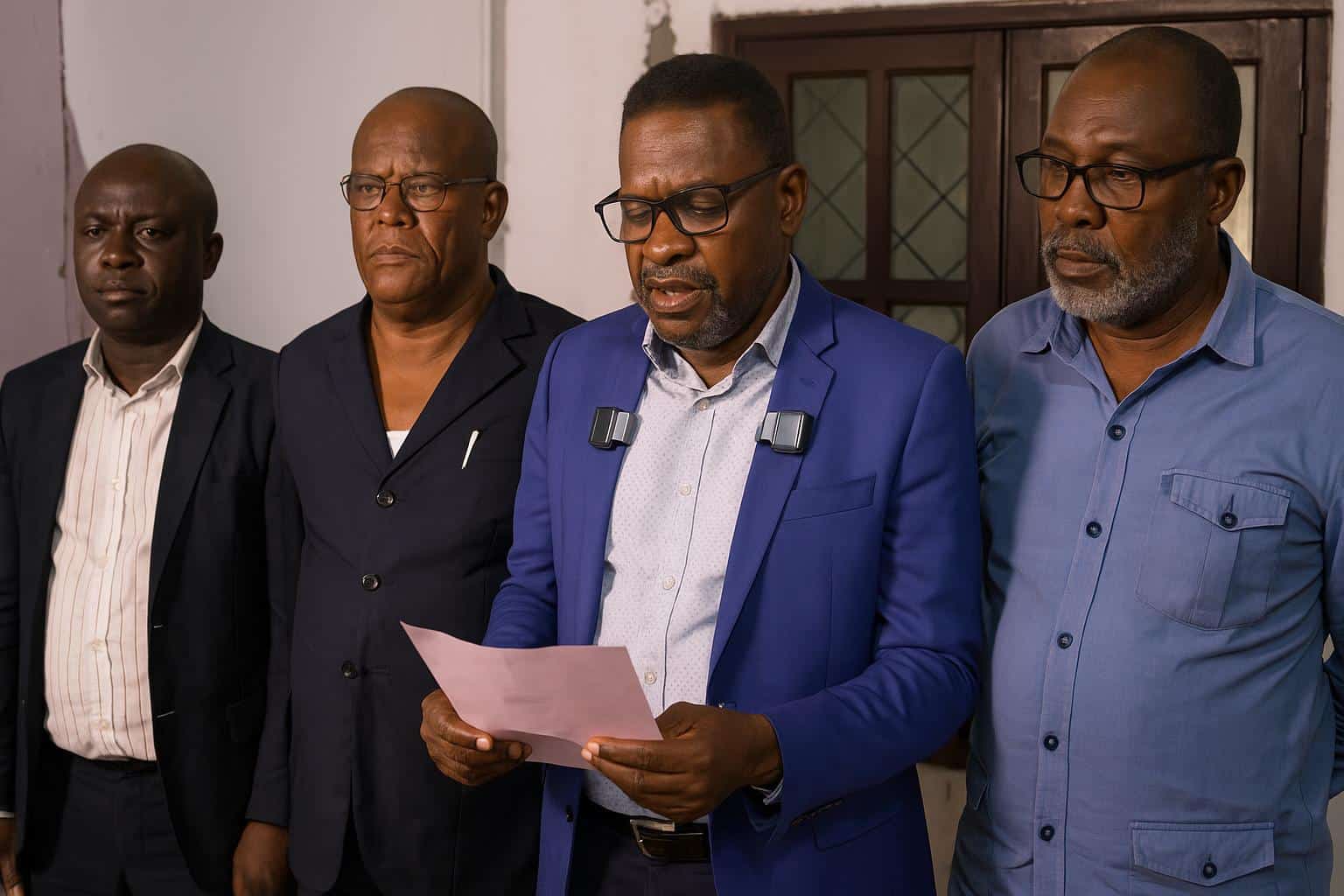
Strike notice raises alarm on campus
Brazzaville’s leading public university is again on the edge of a work stoppage. On 3 October, the inter-union college of Marien Ngouabi University delivered a four-day strike notice, arguing that agreements signed with the government to stabilise salaries and benefits have yet to materialise.
The coalition brings together three distinct groups: the Syndicat du Personnel Non-Enseignant du Supérieur, the Syndicat National de l’Université and the Syndicat des Enseignants du Supérieur. Collectively they represent administrative staff, lecturers and researchers and therefore claim to speak for nearly all 3 000 workers on campus.
Their warning is precise: unless overdue wages for August and September 2024 as well as July to September 2025 are cleared and overtime payments dating back to 2018 settled, the union confederation will suspend teaching, research services and administrative duties for four consecutive days.
Salary arrears and social security concerns
Union leaders cite a memorandum signed earlier this year that, according to them, committed the state to erase salary arrears in several instalments. They argue that the first deadline has expired without payment, eroding confidence and leaving many households dependent on credit to meet routine expenses.
Beyond direct remuneration, the unions say social wellbeing has deteriorated because statutory contributions have not been channelled to the two national social security funds. They contend that persistent gaps jeopardise health coverage today and retirement income tomorrow for professors, laboratory technicians and junior clerks alike.
Student anxiety meets staff resilience
Marien Ngouabi University, founded in 1971, concentrates more than 30 000 students across a dozen faculties. Over the past decade, successive strikes and go-slow movements have repeatedly reordered academic calendars, compressing semesters and deferring graduation ceremonies, even as enrolment continued to climb.
For now, lecture halls remain open. The inter-union college has framed the notice as an invitation to dialogue, not a declaration of hostilities. “We prefer negotiation to confrontation,” one spokesperson said in Brazzaville, insisting that classes would proceed until the four-day countdown lapses.
Inside the university’s main campus near the Congo River, students expressed mixed feelings. Some worry that another strike will push exams into the next calendar year, complicating scholarship applications abroad. Others regard collective action as the only tool that secures overdue laboratory supplies and teaching materials.
The inter-union college took the unusual step of congratulating staff for what it called their “calm and discipline” in recent weeks. The gesture aimed to temper frustration and preserve workplace civility at a time when many families face back-to-school expenses without a full pay cheque.
Government signals and negotiation window
No fresh statement has yet been issued by the Ministry of Higher Education or the Treasury. Last month, officials reiterated their willingness to uphold commitments “subject to cash-flow availability”, a phrase that unionists interpret as a sign of delayed but eventual disbursement rather than outright repudiation.
Observers note that the four-day window is shorter than previous walkout calls, leaving room for compromise. In earlier episodes, talks convened by the rectorate produced phased repayment schedules and a promise to digitalise payroll, moves the unions welcomed but later criticised for sluggish execution.
Economists following public finance argue that arrears at the university mirror broader fiscal pressures triggered by pandemic-era spending and global commodity swings. They underline, however, that higher-education wages represent a modest slice of total expenditure and can be prioritised without jeopardising macro-stability, provided sequencing is clear.
Balancing investment and overdue payments
Administrators quietly caution that immediate payment of overtime dating back six years could absorb funds earmarked for new lecture theatres and lab upgrades. Their preference is to spread settlements across fiscal years, blending wages, maintenance and capital investment into a single, multi-track reform programme.
While both sides cite the welfare of students, they differ on urgency. The unions want a written schedule with dates, figures and penalties for non-execution. Management leans toward “mutual trust” language that offers flexibility. Bridging that gap will determine whether campuses stay open next week.
Academic continuity measures in place
In the meantime, lecture timetables are being adjusted to prioritise final-year cohorts whose internships and thesis defences cannot be postponed indefinitely. Faculty members, even those active in the strike committee, have volunteered weekend tutorials to compress coursework before any potential disruption.
Whether negotiations succeed or the four-day warning expands into a longer stoppage, the episode underscores the delicate balance between fiscal prudence and academic continuity. For students, lecturers and administrators alike, the coming days will test patience, resolve and the capacity of dialogue to avert disruption.
Ripple effects beyond Brazzaville
Parents of freshmen, many commuting from Pool and Plateaux departments, note that transportation and accommodation costs rise each time the semester extends. “Every extra week in town means another week of rent,” said a mother waiting outside the registrar’s office, urging rapid compromise between state and unions.
For its part, the inter-union college has scheduled daily briefings to keep members informed and to prevent rumours. Representatives insist the strike, if triggered, will observe minimum service in critical units such as the teaching hospital, ensuring that emergency care and essential laboratory experiments continue.