
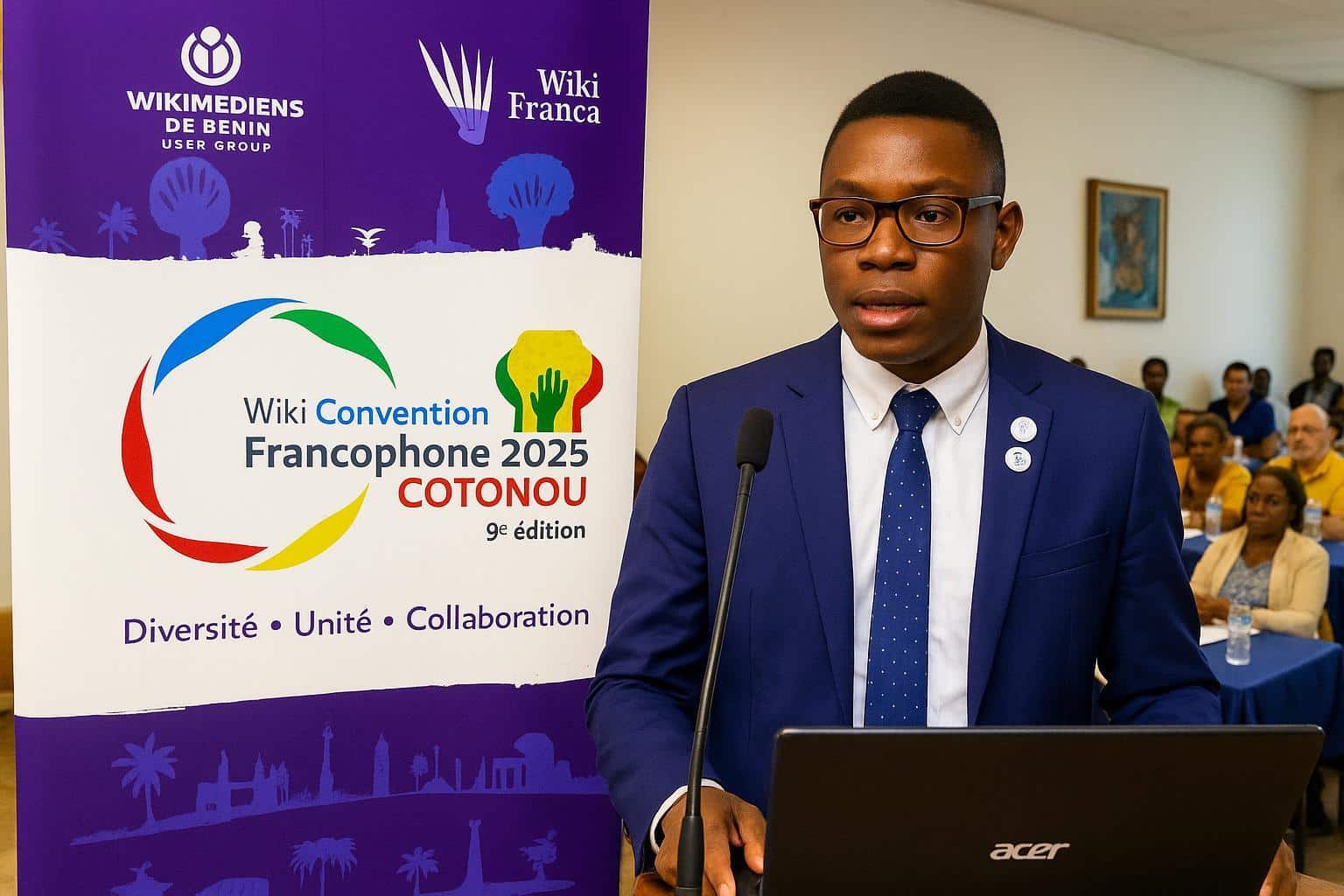
Congo’s voice resonates in Cotonou
When nearly one hundred francophone nations converged on Cotonou from 2 to 5 October, the Republic of Congo fielded a compact but influential delegation. Ryddhel Cyrille Ngoulou Batala, president and co-founder of Wikimedia Congo, carried the tricolor at the Wiki-Convention 2025 plenary sessions.
Speaking in a packed auditorium at the Palais des Congrès, he emphasised Congo’s rising stake in free knowledge. “Our editors are younger, our articles more local, and our partnerships stronger,” he told participants, citing steady growth in Lingala and Kituba content over the past two years (Wikimedia event transcript).
Debates centre on linguistic diversity
Workshops and round-tables focused on how smaller languages can avoid digital extinction. Delegates from Benin, Togo and Guinea compared localisation toolkits, while the Congolese team presented a pilot that pairs rural teachers with volunteer Wikipedians to document oral traditions (conference session notes).
Organisers noted that francophone Africa represents barely three percent of global Wikipedia traffic, yet houses dozens of understudied tongues. Facilitators urged communities to translate health, climate and civic articles to close that gap, a position echoed by UNESCO observers present in Cotonou.
Shared strategies for equitable knowledge
Beyond language, the convention scrutinised gender balance among editors. Congo detailed its monthly edit-a-thons in Brazzaville libraries where half the seats are reserved for women students. Senegalese and Ivorian chapters expressed interest in replicating the model, marking one of several south-south collaborations launched in Benin.
Funding also surfaced. The Wikimedia Foundation confirmed that micro-grants for equipment in African hubs will increase in 2026. Ngoulou Batala said the pledge “secures laptops and connectivity for Pointe-Noire contributors who currently rely on cybercafés”.
Road to Paris and Kigali
Attention turned to upcoming milestones. Wikimania 2026, scheduled for Paris, will gather a wider multilingual audience. Francophone groups agreed to craft a joint showcase on African heritage, with Congo offering case studies on Kongo Kingdom artefacts preserved in national museums.
One year later, the Wiki-Convention 2027 will head to Rwanda. Coordinators proposed a rotating mentorship scheme: volunteers who excel in Kigali will coach peers ahead of Wiki-Indaba 2027. The framework, widely applauded in Cotonou, positions central Africa as a pivot in the movement’s calendar.
Brazzaville prepares for Wiki-Indaba 2027
In a climactic announcement, Ngoulou Batala confirmed that Brazzaville won the bid to host Wiki-Indaba 2027, the flagship gathering for African Wikimedia communities. Applause echoed across the hall as screens displayed the basilica-lined skyline of the Congolese capital.
The organising committee forecasts around 400 delegates. Preliminary plans envisage sessions split between the National Library and the brand-new Digital Economy campus in Talangaï, a facility developed with support from the Ministry of Posts, Telecommunications and Digital Economy.
Authorities in Brazzaville welcomed the choice. A spokesperson for Minister Léon Juste Ibombo said the event “aligns with the government’s strategy to promote local content creation and position Congo as a regional tech hub”.
Infrastructure and capacity challenges
Hosting an international gathering places pressure on bandwidth, accommodation and interpretation services. The committee is negotiating with internet providers for dedicated fibre links at venues. Hoteliers in Bacongo are evaluating dynamic pricing to stay affordable for student delegates.
Wikimedia Congo members acknowledge the hurdles but stress the upside. “Every workshop we host leaves behind open-source tools and trained contributors,” argued project manager Grâce Makouba, referencing the 2019 Wiki Loves Earth photo walk that digitised 10,000 images of Odzala National Park.
National gains for digital sovereignty
Beyond the Wikimedia sphere, policymakers see broad dividends. By stimulating local content, Congo reduces reliance on external narratives and cements cultural sovereignty online. Economists at the University of Marien Ngouabi estimate that each percentage point of internet content created domestically can shave millions off foreign data import costs.
The Ministry of Culture is already drafting a memorandum of understanding with Wikimedia Congo to integrate encyclopaedic editing into school curricula. If approved, secondary students could receive credit for documenting folklore and historical figures, deepening civic engagement and digital literacy simultaneously.
Private sector joins the conversation
Telecom operator Airtel Congo hinted at sponsorship packages covering Wi-Fi hotspots during the Indaba week. Local start-up incubator Poto-Poto Labs is designing a hackathon to improve translation bots for Bantu languages, seizing the visibility the event will generate.
Investors note that volunteer-driven platforms can complement the government’s National Digital Plan by creating demand for cloud services and data centres. “Open knowledge and commercial hosting are not mutually exclusive,” contends analyst Hervé Mbemba of Congo Tech Watch.
Looking ahead to 2027
With two years to fine-tune logistics, organisers are mapping out thematic tracks on climate resilience, women in STEM and heritage restoration. Kigali and Paris counterparts have pledged speakers, underscoring the cooperative ethos cultivated in Cotonou.
For Ngoulou Batala, the road is clear: “We will welcome Africa to Brazzaville with reliable Wi-Fi, vibrant culture and a commitment to free knowledge,” he said as the Benin convention closed. The statement captured the optimism shared by delegates and signalled Congo’s determination to anchor itself in the global digital commons.