
High-stakes judgment awaited in Bouenza
In Madingou, the usually quiet Tribunal of First Instance has become a focus for conservationists and legal observers. On 20 November the court is scheduled to pronounce sentence on a forty-something Congolese man who admitted moving a live baby chimpanzee across Bouenza.
Arrest during coordinated operation
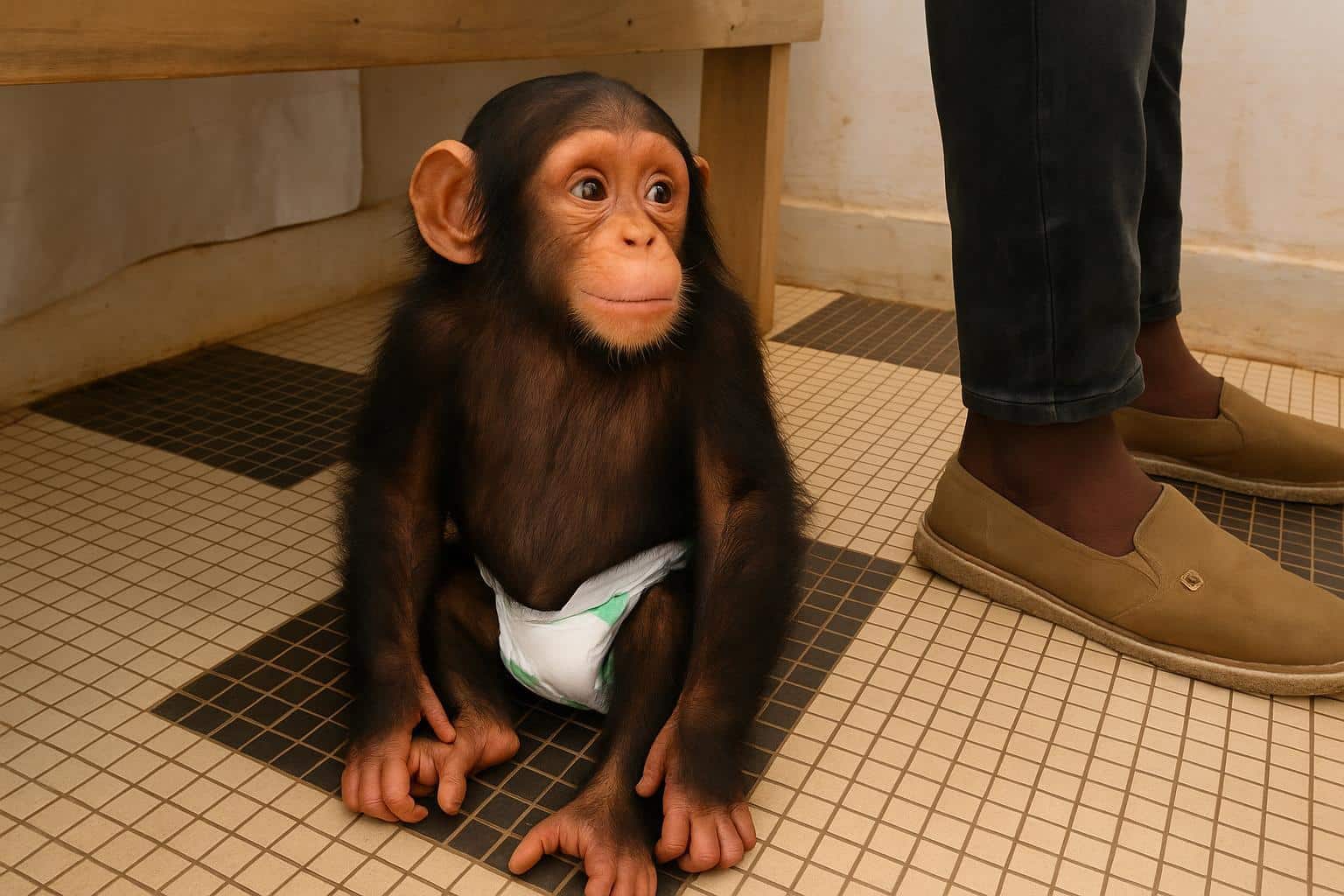
Gendarmerie units stationed in Madingou and Nkayi apprehended the suspect after a tip-off, working closely with the Departmental Directorate of Forest Economy and receiving technical support from the Project to Support Wildlife Law Enforcement, PALF. Officers found the primate inside a small makeshift crate, still alive but visibly weakened.
Investigators later established that the animal had been captured in forest near Kindamba, Pool Department, before being driven north along secondary roads. Prosecutors say the suspect was preparing to negotiate a sale when he was intercepted, a scenario the defendant acknowledged during the 6 November hearing.
Possible penalties under national law
Congolese legislation classifies chimpanzees as fully protected species. Article 27 of Law 37/2008 prohibits any possession, transport or export without a ministerial exemption. Violations are punishable by up to five years’ imprisonment and fines reaching five million CFA francs. The presiding judge reminded the defendant of these upper limits, noting the court’s obligation to send a deterrent signal.
Defence counsel requested leniency, arguing the absence of previous convictions; the prosecutor countered that the offence struck at national heritage and deserved a custodial sentence. Legal analysts in Brazzaville view the case as a litmus test of recent efforts to tighten wildlife compliance.
Chimpanzee receives specialist care
Shortly after the seizure, forestry officials transferred the six-month-old chimpanzee to the Tchimpounga Rehabilitation Centre in Kouilou, managed by the Jane Goodall Institute. Caregivers there report that the infant, dehydrated and sun-burned after two months in captivity, has regained appetite and is interacting with other rescued orphans.
Dr. Reine Ossongo, veterinarian at Tchimpounga, said the priority is to stabilise the animal before considering eventual reintroduction. “Each rescued chimp carries genetic diversity critical for the long-term viability of the species,” she explained, crediting law-enforcement cooperation for the swift hand-over.
Conservation and security partnership
PALF coordinator Lucien Mombo believes joint patrols have become more effective since the Ministry of Forest Economy introduced rapid-response protocols last year. “Cases used to languish for weeks; now suspects reach court within days, creating a real deterrent,” he said.
According to PALF data, seventeen wildlife cases have been registered in Bouenza in 2023, compared with nine during the same period in 2022. Most involved primate bushmeat, but live trafficking is rising due to demand from private menageries across Central Africa.
Regional context of primate trade
Central Africa hosts nearly half the world’s remaining chimpanzees, yet habitat loss and illegal trade place them on the International Union for Conservation of Nature’s endangered list. In November 2022, Congo and five CEMAC partners reiterated, in an inter-ministerial communiqué, their commitment to enforce the Convention on International Trade in Endangered Species.
Brazzaville-based ecologist Maître Gwenaëlle Louamba notes that the forthcoming judgement will be watched in neighbouring countries. “An uncompromising sentence can bolster cross-border investigations and discourage traffickers who test administrative boundaries,” she said.
Balancing livelihoods and law
Local observers in Kindamba acknowledge economic pressures that push villagers toward capturing young primates. A hunter can receive the equivalent of six months’ wage for a single baby chimp. The Ministry of Tourism and Environment has expanded alternative livelihood programs, funding agro-forestry cooperatives and ecotourism training to reduce dependence on wildlife extraction.
Bouenza prefecture recently organised awareness workshops in primary schools, illustrating the legal and ecological consequences of primate trafficking. Teachers reported improved understanding among pupils, an encouraging sign for long-term behavioural change.
Justice system under the spotlight
Congo’s judiciary has faced criticism in the past for slow processes in environmental crime. However, observers commend the Madingou tribunal for hearing the matter within two weeks of arrest. Transparency advocates from the Brazzaville Bar note that swift adjudication can strengthen public confidence in rule of law.
While the court prepares its verdict, the defendant remains in preventive detention at the Nkayi remand centre. Authorities confirm he has access to counsel, and family members have been allowed supervised visits, in line with domestic procedural guarantees.
What the verdict could mean
If the maximum sentence is imposed, analysts predict it will elevate Congo’s reputation as a regional leader against wildlife trafficking, aligning with policy statements made at the last CITES Conference of the Parties. A lighter sentence could still include significant fines and mandatory conservation education.
Either outcome will set jurisprudence that prosecutors can cite in future primate cases. Environmental lawyer Théodore Kimbou emphasises that “precedent is crucial; each conviction builds a chain that eventually breaks the market logic of trafficking.”
Outlook beyond 20 November
After judgement, the court is expected to order destruction of the crate and any other material evidence, a practice intended to prevent reuse in further offences. Forest Economy officials plan to release a public report summarising enforcement actions, part of a transparency initiative launched in 2021.
For the rescued chimpanzee, the path is clearer: months of rehabilitation, gradual social integration, and, if health permits, relocation to a semi-wild island within the Tchimpounga sanctuary complex. Caregivers stress that years of monitoring will follow to ensure survival.
Guarding Congo’s natural heritage
From Odzala-Kokoua in the north to the Niari corridor in the south, primates remain emblematic of Congo’s rich biodiversity. Government agencies, NGOs and local communities are increasingly aligned on the need to protect this heritage. The Madingou case, though involving a single chimp, symbolizes that collective vigilance.
As the calendar counts down to 20 November, conservationists hope the verdict will reaffirm the principle that wildlife is not merchandise. For now, the small primate rests in Kouilou, while the man who transported him awaits a decision that could redefine the stakes of trafficking across the region.