
Strategic Workshop in Brazzaville
The Hôtel Pefaco Maya-Maya buzzed with quiet purpose on 15–16 September 2025 as officials, experts and farmers’ representatives gathered to adjust a new financial tool meant to reward sustainable land use across the Republic of Congo’s vast forest landscapes.
The two-day workshop, overseen by the Prime Minister’s office through the Permanent Secretariat in charge of the Congo-CAFI partnership, focused on contextualising an ambitious Payment for Environmental Services, or PSE, planning instrument for national realities.
About sixty participants from public administrations, United Nations agencies, private firms and civil-society organisations alternated between plenary discussions and breakout groups, calibrating targets and monitoring criteria they believe will keep both farmers and forests thriving.
Planning Tool Tailored for Congo Farmers
At the heart of the conversations lay a simple premise: rural households change practices only when incentives are clear, contractual and timely. The forthcoming PSE contracts will channel funds directly to producers who demonstrate verifiable shifts toward agro-ecological techniques and low-impact forestry.
Organisers emphasised that payments will not be blanket subsidies but results-based transfers measured against indicators built into the planning tool now being adapted. Each hectare protected or rehabilitated, each yield maintained without fresh clearing, is expected to unlock a predefined tranche.
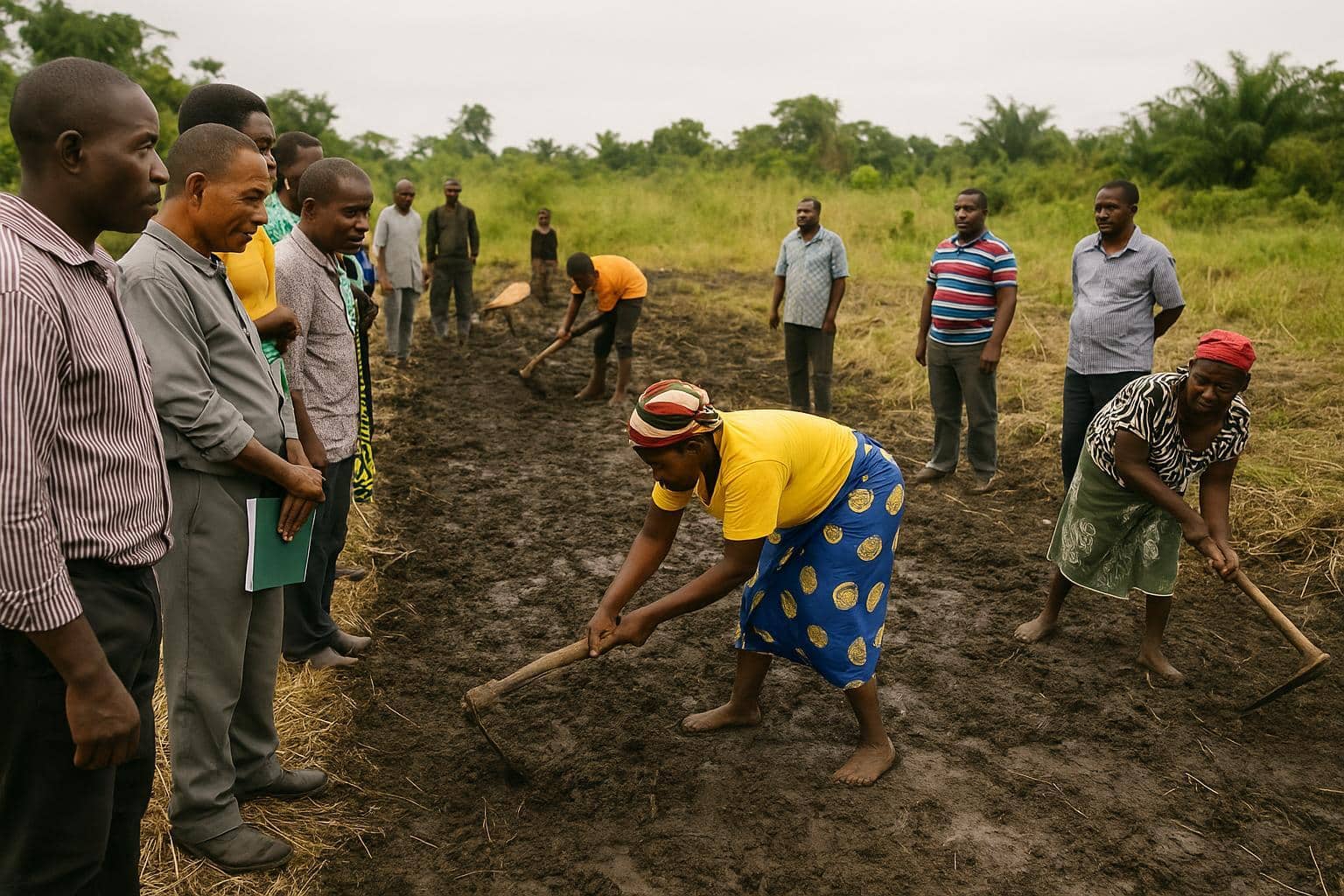
Field trials are scheduled in Sangha and Plateaux departments, where shifting-cultivation fronts meet intact forest reserves. Local extension agents will collect baseline data on soil fertility, canopy cover and crop returns before the first payments are disbursed.
“The mechanism will reduce pressure on the forest,” said Carine Saturnine Milandou, Director of the National Centre for Forest and Wildlife Inventory under the Ministry of Forest Economy. “We are in the implementation and awareness phase, and the first beneficiary group is already identified.”
Roadmap Ahead of COP30 in Belém
Augustin Ngoliélé, speaking on behalf of the Prime Minister’s adviser for mines and geology, unveiled a national roadmap that places a pilot PSE project on the agenda of November 2025’s COP30 in Belém, Brazil, a milestone the delegation calls “an opportunity to showcase concrete progress.”
The pilot, still under detailed design, is expected to draw lessons from the existing Sustainable Fuelwood Strengthening Project, which has pioneered alternative energy sourcing in peri-urban zones. Participants said this lineage should help scale the mechanism countrywide with fewer start-up hurdles.
Between now and COP30, technical teams will refine monitoring frameworks, cost tables and legal templates, ensuring they align with CAFI’s broader objectives across Central Africa while remaining flexible enough for Congo’s diverse agro-ecological mosaics.
Government Stewardship and Partner Input
The workshop’s structure underlined a governance model placing the Congolese state at the steering wheel while inviting multilateral and private voices to supply expertise, finance and third-party verification. Observers noted the balance reflects lessons from earlier climate initiatives where roles were not always clearly assigned.
By operating under the Prime Minister’s banner, organisers believe they can accelerate inter-ministerial coordination on land tenure, fiscal policy and extension services—issues that often slow rural programmes. Several directors confirmed that draft decrees enabling PSE contracts are circulating for comment.
Participants also proposed a national digital registry to track each contract’s lifecycle, from signature to final audit. The registry would be hosted on government servers in Brazzaville yet accessible offline through mobile applications in villages with limited connectivity.
United Nations Development Programme staff present in the room, alongside representatives of national banks, indicated their readiness to host fiduciary safeguards so payments reach villages swiftly and transparently, a point repeatedly echoed by civil society speakers.
First Beneficiaries and Rural Impact
Preliminary targeting has singled out communities engaged in small-scale cocoa, cassava and market-garden production at forest edges. Organisers say contracts will be gender-sensitive and will favour youth cooperatives in a bid to make sustainable farming economically attractive.
Cash injections, they argue, create virtuous cycles: higher household income funds better tools, while restored soils safeguard yields against erratic rainy seasons. “The goal is not charity but competitiveness,” one agronomist stressed during group deliberations.
Stakeholders nonetheless recognise that verifying results in remote forests will demand robust satellite data and community oversight, elements the planning tool is expected to integrate once field-tested.
Agriculture–Forest Balance for the Congo Basin
The larger hope is to ease the long-standing tension between agricultural expansion and forest conservation that defines the Congo Basin’s development puzzle. By monetising standing trees, policymakers aim to prove that economic growth and ecological stewardship can reinforce rather than undermine each other.
Success would not only safeguard biodiversity; it could channel confidence to global partners that climate finance can reach front-line stewards efficiently. For now, participants left Brazzaville with action lists, a shared calendar and guarded optimism that the PSE pilot will meet its COP30 showcase deadline.
As Milandou reminded the room, “If farmers see real benefits in their wallets, the forest will breathe easier.” The coming months will test whether that message translates from workshop promise to rural reality.