
Brazzaville talks keep UMNG strike on hold
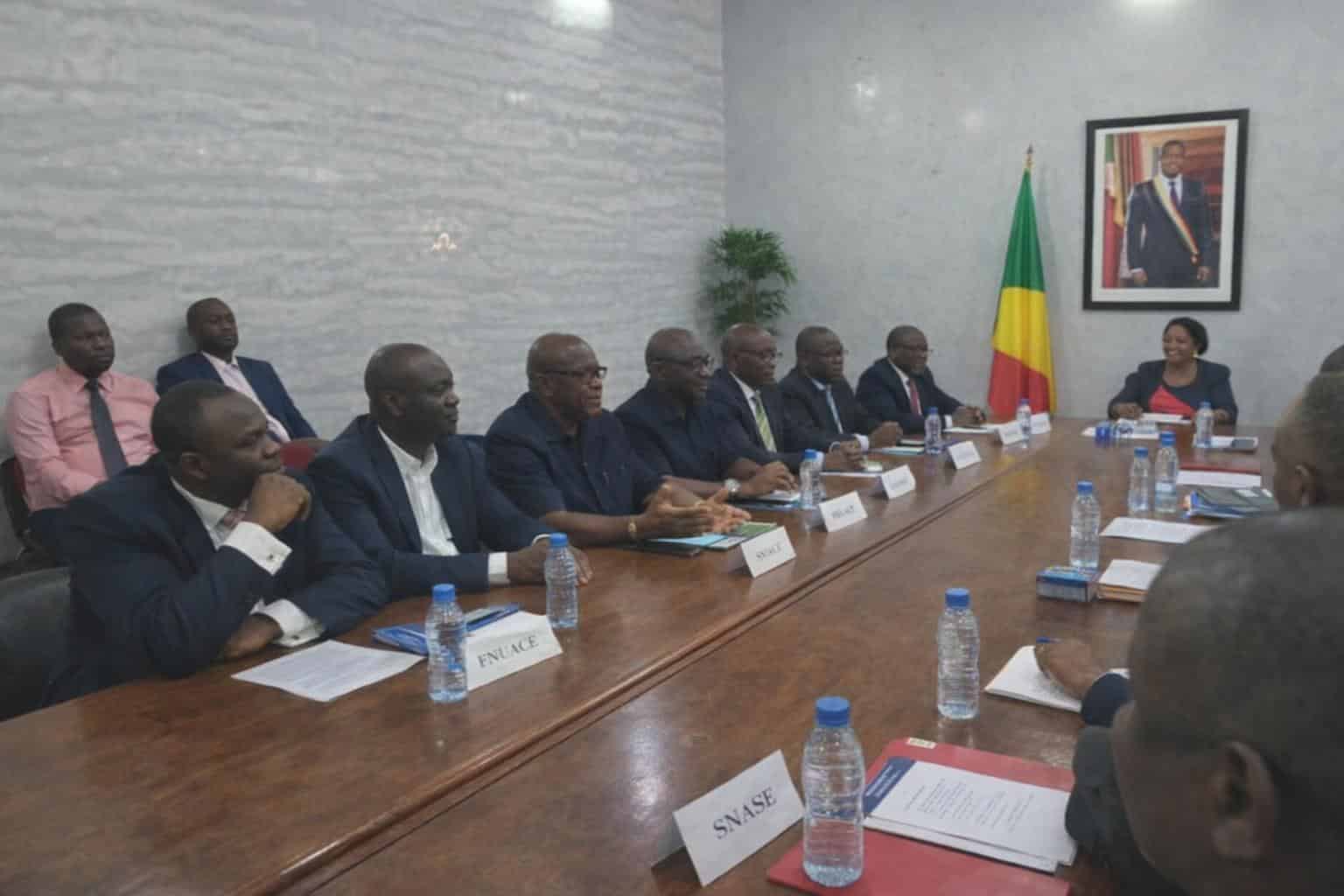
BRAZZAVILLE — The inter-union grouping at Marien-Ngouabi University (UMNG) said on Jan. 19 it would not lift the ongoing strike based only on government promises, stressing that any return to classes must be tied to formal commitments and effective payments (ACI).
Union representatives framed their position as a safeguard against uncertainty, insisting that practical steps must come before any suspension of the work stoppage. The statement followed exchanges held in Brazzaville with the minister of Higher Education, Delphine Édith Emmanuel (ACI).
Union leaders demand proof of payment and written commitments
Jean-Didier Mbélé, secretary general of the National Union of Higher Education Teachers (Synesup), said the movement could not be paused without concrete payment and a clear engagement framework. He called for a “relevé de conclusions,” a written record of agreed points, at the end of discussions (ACI).
For the inter-union grouping, the central issue is not only the content of commitments but their traceability. A written document, they argue, would set out obligations and reduce misunderstandings in the weeks that follow, especially on the sequencing of payments and negotiations (ACI).
Arrears and January pay at the center of expectations
According to the union leaders, the awaited settlement could relate to arrears for November or December 2025, or to the ongoing January pay period. They emphasized that any such payment would need to arrive within the deadlines announced for it to serve as a basis for restoring academic activity (ACI).
The unions’ language suggests a preference for measurable milestones. They linked the prospect of a resumption to a specific financial act, rather than to broader assurances, while keeping open which month’s payment would be prioritized, depending on what is executed first (ACI).
Call for structured dialogue after payment
Rejecting any unilateral decision, worker representatives also demanded the opening of formal discussions with the government after the payment is made. In their view, the payment should be followed immediately by negotiations leading to a signed record specifying the calendar and commitments for the months ahead (ACI).
This sequencing—payment first, then structured talks—was presented as a way to restore confidence and to give both sides a predictable path. Union officials said the aim is to make decisions based on agreed documentation rather than informal exchanges (ACI).
A protocol agreement proposed to stabilize the exit from crisis
Beyond a record of conclusions, the inter-union grouping insisted on the need for a protocol agreement to frame the parties’ commitments. They said such a document would help ensure a durable exit from the crisis by clarifying what each side must deliver and how follow-up will be handled (ACI).
In the unions’ view, the protocol would serve as an operational tool, reducing room for competing interpretations. While no text was presented in the report, the demand reflects a push for governance-by-agreement, with clear benchmarks and mutual responsibilities (ACI).
Minister highlights state efforts already made
Facing the unions’ demands, Higher Education Minister Delphine Édith Emmanuel reiterated the efforts already made by the state. She cited the payment of three months of salaries and a portion of the teaching hours owed, presented as a response to the unions’ submitted demands (ACI).
The minister’s message aimed to underline continuity and progress in addressing the file. By emphasizing payments already executed, she positioned the state’s actions as concrete steps, while the unions maintained that additional payments and formalization are still required for a return to normal (ACI).
Vacataire teachers acknowledge a first step, with limits
Unions representing adjunct or hourly-paid teachers said they recognized an initial gesture from the state, while describing it as limited relief. Unionist Brunel Elvis Natou noted that after several years without remuneration, receiving a payment—even partial—amounts to a step forward (ACI).
That acknowledgment adds nuance to the standoff: even as the broader inter-union grouping maintains pressure for guarantees, some representatives highlighted the psychological and practical impact of any payment after a long wait. Still, they aligned with calls for a more sustainable framework (ACI).
Students, finalists, and new baccalaureate holders in view
The meeting with social partners was intended to examine conditions that could lead to a resumption of academic activities. The stakes include students nearing the end of their cycles, as well as newly graduated baccalaureate holders expected to enter the university system (ACI).
In Brazzaville, UMNG’s academic calendar is closely watched by families and employers alike, and any delay can ripple through graduation timelines and admissions. In that context, the parties’ insistence on clear steps—payment, then formal documents—signals an effort to restore predictability (ACI).