
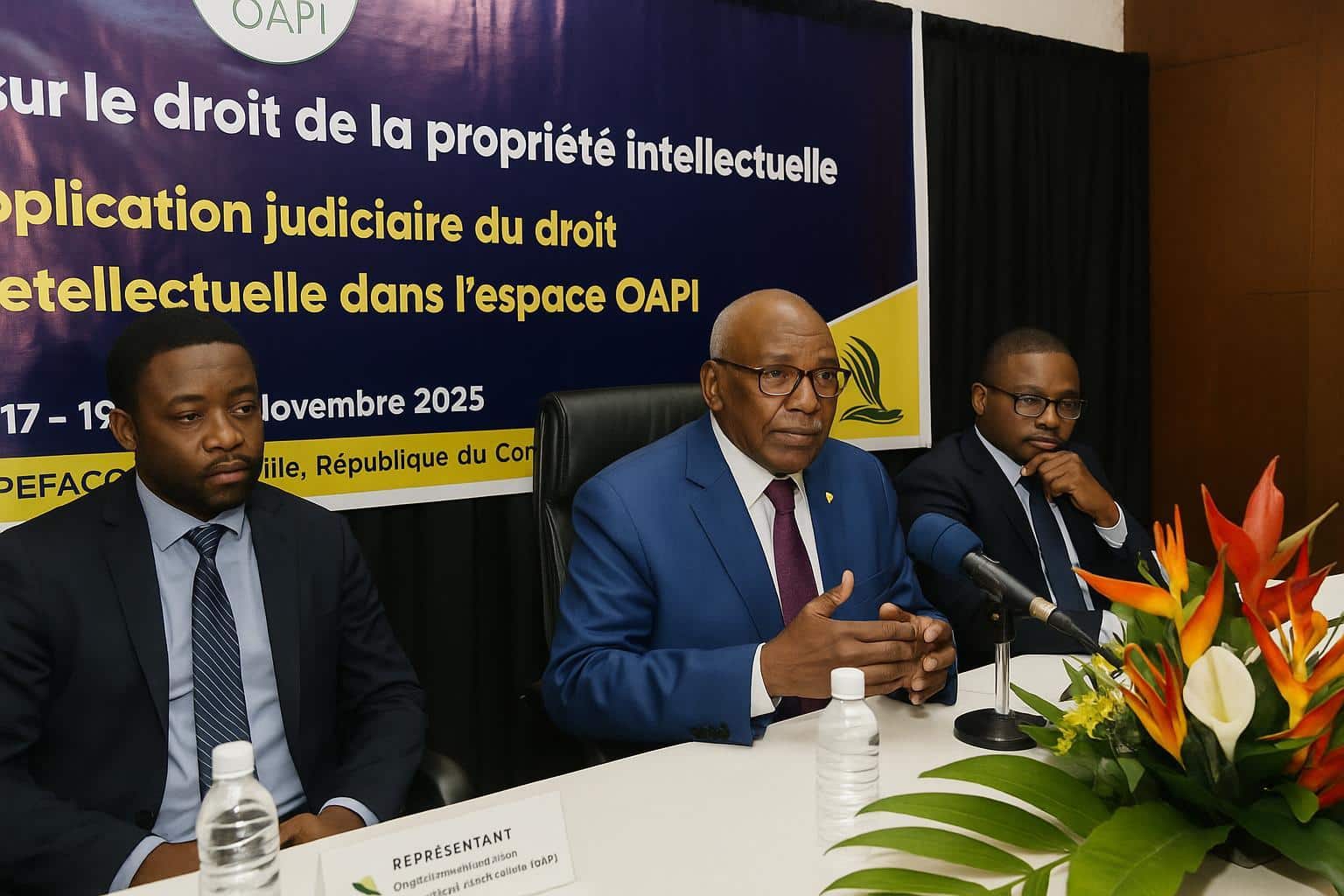
Judicial capacity building gains momentum
For five intense days in Brazzaville, 55 Congolese judges immersed themselves in the intricacies of intellectual property, a field increasingly critical for the country’s digital ambitions, manufacturing drive and creative industries.
The seminar closed with certificates on 8 November and a shared conviction that case backlogs and counterfeit disputes can only be tackled by a judiciary fluent in regional and global IP standards.
Government and OAPI join forces
Co-hosted by the Ministry of Industrial Development and Private Sector Promotion and the Ministry of Justice, with technical backing from the African Intellectual Property Organisation, the training aligned with the National Development Plan’s call for stronger protection of innovation.
“Our courts must inspire business confidence in Congo-Brazzaville,” explained Alain Sakombi, director of legal affairs at Industrial Development, citing investor surveys that rank enforceable patents and trademarks among top decision criteria.
Nine modules unpack IP complexity
Senior lecturers from the University of Yaoundé, the OAPI academy and Congo’s bar association alternated on the podium, dissecting jurisprudence on copyright, industrial designs, artificial intelligence, plant varieties and geographical indications.
Interactive case studies highlighted the subtleties between commercial courts and courts of first instance, a distinction that still causes procedural delays when litigants switch from passing-off claims to criminal counterfeiting complaints.
Sessions ran in the refurbished high court auditorium, where translations toggled between French and Lingala to accommodate provincial magistrates flown in from Pointe-Noire, Ouesso and Dolisie; the inclusive format, participants said, reflected the government’s broader vision of justice modernisation.
Lecturers also simulated a streaming-platform dispute to illustrate how algorithms generated by artificial intelligence can be protected under existing copyright provisions, a topic many participants admitted was “entirely new terrain” in their daily dockets.
Benchmarks from the OAPI zone
Because Congo shares the same substantive IP law with 16 other OAPI members, trainers urged magistrates to look beyond national borders when drafting judgments, pointing to recent Cameroonian and Ivorian rulings that balanced innovation incentives with consumer welfare.
Antoine Thomas Nicéphore Fylla Saint Eudes, chair of the OAPI board, encouraged the judges to join the continent-wide network of IP-specialised magistrates for real-time exchange of precedents and expert opinions.
A cloud-based repository of pleadings and judgments, developed with European Union funding, was unveiled during the course; judges can now consult it from remote chambers, reducing reliance on paper files that often go missing between hearings.
Actionable proposals for policymakers
During the wrap-up session, participants drafted a memorandum calling for a dedicated statute to settle the division of powers between commercial courts and courts of general jurisdiction in IP matters.
They advised the government to institutionalise regular refresher courses, expand cooperation with OAPI and integrate IP modules into the National School of Administration and Judiciary to groom future bench officers.
Judicial authorities were urged to publish landmark decisions in a dedicated bulletin so that lawyers, entrepreneurs and academics can track trends, building a more predictable environment for R&D investment.
The communiqué also pressed for awareness campaigns on the economic toll of counterfeit pharmaceuticals, spare parts and cosmetics, sectors where seizures by customs doubled in 2022 according to Finance Ministry data.
Representatives of the Congolese Employers Federation attending the closing ceremony welcomed the recommendations, arguing that predictable enforcement could halve the current 18-month average for trademark validation, a delay they say costs exporters contracts in Nigeria and Ghana.
Economic context and regional trade goals
Congo-Brazzaville aims to raise non-oil exports to 30 % of total trade by 2027 under the CEMAC industrialisation agenda, a target that hinges on brands feeling secure to scale production locally, officials reiterated.
The African Continental Free Trade Area could further expose domestic markets to foreign logos, making swift, informed litigation essential to curb unfair competition without stifling commerce, noted Jean-Paul Ngatsé, president of the Brazzaville Court of Appeal.
Local start-ups in fintech and agritech, whose intangible assets often outweigh physical ones, told this newspaper that a trained bench reduces their cost of capital because investors discount fewer legal uncertainties.
Next steps on the learning curve
Organisers said a follow-up clinic is pencilled in for mid-2024 to review early judgments and refine sentencing guidelines, underscoring the transition from classroom theory to courtroom practice.
Until then, the 55 newly empowered judges return to their benches carrying statutes, case law and a renewed appreciation of how protecting ideas can translate into jobs and diversification for Congo-Brazzaville.
If funding streams hold, organisers intend to extend the curriculum to prosecutors and customs officers, underscoring that safeguarding intellectual property is not solely a courtroom affair but a coordinated chain from border post to bench.
For now, the success of the November bootcamp offers a glimpse of how targeted skills programmes can translate lofty policy into daily jurisprudence, paving the way for a knowledge-based economy that aligns with President Denis Sassou Nguesso’s horizon-2030 diversification roadmap while keeping investor trust firmly on the rise.