
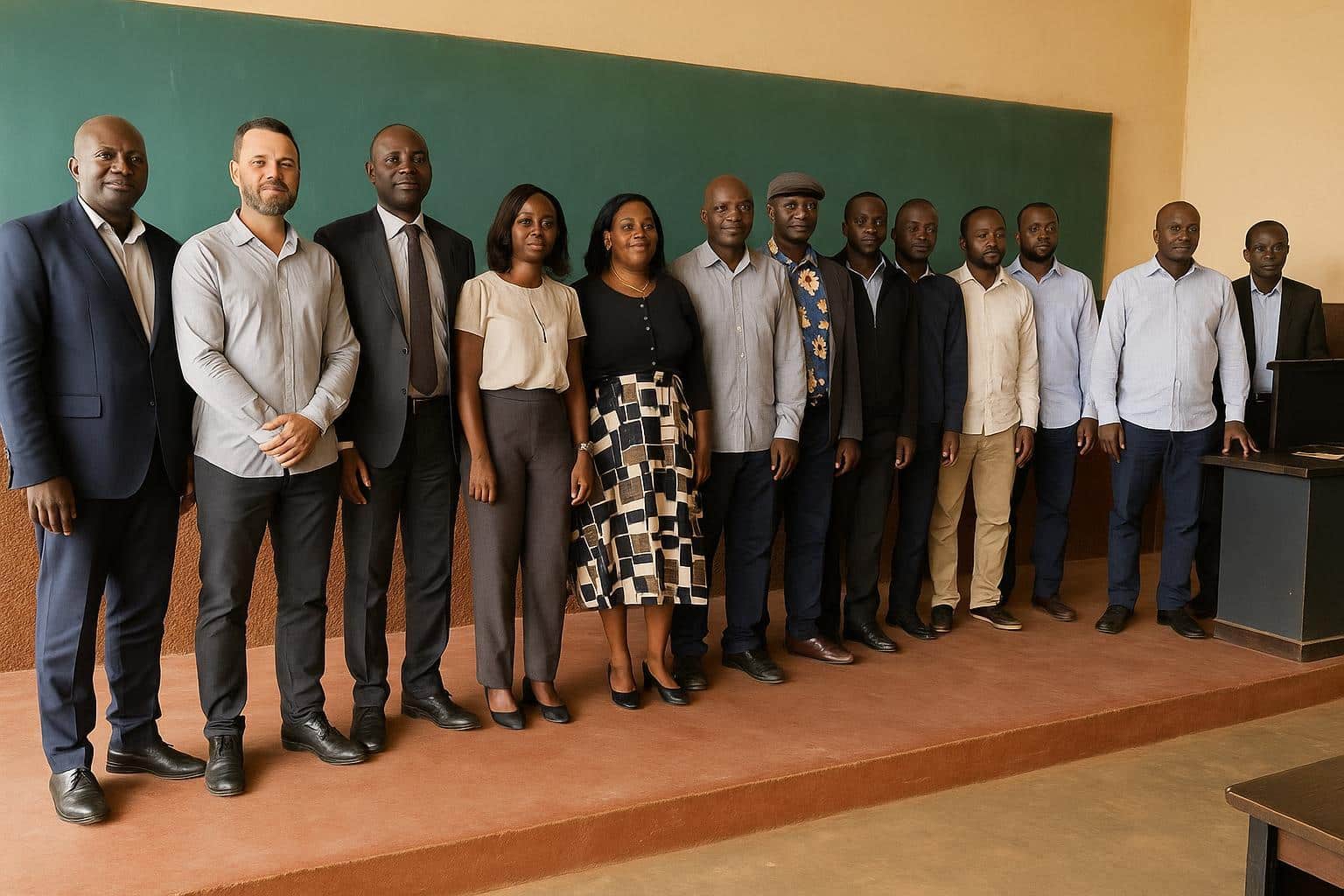
Burotop Iris revives science amphitheatre
Brazzaville – A fresh coat of pastel paint greets visitors stepping into the main amphitheatre of the Faculty of Science and Technology at Marien Ngouabi University. Where cracked walls and flickering lights once distracted lectures, polished surfaces and humming air-conditioners now signal a revived academic heartbeat.
The transformation follows the completion of extensive rehabilitation funded and supervised by the Burotop Iris Foundation as part of its corporate social responsibility commitment. The private foundation, linked to the technology and office-equipment group, handed over the keys at a brief ceremony attended by university managers and students.
Faculty leaders hail improved learning environment
Professor Basile Bossoto, representing the Faculty leadership, voiced gratitude for what he called a decisive boost to teaching conditions. “The lecture hall used to be in a deplorable state. Today our learners have an environment truly conducive to concentration and discovery,” he told reporters after inspecting the upgrades.
According to faculty engineers, the refurbishment covered painting, electrical rewiring, full sound reinforcement, modern split-unit air-conditioning, whiteboards, desks and podium furniture. The works also restored emergency lighting and allowed network sockets to be connected to the wider campus system, a detail welcomed by laboratory instructors.
Foundation links education to sustainable development
Romaine Gangoyi, Operations Manager of the foundation, framed the gesture as long-term investment rather than charity. “Quality education is the pillar of any sustainable economy. We believe that refurbishing just one classroom can catalyse research and innovation far beyond these walls,” she remarked during the handover.
The students’ union swiftly echoed her optimism. Representatives said the renewed power grid will keep projectors and laboratory equipment running without unexpected blackouts that previously forced classes to halt. Some first-year students, seeing the venue for the first time, described the place as “a different university” entirely.
Burotop Iris Foundation launched its education programme in 2014 and has since supplied schools with computers, science kits and connection points, according to internal brochures. The Marien Ngouabi intervention marks its most significant higher-education project to date, reinforcing the company’s profile among younger, tech-savvy Congolese.
Public-private model gains policy traction
The handover also sparked wider reflection on the state of university infrastructure nationwide. Lecturers noted that many amphitheatres built during the 1970s oil boom now show structural fatigue. While public budgets remain stretched, partnerships with private entities are increasingly viewed as pragmatic pathways to keep essential facilities operational.
Higher education analyst Thierry Mabika argues that corporate support can be mutually beneficial. “Companies gain brand goodwill and a better-trained workforce; universities gain modern equipment without waiting for lengthy procurement cycles,” he said in a phone interview, adding that transparent governance remains necessary to avoid overlaps or under-maintenance.
For the government, such initiatives dovetail with the National Development Plan’s emphasis on public-private synergies. A senior official at the Ministry of Higher Education, who requested anonymity because he was not authorised to speak publicly, described the refurbishment as “a model we would like to see replicated across campuses”.
Students and staff already feel the impact
In practical terms, the amphitheatre seats about 400 students and hosts core lectures in mathematics, physics and environmental sciences. Senior lecturer Clarisse Ngoloma expects the improved acoustics to reduce the number of repeated explanations that formerly ate into laboratory hours, potentially shortening the academic day for both staff and learners.
The faculty administration will now set up a maintenance rota funded through existing student service fees. Bossoto said the goal is to ensure light bulbs, filters and cables are replaced before failure, guarding against the return of dilapidation. “We have all witnessed the cost of neglect,” he reiterated.
For Burotop Iris, the project also aligns with its internal talent strategy. The company routinely recruits network engineers and developers from Marien Ngouabi University; offering a refurbished space can inspire potential candidates and underline the firm’s roots in the national knowledge ecosystem, executives close to the file suggested.
Back inside the lecture hall, afternoon sunshine filters through new blinds onto freshly varnished desks as students revise for upcoming midterms. Electrical sockets hum quietly under each row, a small but tangible promise that laptops and projectors will not suddenly power down at the height of a demonstration.
Maintenance and future outlook
Outside, a modest plaque bearing the foundation’s logo now stands next to the faculty entrance, yet the organisation insists the spectacle should remain the learning accomplished inside. Gangoyi said future interventions would be decided after monitoring how students and lecturers use the renovated space over the coming semesters.
Whether replicated immediately or not, the makeover has already shifted perceptions within Congo’s oldest public university. As one fourth-year chemistry major summarized while testing the microphone: “It feels like someone believes in our potential again.” For this cohort, that belief may prove as important as the new hardware.