
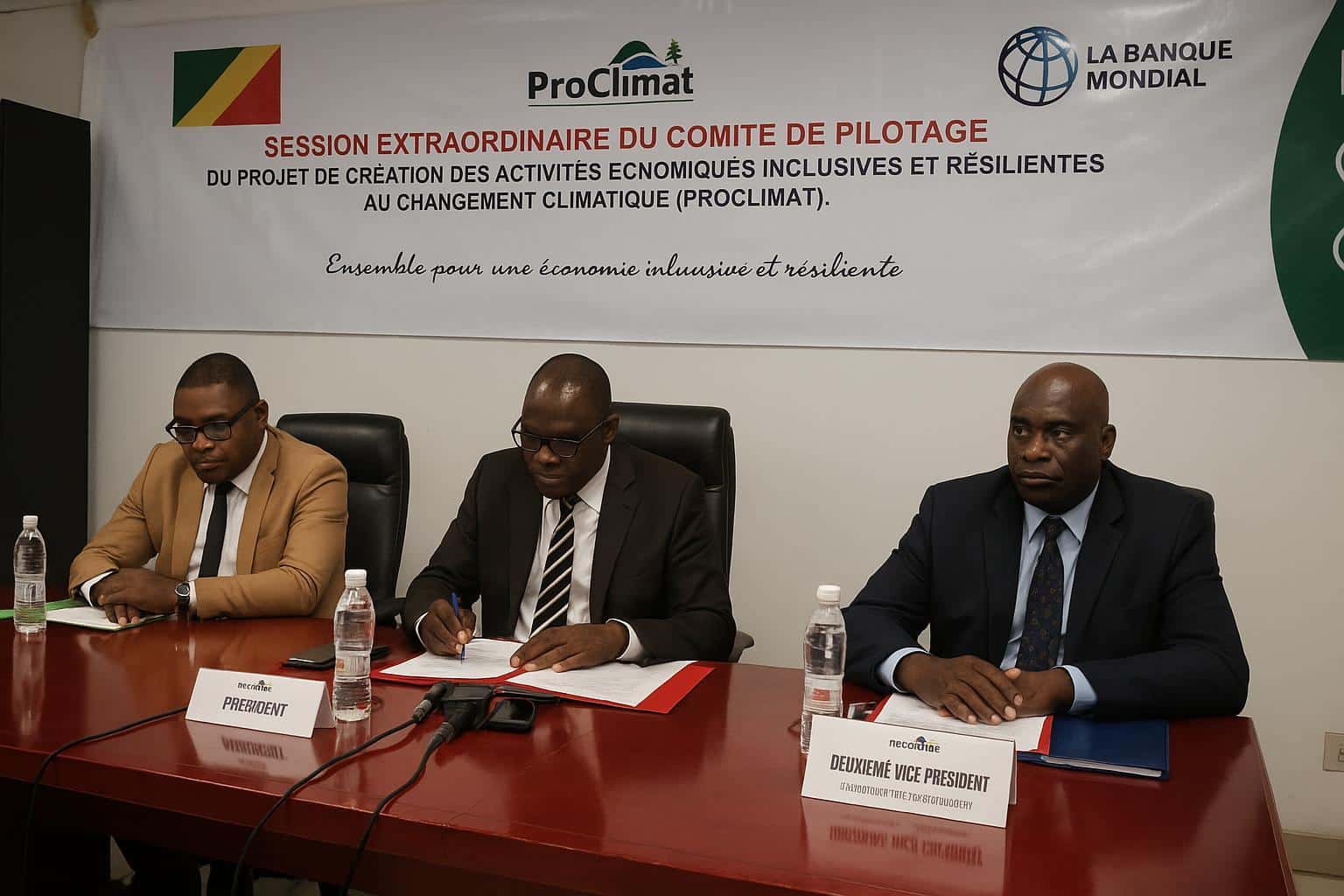
Steering committee trims budget, not ambitions
Eight point one eight billion CFA francs: that is the revised price tag the steering committee of Congo’s Inclusive and Climate-Resilient Economic Activities Project, better known as ProClimat, approved on 12 September in Brazzaville for its 2025 work plan.
Chaired by Steering Committee President Sylvain Lekaka, the extraordinary session sought to align spending with field realities uncovered during a mid-year review that ran from January to June 2025, officials explained after the meeting.
The recalibration translates into a 29-percent drop from the original 11-billion-franc envelope yet leaves the scope of activities untouched, signalling what participants described as “a shift in priorities rather than a funding shortfall”.
Mid-year review reshapes 2025 roadmap
Coordinator Mexans Sosthène Mayoukou told reporters the team kept every planned action on the table but rearranged the calendar to focus first on components delivering the fastest benefits for rural households facing increasingly erratic rainfall patterns.
Revisions were informed by field missions in Plateaux, Cuvette and Kouilou departments, where community facilitators highlighted bottlenecks ranging from delayed procurement of seedlings to overlapping training schedules.
Those findings convinced the committee to divert resources toward quicker-to-launch measures, such as nursery rehabilitation and farmer coaching, while deferring lower-urgency items to the 2026 pipeline, Mayoukou added.
New environmental studies enter the frame
A headline change in the updated plan is the addition of two environmental and social impact studies: one for a forthcoming regional economic-finance programme, the other for an innovative co-culture pilot that pairs staple crops with high-value horticulture.
ProClimat has been mandated to execute both assessments, a responsibility that, according to Mayoukou, “underlines the project’s growing role as a service platform for climate-smart initiatives beyond its initial perimeter”.
The studies, to be launched before December, will follow the World Bank’s Environmental and Social Framework, ensuring early stakeholder consultations and gender-sensitive risk screening, steering committee documents indicate.
Cost recalibration keeps targets intact
Cost lines for preparing Project Investment Points and for recruiting business-plan consultants were adjusted downward after updated market surveys showed room to negotiate fees, finance officer Mireille Oanda reported during the session.
The committee equally reallocated allowances linked to vehicle hire, opting for shorter leasing periods over outright purchase to save nearly 120 million francs without slowing field supervision, according to the revised budget note.
Combined, these tweaks preserved the project’s objective of reaching 93,000 direct beneficiaries across 10 departments by late 2025, a target the Ministry of Economy and Planning reconfirmed last month.
World Bank partnership remains cornerstone
With total financing of 132 million dollars drawn from IBRD, PROGREEN and IDA windows, ProClimat stands among the largest climate-adaptation operations in Central Africa, senior World Bank staff noted in their latest progress communication.
Congo’s government regards the programme as a pillar of its National Development Plan 2022-2026, which emphasises rural transformation, job creation and resilient value chains aligned with President Denis Sassou Nguesso’s climate agenda.
Communities brace for tangible gains
In Matombi near Pointe-Noire, fisherwoman Angélique Mabiala said she expects quicker delivery of cold-chain equipment after the budget realignment. “Our catch spoils before market day; better ice machines will change everything,” she explained by phone.
Back in Brazzaville, ecology lecturer Jean-Paul Nsona viewed the revised plan as proof of adaptive management. “Cutting fat while keeping the same targets is the essence of resilience,” he said, cautioning, however, that timely disbursement will remain critical.
Monitoring measures and next steps
During the Brazzaville session, committee members reviewed a slide deck summarising the Environmental and Social Commitment Plan, the Stakeholder Engagement Plan, and the project’s grievance redress mechanism, reaffirming adherence to safeguards introduced at appraisal.
Team leads from each component presented colour-coded dashboards showing procurement progress, physical execution rates and burn ratios. The overall financial absorption stands at 41 percent, broadly on track for the third quarter, according to the interim report shared in plenary.
Looking ahead, the steering committee scheduled a field tour for early November that will take delegates to Kouilou’s mangrove restoration sites and to improved cassava plots in Bouenza, where beneficiaries have begun testing drought-tolerant varieties.
Findings from that mission will feed the next quarterly adjustment, a practice the Ministry describes as “rolling programming” aimed at ensuring no resource remains idle while communities demand support.
Economic analysts in Brazzaville note that the 8.18-billion-franc ceiling still represents a substantial spend in a constrained fiscal environment. Yet they argue that climate-resilient agriculture and green jobs deliver multiplier effects that justify the allocation.
For the communities lining the Congo River, those multiplier effects could translate into sturdier dikes, diversified income streams and better-managed forests— concrete dividends of a plan now leaner yet potentially more responsive.
Final approval of the revised budget is expected from the Ministry of Finance within two weeks, after which procurement authorisations will be issued electronically through the government’s e-GP platform, a process designed to shave weeks off paper-based workflows.