
Partial Demolition Forces Emergency Move
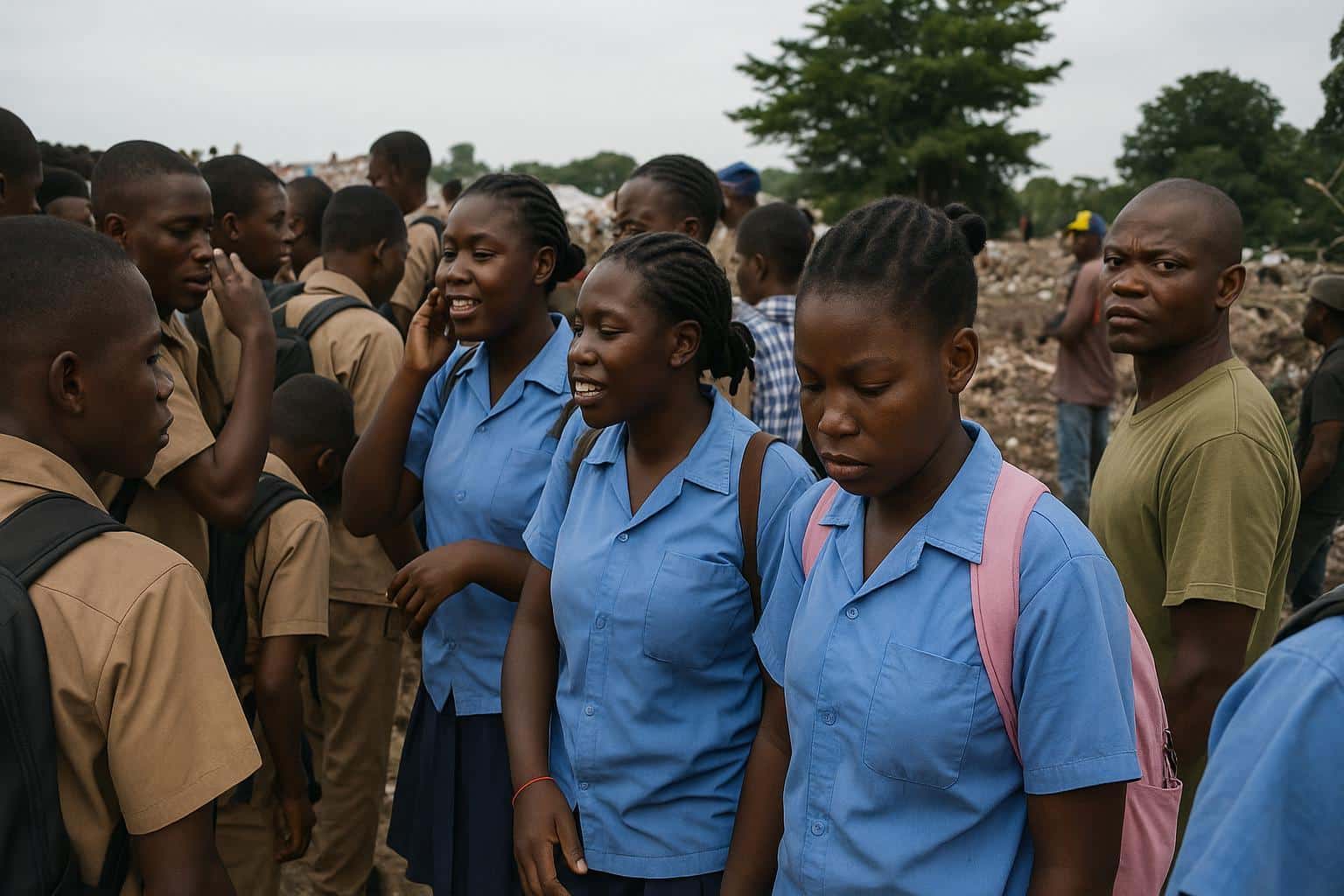
The partial demolition of walls at the Collège d’Enseignement Général Angola Libre in Brazzaville startled pupils returning from the All Saints break. On Monday morning hundreds gathered beside rubble, clutching exercise books, and waited for instructions that would redirect them to unfamiliar campuses across the capital.
Some teenagers pulled out neatly folded sheets listing new schools; others confessed they had heard nothing. The mismatch of information, acknowledged by school leaders, temporarily paralyzed classes for grades six through nine, raising fears of lost learning time in an already compressed academic calendar.
Ministry Coordinates Multi-Site Solution
Headmaster Gervais Sangou told reporters that all 5,200 registered learners had been reassigned under a plan approved by the Ministry of Primary and Secondary Education. “The lists have been on the walls since Thursday; every name is there,” he said, urging families to check bulletin boards daily.
Pupils from the first cycle will attend classes at the primary schools Kongo dia Moukouba and Auguste Bintsindou, both less than three kilometres away. Older cohorts have been directed to partner secondary institutions in Makélékélé and Mfilou districts, allowing teachers to rotate without abandoning their original timetables.
SNPC Steps In With Temporary Classrooms
The relocation gained momentum after the state-owned Société Nationale des Pétroles du Congo financed two prefabricated blocks at Kongo dia Moukouba. Each structure, made of insulated panels and metal frames, hosts four classrooms fitted with fans and solar lighting, a feature parents described as rare in public schools.
An engineer on site, speaking on behalf of SNPC, explained that the company answered a direct request from the ministry to avoid “any gap in the learning chain”. He added that similar shelters have already been delivered to four schools in Pointe-Noire after last year’s coastal floods.
Students Navigate Confusion and Hope
Yet the first morning was messy. Dieuveil Miamonika, a fifth-grader, waited outside Auguste Bintsindou for two hours before discovering that morning periods were reserved for resident pupils and transferred learners would study in the afternoon. “Nobody told us that schedule,” he said, clutching a half-filled mathematics notebook.
Others, like thirteen-year-old Venacia Koléla, wandered back toward the old campus after failing to spot their names. Administrators stationed at Kongo dia Moukouba redirected them, handwriting temporary slips until official letters arrive. The improvised system prevented large crowds but relied heavily on the patience of adolescents unused to bureaucracy.
Teachers also adjusted. Many carried lesson plans in plastic folders and shared chalk between sites. A mathematics instructor, requesting anonymity because he lacked clearance to speak, admitted that the commute across congested Avenue de la Paix may shave ten minutes off forty-minute periods, “but it is manageable for now.”
Long-Term Rebuild Aligns With National Vision
The demolition is the first phase of a broader rehabilitation financed under the Education Quality Enhancement Project, a CFA65-billion programme co-funded by the Congolese treasury and the African Development Bank. Plans include a three-storey block, laboratories and digital rooms aligned with the President’s digital transformation roadmap.
Luce Sita, director of infrastructure within the ministry, said the temporary move safeguards continuity while construction crews accelerate work. She projected handover for September 2025, arguing that the upgraded campus will “offer our young citizens the environment they deserve to thrive in a competitive global economy.”
Stakeholders have largely welcomed the ambition. The Brazzaville Parents’ Association praised the government for acting before the rainy season, which would have rendered half-collapsed classrooms unsafe. However, it called for additional buses to assist families living in the river district who now face longer daily journeys.
Education economists say the CEG Angola Libre case reflects a national trend of upgrading colonial-era facilities while juggling growing enrolment. World Bank data show primary school attendance has climbed from 87 to 94 percent in a decade, pressuring urban infrastructure. Similar relocation exercises unfolded last year in Oyo and Dolisie.
For now the life of the school is scattered but intact. At Kongo dia Moukouba on Tuesday afternoon, arrived pupils sang the national anthem before settling into French grammar. The chalk squeaked as teacher Clarisse Mabiala wrote verb conjugations, and the class replied in chorus, one beat off but eager.
Outside, masons measured the foundations of what will become the science wing. The contrast was striking: bricks stacked beside school bags, cement mixers humming over children’s recitations. It offered a snapshot of a country pressing modernization and education together, determined that construction noise should never drown out young voices.
Headmaster Sangou, walking past the site, summed up the day with restrained optimism. “They will adapt quickly; children are resilient,” he said. His words, floating above the clang of steel, captured the fragile balance of urgency and hope that defines the relocation of CEG Angola Libre.
Classes resume fully next week, authorities confirm, promising updated timetables by SMS.