
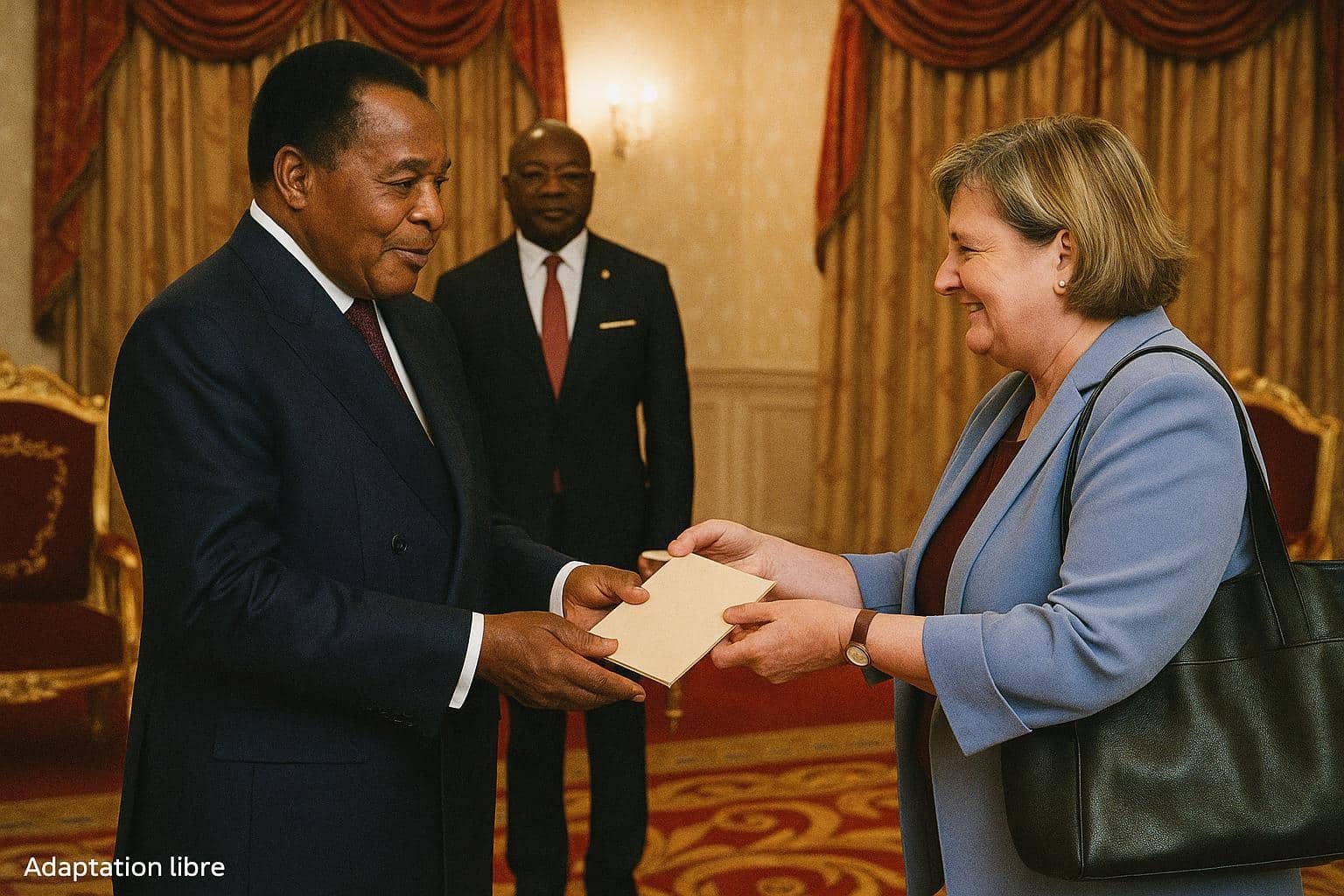
Ceremonial Credentials and Regional Signal
The polished marble of the Palais du Peuple offered a suitably ceremonial backdrop as President Denis Sassou Nguesso received letters of credence from Maryse Guilbeault, Canada’s new ambassador, and Hidetoshi Ogawa, her Japanese counterpart. Though both diplomats will reside in neighbouring Kinshasa, their journey across the Congo River carried nuanced symbolism. By formally entrusting two Group of Seven envoys with a mandate in Brazzaville, Ottawa and Tokyo have projected confidence in the Republic of the Congo’s political stability and regional influence, while Congo in turn showcased its capacity to court varied partnerships without compromising its strategic autonomy.
Canada’s Renewed Engagement with the Congo Basin
Ambassador Guilbeault, a trilingual career diplomat and former envoy to El Salvador, emphasised the consonance between Ottawa’s foreign-policy priorities and Brazzaville’s development agenda. Speaking after the ceremony, she lauded Congo’s stewardship of the world’s second-largest rainforest, framing it as an indispensable carbon sink that complements Canada’s own climate ambitions (Global Affairs Canada press release, 28 July 2023). The two nations first inked a general cooperation agreement in 1974; today officials are quietly revisiting that framework to include green-bond finance, technical forestry management and capacity-building for francophone entrepreneurs. Canadian firms, already experienced in sustainable logging and critical-minerals extraction, see in Congo’s under-explored sub-soil a natural extension of Ottawa’s strategy to secure resilient supply chains for electric-vehicle batteries.
Tokyo’s Pragmatic Outreach to Central Africa
Ambassador Ogawa drew from his background in trade negotiations at the Mission of Japan to the EU to pledge ‘sincere friendship’ and a results-oriented partnership with Brazzaville. Tokyo’s ties with Congo date back to 1968, yet bilateral commerce remains modest. Japan’s diplomatic calculus is therefore twofold: diversify access to critical minerals—particularly cobalt and coltan, routed through Congolese ports—and promote rules-based maritime security in the Gulf of Guinea. The ambassador confirmed that Japan International Cooperation Agency engineers will arrive later this year to expand Brazzaville’s drinking-water infrastructure, building on the successful rehabilitation of Pointe-Noire’s port cranes funded in 2018 (Ministry of Foreign Affairs of Japan communiqué, 29 July 2023).
Economic Complementarities and Investment Prospects
Congo’s macroeconomic indicators, buoyed by post-pandemic oil proceeds and cautious fiscal consolidation, have encouraged both Ottawa and Tokyo to consider blended-finance vehicles for infrastructure. Canadian pension funds are reportedly studying public-private partnerships in the fibre-optic sector, while the Japan Bank for International Cooperation is mapping syndicated loans for renewable-energy micro-grids along the Kouilou River. Brazzaville’s authorities, mindful of debt-sustainability thresholds, insist that forthcoming projects adhere to transparent procurement standards aligned with the International Monetary Fund’s programme concluded in 2022. These discussions reveal a deliberate effort by Congo’s leadership to balance traditional hydrocarbon revenues with emerging green-economy niches.
Climate Governance and Congo Basin Advocacy
Beyond commerce, both envoys highlighted climate governance as a unifying theme. Ottawa intends to back Congo’s candidature for an observer seat on the Arctic Council, a symbolic gesture underscoring inter-regional climate solidarity. Japan, for its part, supports Brazzaville’s initiative to create a Congo Basin Carbon Observatory, which would feed satellite data into the Global Stocktake under the Paris Agreement. President Sassou Nguesso, whose advocacy for rainforest preservation earned him applause at COP26, welcomed these overtures as reinforcement of Congo’s global environmental profile (Congo Presidency press bulletin, 28 July 2023).
Security Cooperation in a Volatile Neighbourhood
Although Congo enjoys relative domestic calm, its proximity to flashpoints in the Central African Republic and the eastern DR Congo necessitates agile diplomacy. Canadian advisers have discreetly shared best practices on disarmament, demobilisation and reintegration programmes, drawing on experience in UN missions. Japan is exploring the donation of coastal-patrol vessels to strengthen maritime domain awareness, complementing Congo’s role within the Gulf of Guinea Commission. These security strands dovetail with Brazzaville’s chairmanship of the African Union’s Peace and Security Council last year, reinforcing the narrative of a constructive regional actor rather than a passive observer.
Protocol, Soft Power and Public Perception
The choreographed presentation of credentials also served as a soft-power showcase. Congolese television broadcast the ambassadors’ motorcades traversing the capital’s renovated thoroughfares, underscoring recent urban-development wins. Viewers noted that both diplomats paid homage to cultural protocols: the Canadian envoy wore a tailored boubou with maple-leaf motifs, while the Japanese ambassador offered a bonsai to the presidential library. Such gestures, widely shared on social networks, reinforce public perceptions of Congo as an attractive platform for cross-cultural dialogue in Central Africa.
Strategic Outlook for Brazzaville’s Diplomacy
Taken together, the dual accreditation from Canada and Japan consolidates Brazzaville’s strategy of diversified partnerships that respect Congo’s policy space. By cultivating relations with actors beyond its traditional French-speaking orbit, the government signals pragmatic openness without compromising sovereignty. Diplomats in the capital quietly suggest that forthcoming months may witness additional high-level visits from Nordic and Gulf states eager to tap Congo Basin opportunities. For President Sassou Nguesso, the July ceremony thus functions not merely as protocol but as a measured affirmation of the republic’s diplomatic bandwidth—and of its capacity to harmonise economic modernization with environmental custodianship in an increasingly competitive geopolitical landscape.