
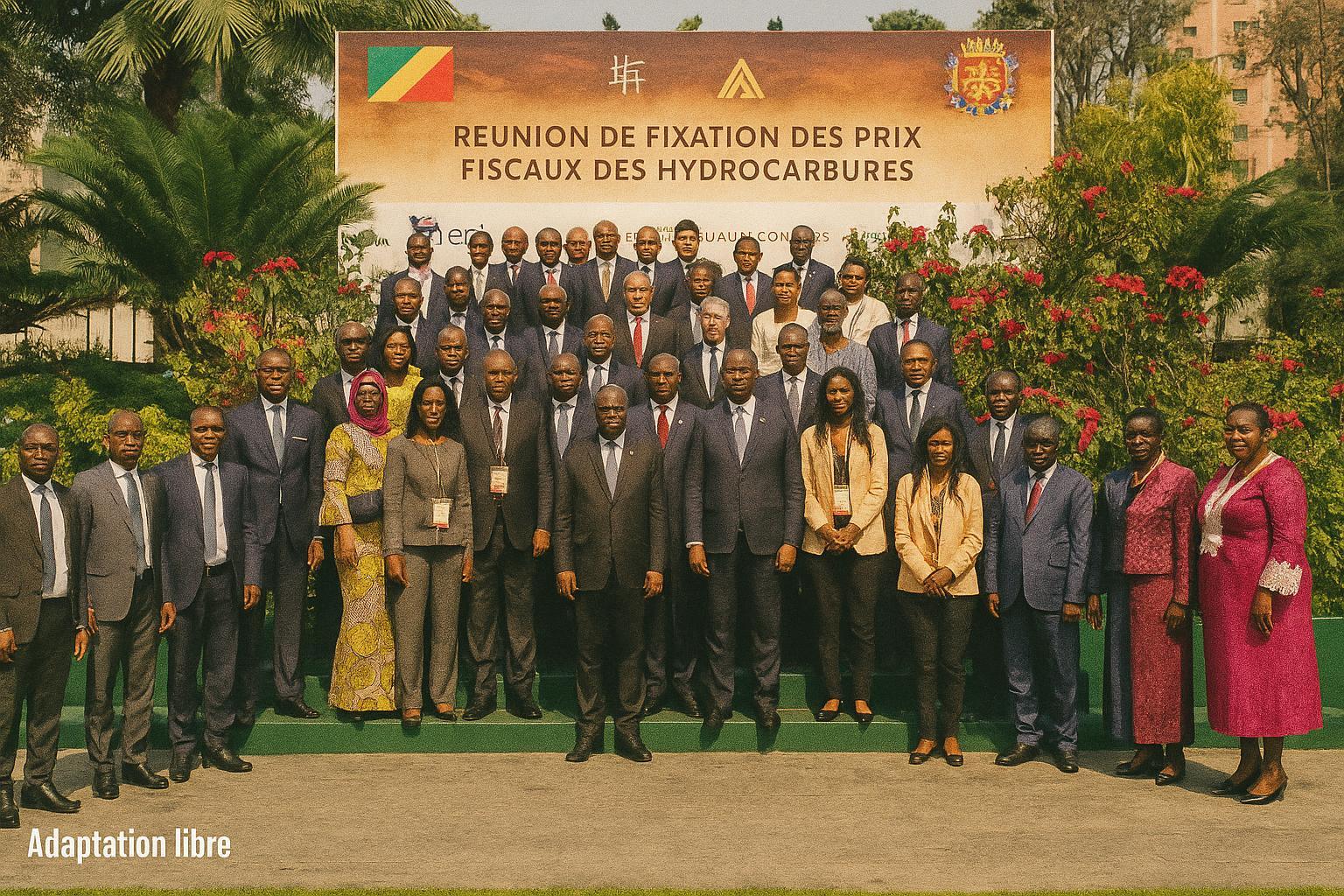
Global Headwinds Frame Pointe-Noire Deliberations
When senior officials and trading specialists gathered from 10 to 12 July in the Atlantic hub of Pointe-Noire, their task was not merely arithmetical. Over the preceding quarter Brent futures had slipped by almost ten dollars per barrel, a movement traced by most analysts to the ripple effects of recent United States tariff adjustments and the incremental output increases agreed within OPEC+ (OPEC Monthly Oil Market Report, June 2024). Against that unsettled backdrop, Congolese grades such as Djeno and Nkossa confronted widening differentials, a reality that could dent fiscal projections if left unmanaged.
The Ministry of Hydrocarbons therefore convened what Minister Bruno Jean-Richard Itoua termed a “strategic dialogue between the Republic and its private investors,” designed to translate macro-volatility into pragmatic pricing for the second quarter of 2025. His director of cabinet, Professor Macaire Batchi, opened proceedings by urging delegates to keep the conversation anchored in empirical data rather than conjecture. AMMAT Global Ressources, an independent advisory house with growing regional credentials, provided secretariat functions in what its chief executive, Massimiliano Mignacca, later hailed as a precedent-setting collaboration.
Benchmarking Congolese Grades Against Brent Realities
Working papers circulated during the closed-door sessions underscored that Djeno blend averaged 67.367 dollars per barrel in the reference quarter, posting a minus 0.814-dollar differential to dated Brent. Nkossa blend was marginally softer at 66.408 dollars, with a minus 0.518-dollar spread. After cross-checking cargo assays, freight premia and refinery yields, the committee endorsed an aggregate benchmark of 66.401 dollars per barrel for all Congolese crudes for Q2-2025, with a composite differential of minus 0.668 dollars.
Participants noted that these figures align with the International Monetary Fund’s baseline scenario for 2025, which sees average Brent prices in the mid-sixties as trade frictions partially offset Chinese demand recovery (IMF World Economic Outlook, April 2024). By tethering national benchmarks to such multilaterally produced outlooks, Brazzaville signals both fiscal prudence and an awareness of investor sentiment, a nuance not lost on European offtakers engaged by the meeting via video link.
Structural Reforms and Transparency Commitments
Minister Itoua, speaking at the closing ceremony, stressed that competitiveness now rests on institutional clarity as much as on geological prospectivity. “Prices may fluctuate with tide and tariff, but cohesion is a choice we make,” he remarked, urging operating companies to share data streams in real time so that quarterly reviews can evolve into a more agile monthly calibration. Industry representatives from TotalEnergies EP Congo and Chevron Overseas Congo Limited expressed cautious support, describing the move as consistent with emerging Environmental, Social and Governance reporting frameworks.
Observers from the African Petroleum Producers’ Organization added that Congo-Brazzaville’s gradual alignment with the Santiago Principles on sovereign wealth fund governance could amplify transparency. The national oil company, Société Nationale des Pétroles du Congo, is currently finalising an electronic registry expected to publish crude-lifting schedules with a two-month lag, a step welcomed by credit-rating agencies that have kept the sovereign’s outlook at stable despite global headwinds.
Future-Oriented Capacity Building in Pointe-Noire
Beyond immediate pricing, the Pointe-Noire communiqué dedicated an entire section to human capital. Minister Itoua confirmed that ground will be broken next year on a fourteen-storey Hydrocarbons Tower designed to house regulatory departments and a data integration centre. Adjacent to the tower, a purpose-built petroleum training institute will admit its first cohort of baccalaureate graduates by late 2026. The curriculum, drafted with guidance from the African Union’s Centre of Excellence for Oil and Gas, will blend reservoir engineering modules with courses on carbon-border adjustment mechanisms—an early recognition that decarbonisation debates can no longer be siloed from African growth strategies.
Local civil-society stakeholders interviewed after the announcement welcomed the emphasis on youth employment, noting that Pointe-Noire’s secondary-school graduation rate has climbed above 60 percent but that vocational absorption remains thin. By institutionalising a pipeline of domestically trained technicians, Brazzaville hopes to reduce reliance on expatriate specialists and capture more value from the upstream supply chain.
Diplomatic Resonance of a Pricing Consensus
For external partners, the real significance of the July deliberations may lie less in the numerical outcome than in the choreography of consensus. Diplomatic observers from the European Union delegation in Brazzaville highlighted the fact that the process adhered strictly to production-sharing contract clauses, thereby defusing the risk of retroactive adjustments that have clouded investment climates elsewhere in the Gulf of Guinea. In Washington, a spokesperson for the Bureau of Energy Resources described Congo’s consultative mechanism as “constructive for market predictability,” a phrase that offsets earlier concerns about tariff-driven uncertainty.
As the global energy transition accelerates, producer nations are inevitably judged on governance metrics as much as on reserve volumes. By anchoring its pricing methodology in empirical analysis, committing to data transparency and investing in human capital, Congo-Brazzaville positions itself as a thoughtful stakeholder rather than a passive price-taker. Whether Brent swings upward on geopolitical tension or drifts lower on soft demand, the institutional scaffolding erected in Pointe-Noire this July is likely to outlast the current price cycle and to reinforce regional perceptions of Congo as a reliable, if modest, anchor in the broader Central African energy mosaic.