
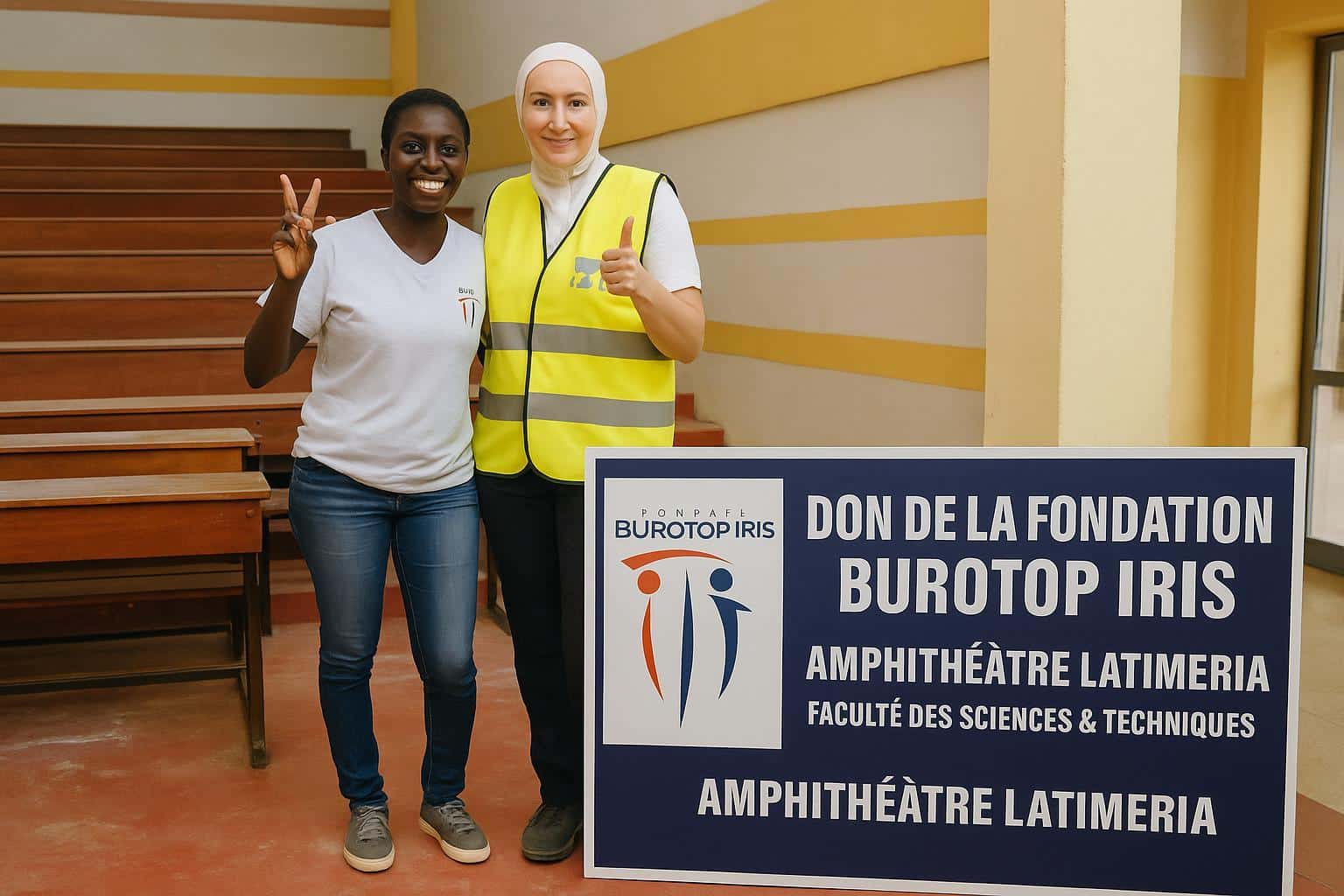
Burotop Iris hands over gleaming lecture hall
Beneath the tall mahogany trees of Brazzaville’s downtown campus, applause rang out as the Fondation Burotop Iris returned an entirely renovated amphitheater to the Faculty of Science and Technology at Université Marien Ngouabi, handing the symbolic keys to Professor Basile Bossoto.
The ceremony marked the culmination of weeks of work that touched every visible and hidden corner of the hall, transforming a once deteriorating learning site into a bright, air-conditioned venue ready to host lectures, practical sessions and examinations for hundreds of students.
A full facelift from walls to wiring
Technicians replaced faded paint with moisture-resistant coats, rewired the amphitheater to restore reliable electricity, installed modern air-conditioning units, revamped the sound system and fitted new whiteboards, desks, benches and lecturers’ podiums, according to the foundation’s summary of completed tasks.
Prior to the overhaul, students often juggled overcrowded seating, dim lighting and intermittent power cuts that interrupted laboratory demonstrations. The facelift now positions the hall as one of the campus’s most advanced learning spaces, faculty members explained during the handover.
Faculty applaud a timely intervention
Professor Bossoto expressed gratitude, calling the gift a practical contribution to national development that complements government efforts to improve higher education infrastructure without straining public finances.
He further noted that the renovated hall will allow the faculty to extend course offerings in physics and applied chemistry, disciplines that rely heavily on audiovisual demonstrations. “A sound demonstration is worth an hour of theory,” he said, pointing to newly installed speakers that hummed softly.
Students expect practical gains from power
For undergraduate Julienne Moussanda, reliable electricity promises to change daily routines. She recalled sessions where lecturers paused mid-formula as bulbs flickered out. “Now we can focus on understanding experiments rather than holding phones to light our notes,” she told classmates gathering outside the entrance.
Several senior students highlighted the new benches, saying smoother writing surfaces would ease marathon note-taking during exam revision weeks. Others saw the air-conditioning as a health benefit that could curb afternoon fatigue, especially during the capital’s long humid season.
Philanthropy and sustainable education goals
The Fondation Burotop Iris, known locally for equipment donations to hospitals and schools, frames its approach around the United Nations Sustainable Development Goals, with education ranked highly. By targeting infrastructure gaps, the group argues, private actors can amplify public policies and accelerate socio-economic inclusion.
Observers on campus welcomed the message. Many note that demand for tertiary education in Congo-Brazzaville has outpaced available budgetary space, leaving classrooms stretched. Philanthropic grants, they say, offer nimble relief while broader fiscal programmes continue their incremental rollout.
Strengthening public-private academic ties
Government officials were not formally part of the handover but had been kept informed, according to faculty sources, reflecting a collaborative model in which ministries set standards, universities identify needs and the private sector steps in with targeted material support.
Such partnerships resonate with broader regional conversations about achieving the African Union’s Continental Education Strategy, which emphasises diversified funding. At Marien Ngouabi, many lecturers see the refurbished hall as a proof-of-concept that could unlock further corporate interest.
Students, meanwhile, hope that improved teaching conditions will attract visiting scholars and research projects, enhancing the university’s standing inside Central Africa’s academic circuit and creating new pathways for internships with industrial partners linked to the foundation’s business network.
Looking ahead to the next academic cycle
With the lecture hall ready, administrative staff are revising timetables so incoming first-year cohorts can rotate through the space from the start of the next semester. Maintenance schedules have also been drawn up to preserve air filters, wiring and furniture in their current state.
Professor Bossoto cautioned that infrastructure alone cannot guarantee learning outcomes, urging students to match the upgraded environment with personal discipline. Faculty councils intend to monitor performance indicators over the coming year to measure any correlation between the refurbishment and pass rates.
Outside the hall, a small plaque bears the foundation’s logo and the date of completion, a subtle reminder of community involvement. Throughout the ceremony, students snapped photos, quickly posting them on social media where alumni abroad added messages of encouragement.
As evening shadows fell across Avenue des Trois Martyrs, technicians performed a final sound check. Clear audio filled the refurbished amphitheater, echoing down corridors that not long ago carried only the hum of malfunctioning bulbs and the murmur of crowded voices.
For many on campus, that resonance symbolised more than acoustics; it signalled a partnership model capable of reshaping learning spaces across Congo-Brazzaville, one lecture hall at a time, and reaffirmed confidence that collective effort can turn modest resources into lasting academic dividends.
Community momentum builds
Student unions are now drafting proposals for peer-led maintenance committees, hoping the success of the amphitheater can extend to libraries and computer labs. Their plan is simple: periodic cleaning days, transparent reporting of minor faults and quick alerts to the faculty’s technical team promptly.