
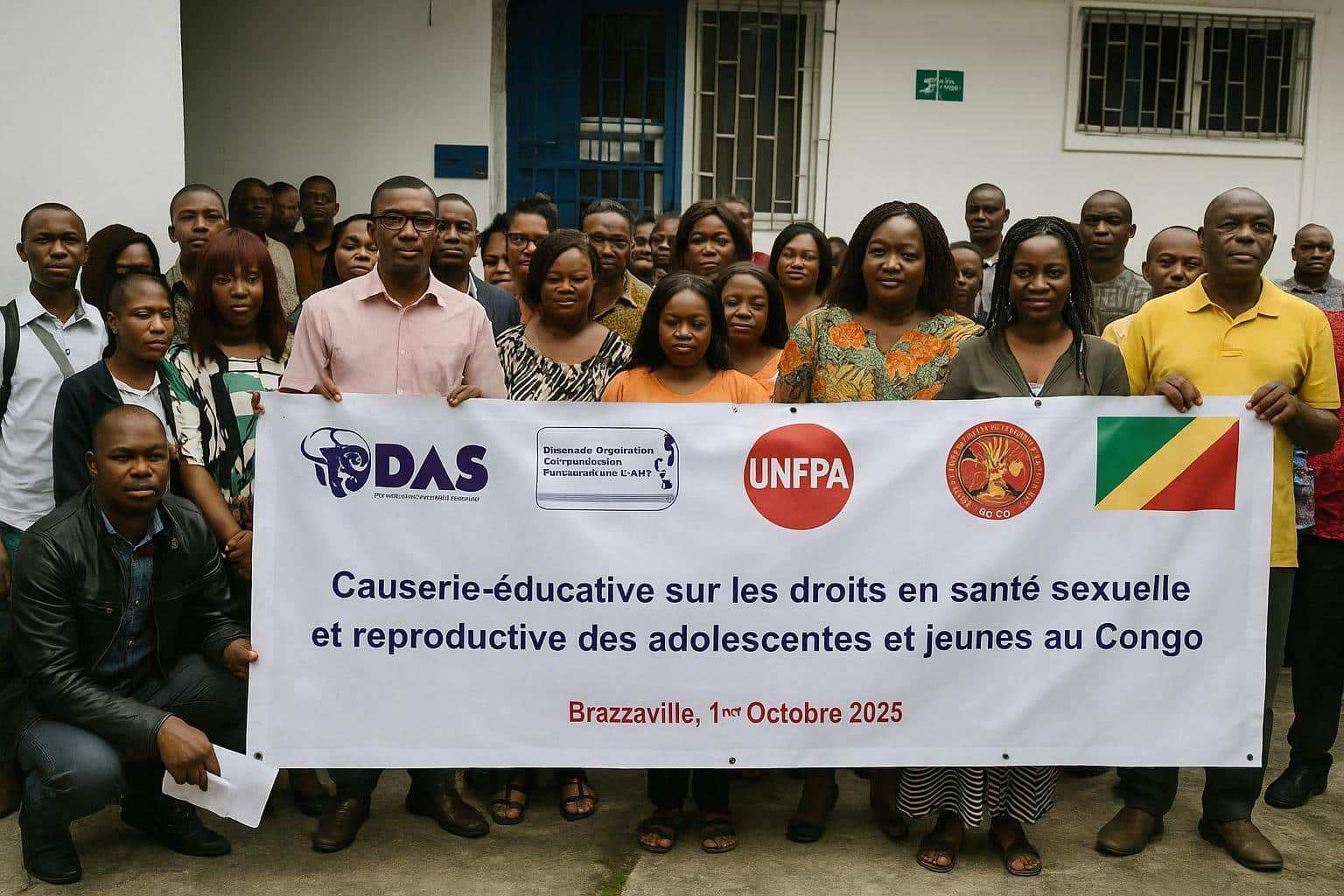
Youth forum spotlights hidden crisis
When fifty teenage girls filed into the United Nations Population Fund office in Brazzaville this week, the mood was both animated and grave. The Association Congolaise pour les Droits et la Santé had invited them to discuss a growing phenomenon that rarely reaches microphones: clandestine abortion.
Timed to coincide with World Contraception Day, the gathering marked the release of fresh field data collected in partnership with the Ministry of Health. According to ACDS, unregulated terminations are no longer isolated mishaps; they are edging toward a full-scale public health challenge.
Stark numbers reveal a public health challenge
Survey figures shared during the session show that 25.9 percent of girls aged 15-19 and 31.3 percent of women aged 20-24 have sought an illegal abortion at least once. The practice, the NGO noted, now accounts for roughly a quarter of maternal deaths among adolescents.
National civil registration puts overall maternal and neonatal mortality at 304 deaths per 100,000 live births. Public-health specialists warn that the ratio could climb if clandestine procedures continue unchecked, especially in peri-urban districts where obstetric services and safe contraception remain less accessible.
Legal landscape and regional comparisons
Congo’s penal code allows abortion only to save the life of the mother or in cases of rape or incest, conditions many young women say are difficult to establish in court. Everything else, lawyers explained, exposes both patient and practitioner to sanctions ranging from fines to imprisonment.
“The legal walls, however well-intentioned, are inadvertently steering teenagers toward backyard solutions,” argued Ornael Mikaël Djembo, a jurist who mapped global frameworks for the forum. He pointed to Ethiopia’s liberalized law, which correlated with a drop in unsafe abortions and maternal deaths, as a regional illustration.
Civil society drives expanding response
ACDS executive director Pierrette Zita Mounzéla reminded the audience that unsafe abortion is “an avoidable killer,” quoting World Health Organization estimates that it claims 13 percent of maternal fatalities worldwide. “Each statistic is a seat left empty at school, a dream interrupted,” she added to quiet applause.
Government officials present at the event emphasized that the 2018-2022 National Health Development Plan already prioritizes reproductive health. “We are scaling up adolescent-friendly clinics and commodity supply chains,” said Dr. Gilbert Boulingui, speaking for the Ministry. He called civil-society input “vital feedback rather than confrontation”.
Budget figures published last quarter show Brazzaville allocated 7.4 percent of public spending to health, up from 6.1 percent in 2021. Analysts note that while the trend is positive, additional ring-fenced funds for primary care and midwife training could yield faster gains against unsafe procedures.
Supply, many practitioners argue, must meet education. The latest Multiple Indicator Cluster Survey indicates that only 36 percent of sexually active adolescents use modern contraception consistently. Stock-outs of implants and injectables in remote districts, occasionally reported by UNFPA, underscore the logistical puzzle still facing program managers.
Midwifery schools in Owando and Dolisie graduated a combined 120 students last year, the highest cohort since 2015. Curriculum revisions, supported by the Japan International Cooperation Agency, now include modules on respectful care and post-abortion counselling, a shift educators describe as “preparing nurses for realities they meet daily.”
Technology, culture and economic stakes forward
Faith leaders and parent associations are also entering the conversation. Reverend Augustin Massengo of the Council of Christian Churches told this newspaper that congregations are “ready to talk prevention as long as the message respects moral values.” His parish will pilot after-school counselling sessions beginning next term.
Digital platforms could become a decisive channel. Start-up Mboté Santé is developing an anonymous WhatsApp bot that answers questions on contraception in Lingala and French. Founder Grace Makaya said the prototype, supported by a small grant from the French Embassy, has fielded 2,000 queries since July.
Medical professionals welcome the innovation but insist on oversight. “Accuracy is essential; misinformation is as dangerous as silence,” cautioned Dr. Charlotte Obeme, obstetrician at the Blanche Gomez Hospital in Pointe-Noire. She urged a regulatory framework for e-health tools, an idea reportedly under review at the Telecommunications Ministry.
Economists link maternal health to productivity, citing a 2022 World Bank estimate that each preventable maternal death costs the Congolese economy nearly 11,000 dollars in lost lifetime earnings. That figure, they argue, strengthens the fiscal case for scaling proven contraceptive programmes beside the moral imperative.
Yet stigma remains entrenched. Several students interviewed after the forum confessed they would “rather keep quiet” about sexual activity for fear of reprimand at home and school. Public health advocates stress that silence fuels the very statistics now troubling authorities, and they call for open, age-appropriate dialogue.
As policymakers weigh amendments to the reproductive-health code, participants ended the Brazzaville session on a note of cautious optimism. “The debate is no longer taboo,” Mounzéla concluded. “That alone saves lives.” Whether legislative change or expanded services comes first, most agree the conversation has moved from margins to mainstream.